


Pests threaten soybean harvest in Subarnachar

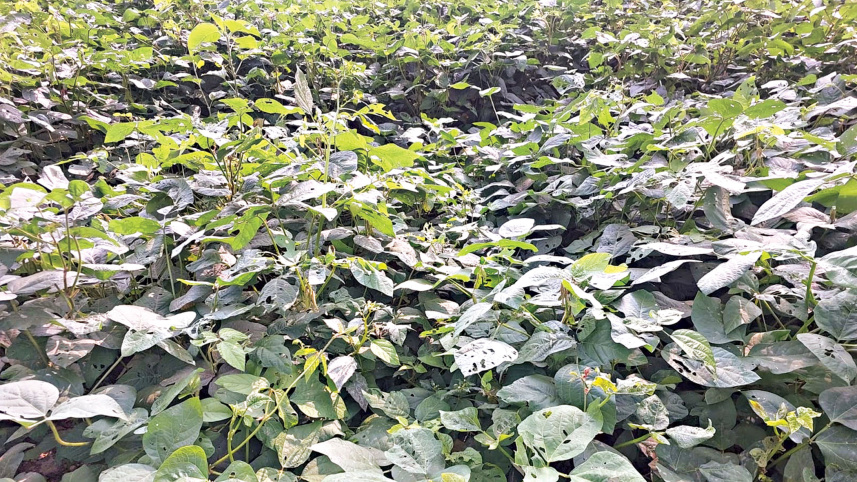
Siraj Mia, 70, a farmer from Katabunia village in Char Amanullah Union of Subarnachar upazila, Noakhali, had spent Tk 10,000 this year cultivating soybeans on 40 decimals of land. He had hoped to harvest 12 to 15 maunds (1 maund = 40 kg) and, with prices ranging from Tk 1,500 to Tk 1,600 per maund, expected a profit of Tk 10,000 to Tk 14,000.
However, pests have attacked his entire field, putting his expected yield at risk.

Like Siraj Mia, most farmers in Subarnachar -- known as the granary of Greater Noakhali, which includes Noakhali, Lakshmipur, and Feni -- are reporting widespread pest infestations.
This season, Subarnachar’s soybean fields cover 10,120 hectares, while the total area planted in Noakhali district is 17,059 hectares. The district’s production target is 31,559 tonnes, with an expected average yield of 1.85 tonnes per hectare, Ashish Kumar Kar, deputy director of the Department of Agricultural Extension (DAE) in Noakhali, told The Daily Star.
Farmers say pesticides are having no effect
According to the US Department of Agriculture (USDA) Foreign Agricultural Service, Bangladesh is expected to plant soybeans on 105,000 hectares in the marketing year (MY) 2026-27, producing 180,000 tonnes -- a 5 percent increase in area and a 2.8 percent increase in production compared with MY 2025-26.
Yet the country produces only about seven percent of its annual soybean requirement. Soybeans are mainly grown in the southern belt, including Noakhali and Lakshmipur in Chattogram division, and Pirojpur, Patuakhali, Borguna, and Bhola in Barishal division.
Soybeans are increasingly popular due to lower production costs and minimal irrigation needs. Farmers plant them after harvesting Aman rice, relying on residual soil moisture, and harvest in 100-110 days.
Usually, farming starts between mid-December and January, but last year’s heavy rains and prolonged waterlogging delayed planting. Harvest is now expected in late April or early May.
CROP DAMAGE VISIBLE IN FIELDS
A visit to several fields in eight unions of Subarnachar on Monday afternoon revealed serious crop damage.
Although the fields appear green from a distance, closer inspection showed hairy caterpillar infestations on the leaves and shoots.
Over the past two weeks, pests have fed on the undersides of leaves, causing holes, browning, and leaf death. In some areas, black spots have appeared on leaves, and plants are failing to flower.
Farmers now fear they will be unable to meet production targets. Many worry about financial losses, as some have leased land, taken high-interest loans from moneylenders or non-governmental organisations, and even sold livestock such as cows and goats, in the hope of a profitable harvest.
Subarnachar Upazila Agriculture Officer Md Harunur Rashid acknowledged the pest attack but claimed that the situation is under control.
“We are advising farmers to use pesticides. The infestation is being managed and will gradually be eliminated,” he said.
However, farmers say they see no results despite applying pesticides.
“Officials from the DAE sometimes drive past the fields and leave. They don’t offer any advice or support, and don’t even tell us which pesticides to use to save our crops,” Siraj Mia alleged.
Other farmers in the Char Amanullah union shared similar complaints.
In response, Harunur Rashid cited a severe manpower shortage. Each of the 24 agricultural blocks in the eight unions should have one sub-assistant agriculture officer, but only 10 officers are currently working.
 For all latest news, follow The Daily Star's Google News channel.
 Ashish Kumar Kar of DAE added that soil salinity and a lack of rain also worsened the pest attack.
“The pest attack should ease after the recent rainfall,” he stated.
He confirmed the manpower shortage and said a recruitment process is underway to address it.
Comments