


Bangladesh’s apparel success has a ceiling

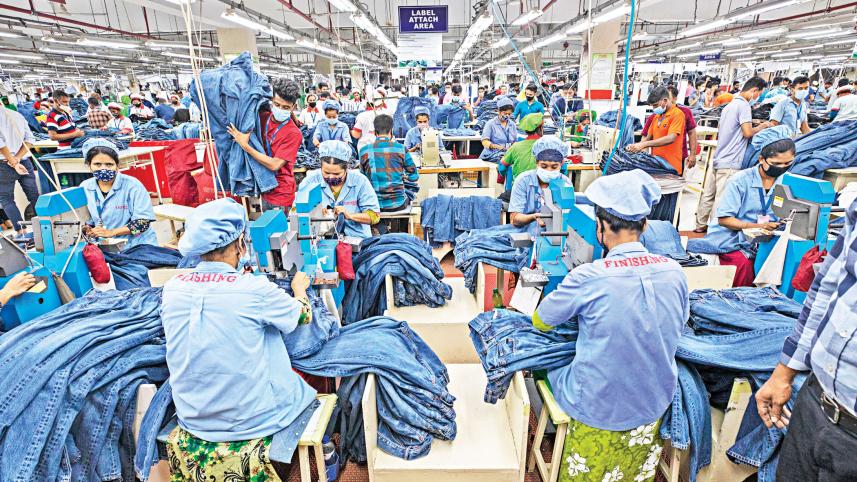
Bangladesh’s apparel exporters shipped $38.825 billion worth of garments in calendar year 2025, worth celebrating on its own terms. Set against the world’s $426 billion, Bangladesh’s position in global apparel trade comes into sharper relief. Grouped by product complexity, basic, semi-basic/core and advanced/value-added, the baskets are shaped differently, with consequences for how much growth remains along Bangladesh’s three-decade path.
Basics, bottom wear, t-shirts and vests, sweaters & cardigans, inner wear, babies’ garments and small accessories, total $29.873 billion, 76.94 percent of exports, against 61.58 percent of world trade. Bottom wear alone is $13.076 billion, 33.68 percent versus 21.68 percent world share; T-shirts and vests are $7.238 billion, 18.64 percent, nearly double the world’s 10.09 percent. Sweaters and cardigans and inner wear track close to world shares. Small accessories is the outlier, at 0.35 percent of exports against 7.52 percent world share.

Shirts and blouses, the semi-basic tier, is $4 billion, 10.33 percent of exports, above the world’s 7.38 percent. The mix is lopsided: $3.092 billion is men’s shirts, just $0.917 billion women’s blouses, a 77-23 split versus 55-45 worldwide. Bangladesh has maxed out this category almost entirely on men’s shirts.
Advanced categories, outerwear, dresses, technical wear, sportswear, suits and ensembles, total $3.629 billion, 9.35 percent of exports, against 30.46 percent of world trade. Outerwear is starkest: 3.83 percent of exports versus 13.45 percent world share, the largest category in world trade but one of the smallest in Bangladesh’s. Dresses, technical wear, sportswear and suits repeat the pattern, each well below its world weight: 2.10 percent, 1.92 percent, 1.17 percent and 0.33 percent of Bangladesh’s exports, against 6.03 percent, 4.15 percent, 3.93 percent and 2.90 percent world share. The remaining 3.38 percent sits in an unclassified EPB reporting gap.
The same story shows up in fibre composition. World apparel trade is now majority non-cotton, 58.4 percent to 41.6 percent cotton, driven largely by synthetic and blended fabrics used in outerwear, technical wear and sportswear. Bangladesh runs almost the inverse: 72.7 percent cotton, 27.3 percent non-cotton. A supply chain built overwhelmingly around cotton cannot build outerwear capability without first developing synthetic and technical fibre expertise.
What does this mean for decision-makers? Together, these are one signal: Bangladesh has largely exhausted the easy growth inside its current mix. Advanced categories carry higher prices, thicker margins and more insulation from wage competition, exactly what basics lack and what a post-LDC Bangladesh, facing eroding duty preferences and tariff exposure, will need. Cheap labour’s savings were never free: they came at the cost of the machinery, quality systems and skilled labour needed to compete in outerwear, deferred for three decades while Bangladesh kept undercutting on price in bottom wear.
Three directions follow. First, push hardest into advanced categories, with outerwear the priority test case. It is the world’s largest category and Bangladesh’s most underweight, so closing even a third of that gap adds more value than any further gain in bottom wear or T-shirts. Second, stop looking for growth inside basics. At 76.94 percent versus 61.58 percent world share, further gains mean displacing other producers on price, a thinning-margin race, not new demand. Third, treat small accessories and fibre-mix gaps together as diagnostic: both point to missing capabilities in hardware, trims, small-batch production, synthetic and technical fibre sourcing.
None of this means abandoning basics, which will remain the industry’s backbone. It means treating the current mix as a ceiling to grow past, not a base to defend.
The writer is the founder & CEO of Bangladesh Apparel Voice. He can be reached at mohiuddinrubel@gmail.com
 For all latest news, follow The Daily Star's Google News channel.
Comments