


A graphic rebellion against patriarchy
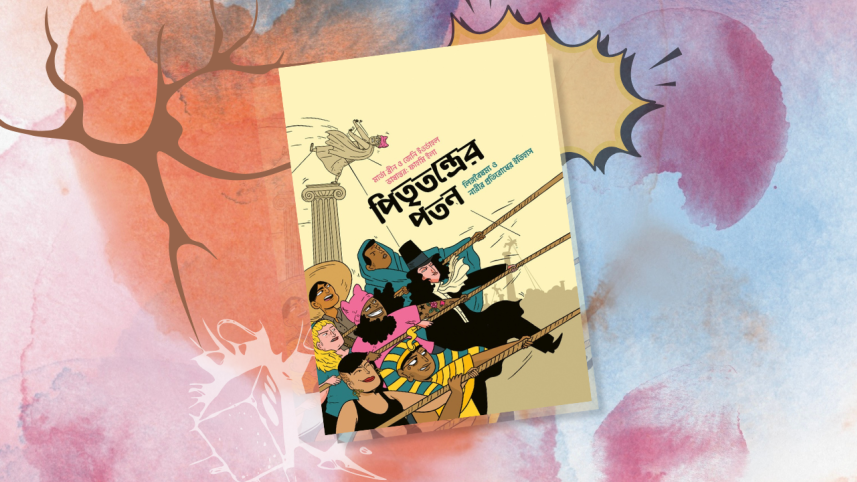
We are living in the advancing era, mended meticulously with dreams and expectations. It is the era of new norms. And yet, a woman asking for the basic human rights will be scrutinised for standing up for herself. They are caught up in a never-ending cycle that extends borders. It is the reality, and there are expectations that these conditions will improve over time. Unfortunately, though, the dreams are just that—dreams. Pitritontrer Poton (originally Smash the Patriarchy) captures the similar prevalence of patriarchy throughout the generations and its impact on all genders, including men themselves.
The graphic nonfiction is an excellent display of historical examples of women who have opposed patriarchy—the brave and the unfortunate who were exemplary for fighting against inequality, injustice, and instability. This includes major figures such as the French revolutionary Charlotte Corday, and Alexandra Mikhailovna Kollontai who was a Russian revolutionary, politician, diplomat, and Marxist theoretician. The book explores the power dynamics that have been consistent throughout history. Despite these constraints, many revolutionary women have spoken out about the challenges they and other contemporary women face. Consequently, the author does an amazing job by mentioning these brilliant voices advocating for equality and equity.

The book opens with portraying a humorous discussion between illustrated versions of Marta Breen and Jenny Jordahl's characters, which immediately sets an exciting and engaging tone. Although the mood is meant to be humorous, the messages that come along with it are powerful and serious. Jordahl's humorous illustrations add another layer of appeal. These are essentially drawn in a comic style to make the book more intriguing and fun to read. However, it does not minimise women's growing awareness of resistance to injustice; rather, it incorporates their attempts to raise awareness relentlessly in a unique way.
Wherever history takes us, whether we are navigating through textbooks or pictures, every medium is filled with depictions of glorious empires like that of the Greco-Roman civilisations. There are acknowledgments of exceptional contributions, mostly by male figures from numerous fields; areas they have improved with their knowledge and exceptional calibre—figures who have been celebrated throughout history, glorified, and even overglorified for their work, but who, at the same time, harbour some questionable perceptions women. The author mentions several of these prominent male figures, ranging from philosophers to playwrights. For example, the renowned German philosopher Immanuel Kant and his oft-cited opinion: "A woman who becomes learned loses her charm", as well as Genevan philosopher Jean-Jacques Rousseau's, who said, "If woman is made to please and to be subjugated to man, she ought to make herself pleasing to him rather than to provoke him."
It is relatively easier to break, stretch, and forge a woman in accordance with the convenience of society rather than changing the flawed system. The outright declaration of internalised misogyny these men harbour are often overshadowed owing to their "genius" but in the same exact field, female intellectuals need to overcome barriers that they solely face as women and often "prove themselves" in order to become established. The book talks about women using pseudonyms and cross-dressing to portray themselves as men and prove their competence—all because women are often presented as a secondary race who carry no agency of their own.
Fahmi Ela's translation captures the energy of Breen's words. The feminist message remains just as sharp and impactful in Bangla with Ela's potent use of Bangla phrases and expressions. In the same vein, Jordahl's vibrant use of colour makes the illustration both visually striking but aesthetically pleasing at the same time. Like Breen has her way of using the harsh, uncomfortable language that society has frequently used against women, Jordahl's illustrations too highlight oppression, brutality, and the bareness that portray scenes of violence, showing how women's bodies, along with their voices, have been subjugated.
There are some parts where the names or the years of historical figures might seem information heavy, however, the author here has divulged in-depth and provided detailed insights into the lives of these figures. It maps out the patriarchal structures, offering new perspectives for those who are skeptical about feminist notions.
Pitritontrer Poton narrows down to one aim: dismantling patriarchy; this concept is well integrated into the information provided in this book, a phenomenon that has been overlooked for many years and has been normalised. Consequently, as a people, we have unintentionally become accustomed to and accept misogyny even in the most intellectual spheres of society.
Juhi Rubaba Jurana Jahan is a creative enthusiast and someone who lives through art. Feel free to reach out at rubaba.juranas@gmail.com.
 For all latest news, follow The Daily Star's Google News channel.
Comments