


The devil wears Maria B
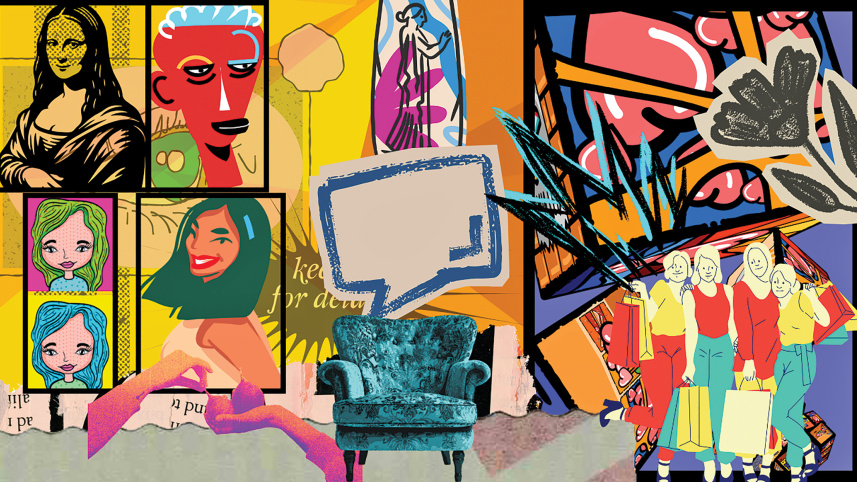
I sit on a chair. Sometimes I wish I were sitting on my old chair of humble plastic, but right now my chair is a plush armchair, with armrests no less, swaying and swooning on its cabriole legs of sturdy s-curve perfection. Its upholstery is luscious mauve velveteen and rapturous foliage embossing embraces its expanse. But my chair is mass produced. It has room for only one. Just me. And even I barely fit on it at times. That does not make it any less expensive.
And though its upkeep keeps my bank balance on its toes till the end of the month, I cannot imagine trading it in for anything less—owing to the vantage point it gives me to watch over all things just as beautiful, to claim them for myself; to look up and find that its height is just right for my hands to reach for more, and know that this chair has the ability to take on more intricate chippendale and thusly raise me to higher heights of bigger, more beautiful hoards of claims.

But when you have grown up sitting on sticky plastic, sooner or later, the pins securing the upholstery start to unhook and sting.
I felt my first sting when I was told my bill at a Pakistani multi-brand retailer’s counter had amounted to nearly 50K. Suddenly, the velveteen of my chair started stinking of mildew and its wooden skeleton rattled like termite fodder.
50K can comfortably sustain a month of livelihood in a low-income nuclear family.
50K can lavishly dine 50 people for a whole day …right?
Sitting on my pretty chair of Pinterest-core magnificence, I felt out of touch with reality: with the cost and value of money. Thereby, all the posts I shared on my Facebook timeline and all my Instagram reel reposts, all of them about the inbred disease of capitalism and neocolonialism perpetuating patriarchal control and survivalist competition, all rendered meaningless in that one instant of pure, absurd vanity. All in the name of the biannual pandemic of Eid shopping.
I realised that my chair wasn’t just fancy, it was also positioned on a pedestal of my own worship, contradicting the virtues that the religious teachings of Ramadan promotes. It’s an ironic realisation-slash-observation that bumps and skitters around on Facebook statuses every Ramadan, often accompanied by a hastily snapped picture of overpriced boutique designs and/or the swarming hordeing of consumers at Aarong or the tristate mela displays.
The stuffing of frills and bows battening my seat are starting to feel like they’re morphing into something alive and biting. I fidget my fingers on a lipstick-cage-bag-charm I had bought from a small-business Facebook page selling “aesthetic” products (which they probably sourced from Shein). The cap of the lipgloss I’ve placed in the “cage” and the other bag-charm I’ve hung my employee ID card from are both matching shades of lime green. My Instagram Explore page tells me how to add whimsy to my life in 2026 and shows me aesthetics of the “divine feminine” through imagery of pastels and nature and ethereal, gossamer-like fabrics. I consume it all–with my eyes, with my salary.
My salary. To quote Anthony Bridgerton, “the bane of my existence and the object of all my desires.” (At this point, I am reminded of and starting to feel an urge to order online the Bridgerton collection stationery I’d seen at an Aloki event this Ramadan, but I digress.) The point is: my salary (with the rest of my side-hustlely incomes) puts me in a comfortable income-bracket, positioning me as a privileged woman in Dhaka’s urbanscape, but this privilege does not come without the caveats of being employed, and thus, being working-class nevertheless. And this exactly is why the comfortable armchair of my employed self is, at its joints, creaking.
It’s the fact that I will receive a Whatsapp text in my team’s group chat from our supervisor of the dresscode on Sunday being any shade of purple or pink, and all of us employees will wear our curated outfits while our students recite poems talking about “oh women so divine, so beautiful, such flowers” at the special morning assembly, and we will take group pictures in our ombre of purples and pinks, and share them on the Whatsapp group and our personal Facebook profiles. It’s the fact that I’m all set for this International Women’s Day with my solid lilac Dubai georgette coords and matching studs, just like I am every year with a new carefully curated purple or pink outfit. It’s the fact that some brand will once again unleash another gallivanting marketing campaign regurgitating the same old message of “je raadhe, shey chul o baadhe” or “ghor and office duto tei expert” while other brands advertise Women’s Day Sales to make the women in your lives feel special.
It’s the very irony of the fact that the economic system that builds us our chairs of comfort and discomfort—of the ruling thrones on stage and the bendy chairs in the “peasant-ly” audience—is strategically consuming meanings and synthetically throwing up new definitions. Whether it is the true meaning of Ramadan being the practice of restraint and exercises of spiritual growth, traded in for the market engineered meaning of Eid-shopping, iftar platters and suhoor nights, or the origin of the International Women’s Day being the fruit of the literal labours of working women, working-class women, and socialist women’s unions, being traded in for the pinkwashing of women’s experiences, repackaged as products for the same women’s consumption. All the while, we let it keep us separated on our own little chairs of curated experiences, based on what our circumstances lets us afford. All the while, the women who laboured over the creation of such pretty things can merely afford survival, much less the product themselves.
Now, as the s-curve of my chair’s legs are curling in on themselves, when I look down at all my girly knick-knacks in their mountain-range piles precariously balanced on my lap, I hear ghostly voices from my phone-screen echoing in my ears, in coiffed, medicated drawls—“These are your symbols of self-love!” I look at my reflection in my vanity mirror (such a fitting name!) and my reflection wants to take the shape of the devil that Ramadan promises to have chained.
I behold my ghastly apparition and pray at its deathly stare that one day we will throw away all our matrixes of cluttered isolation and rebuild our own humble chairs, loveseats really, where we house not our tinkering commodities but our friends and lovers of sharing communities.
Tashfia Ahmed is a writer and an educator at Scholastica. She requests readers to send her, on her Instagram @tashfiarchy, recommendations of any essays, articles, books and visual content that can actively support her strife in becoming a better feminist.
 For all latest news, follow The Daily Star's Google News channel.
Comments