


Contested words, painful genealogies
Buried beneath masses of mangled bodies of countless innocents slowly pulled from the shrapnel and debris, their remaining flesh torn in the extraction, lies a reflection of the world's inhumanity. The recent devastation in Gaza—what many observers have termed a genocide—has buried everything we thought integral to our conceptualisation of modernity: international law and human rights. While the Palestinian struggle continues amid unprecedented international outrage, particularly in the Global North, accusations of antisemitism have been increasingly weaponised to shut down criticism of Israel and champion the rights of one group over another. Has antisemitism always had one meaning? Like ideas and theories, meanings shift depending on their context.
A historian's job is seldom easy, and dissecting the past and present poses challenges of deep introspection and reflection. Mark Mazower, an acclaimed historian at Columbia University known for his distinguished books on the Balkans, delves into uncharted territory, attempting to understand a word—"antisemitism"—that is largely a product of the western modernity and a stain on Europe's bleak record of historical tolerance toward the Jewish people—which has added numerous words to our everyday vocabulary: pogroms, Holocaust, and ghetto.

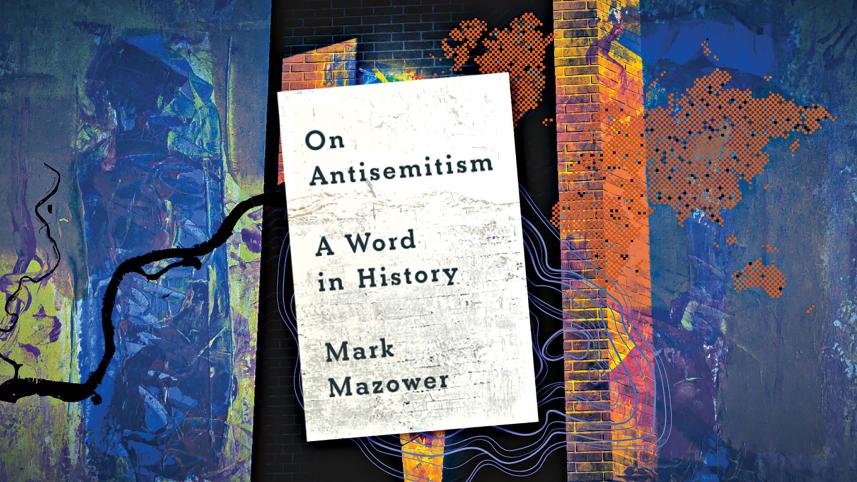
On Antisemitism: A Word in History sifts through the troubled legacy of a word that was once used to hunt down Jews who spoke about equality and today is routinely used to silence critics of Israel, including Jewish critics themselves. Languages are often turned into instruments of power, and antisemitism—a term famously popularised in 1879 by a German politician, Wilhelm Marr, to oppose legal equality of Jews—has been transformed into an abstract noun with far-reaching consequences in world politics. The meaning of antisemitism has shifted since World War II, first being associated with the genocide of Jews at the heart of Europe, to now being inextricably linked with Israel's image in the world. Mazower argues that "no form of racial or religious prejudice enjoys such international attention," with countless countries and organisations pledging against it. Antisemitism, in of itself, "has become a world power."

While antisemitism exists in many parts of the world—including regions without Jewish populations, where it manifests through blanket demonisation of Jews simply for existing as a people (a phenomenon known as "antisemitism without Jews")—the ideological conflation of Israel with the Holocaust is a relatively recent development. In the early 20th century, the Jewish experience in Europe oscillated between the remarkable successes of electoral democracy and the rise of communism and fascism, the latter becoming the death knell for a people and their storied civilisation. Mazower's great strength as a historian, particularly as a Jewish historian rooted in the Anglosphere, is his ability to create a narrative history of a world that evokes powerful memories for many people, contested as they might be.
To understand how this transformation occurred, Mazower examines the demographic and political evolution of Jewish communities in the 20th century. Israel, from its initial formation through the early years of the new millennium, did not house the world's largest Jewish population. In fact, it had the third-largest Jewish population after the world powers of the day—the United States and the Soviet Union—with constant calls to Jewry in both countries to settle in the Jewish state. As Jews in the American polity reached new heights, establishing themselves in terms of influence and representation, constant linkages to Israel evoked anxiety over dual loyalties. Meanwhile, prominent Jewish organisations hailed "the virtual end of overt antisemitism," even as it remained embedded in larger forms of racial discrimination in society, particularly toward the African-American community—a parallel struggle that many Jews had actively supported. Mazower traces the presence of Israel in American politics from colonial times to the present day, when Christian Zionists continue to view Jewish rule over the Holy Land as necessary to hasten the coming of the Messiah. The politics of Christian Zionism remains enmeshed with support for Israel's actions to this day.
In the post-1945 period, most American Jews saw their own fates tied to America and its numerous problems—the Vietnam War and the Civil Rights struggle—rather than conflating what it meant to be Jewish with Israel. This changed with the 1967 war, when Israel emerged victorious over its Arab neighbors. "American Jewry had become Zionized," in the words of a fellow Israeli historian. Since 1967, support for Israel has been the top priority of American Jewish civil rights organisations, superseding topics such as the struggle for civil liberties and the fight for anti-discrimination measures. Interestingly, politicians and early advocates of Israel did not view Arab opposition to the Zionist project as antisemitic, but rather as a political movement for nationalist self-determination in a land from which they had been forcefully displaced.
In the aftermath of what many people call the world's first live-streamed genocide, clarion calls for justice and a one-state solution grow louder. Mazower, a professor at Columbia University, where numerous protests against Israel's actions have taken place, has penned a book that explains how words are a double-edged sword, capable of both describing oppression and perpetuating it.
Israr Hasan is currently working as researcher in a public health institute.
 For all latest news, follow The Daily Star's Google News channel.
Comments