


Boost investment, energy supply to create jobs
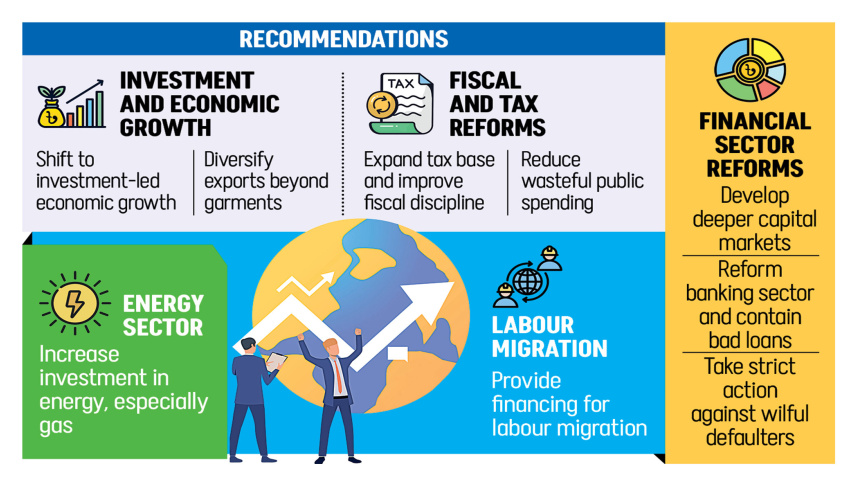
Bangladesh must prioritise boosting investment, strengthening energy supply and supporting private sector growth to generate jobs for its expanding workforce, economists and business leaders said at a policy dialogue yesterday.
They also called for decisive action against wilful loan defaulters and deeper financial sector reforms, warning that the country’s banking system remains fragile amid rising non-performing loans and weak credit growth.

The observations and suggestions came at a roundtable, titled “Looking into Bangladesh’s development: priorities for the newly elected government in the short term to medium term”, jointly organised by the Centre for Policy Dialogue (CPD) and The Daily Star at BRAC Centre Inn in Dhaka.
ECONOMY UNDER STRAIN
Speaking at the event, Sadiq Ahmed, vice-chairman of the Policy Research Institute of Bangladesh, pointed out that Bangladesh is currently facing a precarious economic situation.
GDP growth slowed to around 3.5 percent in the fiscal year 2024-25, while unemployment among educated youth has climbed above 10 percent, he noted.
Besides, he said, poverty is rising, underemployment remains widespread, and inflation persists at about 8.5 percent, nearly three times the global average.
Moderating the programme, Fahmida Khatun, executive director of CPD, said, “Weak private investment and declining credit growth are limiting economic expansion and employment opportunities.”
Noting that boosting the investment climate and private sector activity are essential for creating jobs, Khatun said restoring macroeconomic stability, ensuring policy predictability and reducing regulatory complexities would help attract both domestic and foreign investment.
Khatun added that expanding the tax base and strengthening governance in the financial sector would help attract investment and create sustainable employment opportunities.
M Masrur Reza, chairman and CEO of the Policy Exchange of Bangladesh, said the new government has inherited a fragile economy and must restore fiscal discipline.
He highlighted weak revenue mobilisation, rising debt and inefficient public spending as major concerns.
BANKING SECTOR’S BURDEN
Multiple speakers identified the banking system as a critical bottleneck. Non-performing loans continue to rise, depositor confidence has eroded, and credit to the private sector remains sluggish.
AK Azad, vice-president of ICC Bangladesh, warned that heavy government borrowing from banks is crowding out private sector credit.
He also called for strict action against wilful loan defaulters.
Md Main Uddin, a professor at the University of Dhaka, criticised policies that allow loan regularisation with minimal down payments, arguing that repeated restructuring offers only temporary relief.
“Strict action against wilful defaulters is essential to restore confidence in the banking sector,” he said.
Mohammed Nurul Amin, former chairman of the Association of Bankers, Bangladesh Limited (ABB), said restoring depositor confidence in troubled banks should be the government’s immediate priority.
He also emphasised the need for stronger corporate governance, improved regulatory oversight and faster implementation of banking sector reforms.
 For all latest news, follow The Daily Star's Google News channel.
 ENERGY INSECURITY
The dialogue also highlighted energy supply as a constraint on industrial expansion. Shafiqul Alam, lead energy analyst at the Institute for Energy Economics and Financial Analysis, noted that Bangladesh’s growing reliance on imported fuel has increased vulnerability to global price shocks.
He called for greater investment in domestic gas exploration, energy efficiency measures, and renewable power to ensure industries have stable access to electricity.
CPD’s Khatun also stressed the importance of reliable energy supply to support industrial production and business growth, while ICC Bangladesh’s Azad called for increased investment in energy to revive industrial growth.
SOUND POLICIES, LAX EXECUTION
Mahfuz Anam, editor and publisher of The Daily Star, observed that Bangladesh often formulates sound policies but struggles with execution.
He noted that bureaucratic processes, many inherited from the colonial era, often slow decision-making and complicate policy execution, leading to delays and cost overruns in development projects.
“The new government must manage the bureaucracy carefully while pursuing reforms through dialogue and gradual modernisation,” Anam said.
He suggested expanding digitalisation across ministries to improve efficiency and reduce irregularities. In addition, he proposed forming independent advisory groups for key sectors to provide expert guidance.
Asif Ibrahim, former director of Bangladesh Garment Manufacturers and Exporters Association (BGMEA) and vice chairman of NewAge Group, echoed the call for administrative reforms.
He suggested streamlining foreign investment approvals, implementing a single-window system, and providing better support for small and medium enterprises.
Mahmud Hasan Khan Babu, president of BGMEA, stressed that policies should be formulated with stakeholder participation to ensure effective implementation.
Shams Mahmud, former president of the Dhaka Chamber of Commerce and Industry (DCCI), urged policymakers to take immediate steps as Bangladesh prepares to graduate from the Least Developed Country (LDC) category.
Among others, Mostafa Abid Khan, trade specialist and former member of the Bangladesh Tariff and Trade Commission; Syed Almas Kabir, former president of the Bangladesh Association of Software and Information Services; Mohammed Nurul Amin, former ABB chairman; Mirza Nurul Ghani Shovon, president of the National Association of Small and Cottage Industries of Bangladesh (NASCIB); Mohammed Helal Uddin, executive vice chairman of the Microcredit Regulatory Authority; Doulat Akter Mala, president of the Economic Reporters Forum; Amrita Islam, deputy managing director of Picard Bangladesh Ltd; AKM Fahim Mashroor, chief executive officer of Bdjobs.com, also attended the event.
Comments