


Bhai, power, and the politics in The University of Chankharpul

Filmmakers, like most people, have riveting things to say about what they’ve seen and endured at close range. This approach places extraordinary strain on the art form. The form demands not only an assertive, even audacious imagination to animate its surfaces, but also a dense substratum of political consciousness and intellectual coherence to keep that imagination from drifting into empty spectacle. The University of Chankharpul wins on that front.
Directed by Akash Haque, The University of Chankharpul announces itself as a comedy, but its laughter is edged with recognition. In the shots, a finely observed portrait of public-university life can be witnessed, in which the ordinary rhythms of student existence are steadily eclipsed by the intoxicating promise of authority. The film charts the petty stratagems and performative loyalties through which students chase the symbolic power of a post, revealing how ambition and insecurity collude with institutional ritual to elevate the trivial into the tyrannical.

Haque’s inspiration emerges from a stark contrast: the nightmarish political claustrophobia of public university dormitories set against the comparatively freer, more open campus culture of Sikkim University, where he completed his master’s degree.
Central to the former is the notorious “guest room” culture, along with the ritualised abuse dispensed by senior leaders eager to demonstrate their dominance and curry favour with those above them. These scenes prise open doors long kept shut, compelling viewers to confront a brutality so habitual that it has ceased to shock those who practise it. Power here is rehearsed and finally normalised.
One may think that the “aesthetic dogma” propelled the director to cast students from his own institution, but it was a choice driven by financial constraints. Shot entirely in natural light, the film achieves an authenticity that polished contemporary productions often lack. The acting is so persuasive that one quickly forgets these are familiar faces on campus and not trained professionals. Debdyuti Aich, Rocky Khan, Boby Biswas, Akhtaruzzaman Azad, Abu Sayed, Ifad Hasan, Niloy Bala, and other actors shone throughout the entire film.
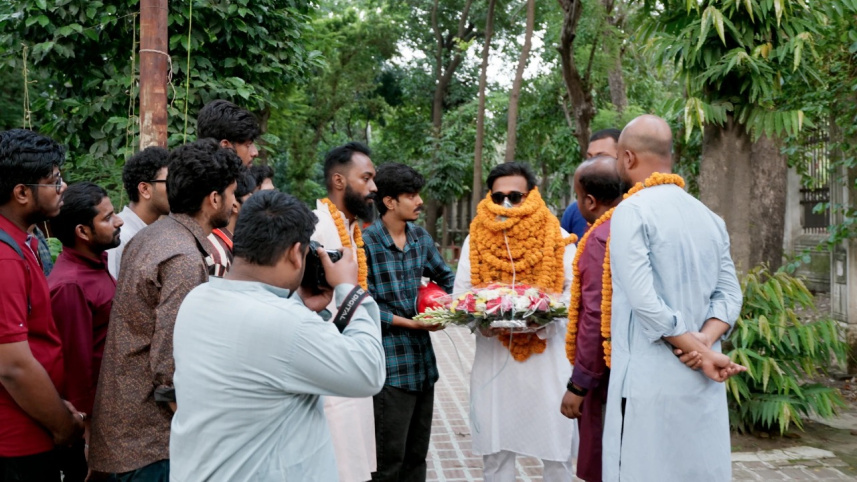
The textures of student politics are rendered with affectionate precision: garlands piled onto student leaders like sacred offerings, compulsory political programmes attended to “justify” one’s place in the hall, the rigid insider–outsider divide, the cruelty of ragging, and the eclipse of intellectual life. Yet these grim realities are smuggled into scenes so comically staged that the audience finds itself laughing even as they wince. Coupled with the grim environment, the film sets itself in a place that is relatable to the youth and even more so to the general students of public universities.
If one listens carefully, every character answers to the same name: Bhai. The repetition is deliberate and telling. In Haque’s mordant universe, the frequency with which one is called ‘bhai’ appears to be directly proportional to one’s appetite for power, a linguistic embrace that conceals a clenched fist.
The music is deployed with discriminating intelligence, gripping the audience while offering commentary in moments where dialogue falls silent. Politically charged and precisely timed, the soundtracks converse with the images rather than merely accompanying them.
Together with the plot, characters, writing, and setting, they create a rawness so acute it borders on the heartbreaking. This unvarnished intensity renders The University of Chankharpul compelling from beginning to end; it captures the tragedy of students chasing a fleeting taste of power at the cost of their own promise, revealing a game that is structurally rigged, morally bewildering, and ultimately self-defeating.
Also, if you’re planning to watch the film, stick around for the credits.
 For all latest news, follow The Daily Star's Google News channel.
Comments