


Driving innovation in the paint market

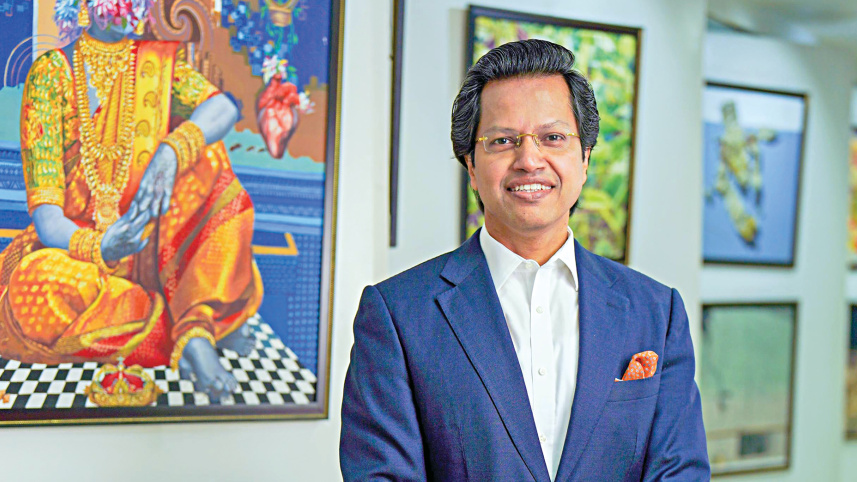
Md. Mohsin Habib Chowdhury
COO & Director
Berger Paints Bangladesh Limited
President, Bangladesh Paint Manufacturers’ Association (BPMA)

Leadership is defined by more than market share; it’s about innovation and trust. Berger is transforming the industry from selling colour to providing essential protection for a resilient Bangladesh.
Berger Paints Bangladesh Limited leads the market by providing innovative coating solutions to safeguard national infrastructure. In this interview Md Mohsin Habib Chowdhury, COO and Director of Berger, explains how they enhance living spaces through sustainable, customer-centric and professional home improvement services and expertise.
The Daily Star (TDS): Bangladesh’s paint industry is closely linked with construction, housing and infrastructure. How would you assess the current state and long-term potential of the sector?
Md. Mohsin Habib Chowdhury (MMHC): Bangladesh’s paint industry, valued over Tk 6,000 crore, is vital for protecting physical assets against deterioration. Despite current economic pressures, supplementary duty increases, and inflationary challenges, the long-term potential remains immense. Bangladesh’s per-capita paint consumption is under 2 kg, significantly lower than regional neighbours like India and Sri Lanka. As urbanisation accelerates, Berger aims to drive growth by raising application standards, strengthening backward linkages, and promoting paint as an essential protective tool for sustainable development.
TDS: How has consumer buying behaviour changed in Bangladesh’s paint market recently?
MMHC: Painting has transitioned from a functional necessity to a lifestyle choice. Consumers are value-conscious and design-orientated, seeking personalised living spaces that reflect their personality, taste, and sense of identity. Homeowners now prioritise trusted brands that offer durability, professional guidance, and seamless, end-to-end service experiences. They seek an accountable, one-stop solution for colour selection and application rather than dealing with separate parties for different tasks.
TDS: How has Berger responded to this shift from paint as a product to painting as a complete solution?
MMHC: Berger has built a holistic ecosystem through “Berger Experience Zones”, offering one-stop painting solutions. We provide professional services like Express Painting, Illusions for artistic finishes, and FurniFab for furniture finishing solutions at the customer’s premises with professional handling. Our Berger Design Studio offers interior solutions led by architects. By integrating high-quality products with expert application, we transform painting into a professional experience that enhances the longevity and aesthetic value of homes.
TDS: What are the most important innovations Berger is investing in right now?
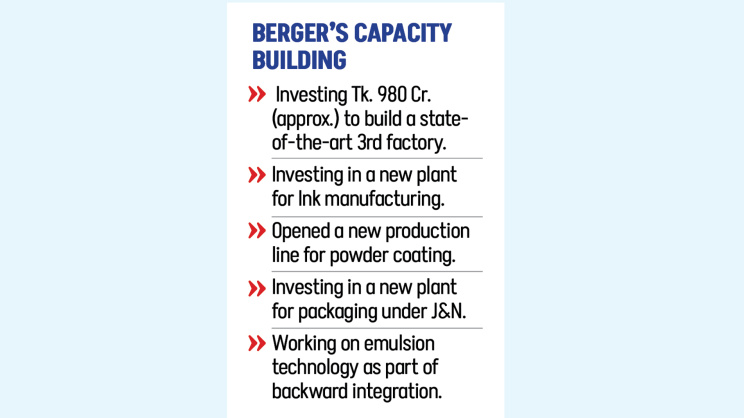
MMHC: We are investing Tk 980 crore in a third automated factory at Mirsarai to boost efficiency and supply reliability. Innovation also includes creating our own emulsions and special textile chemical solutions to help the ready-made garment (RMG) sector. Berger pioneered lead-free paints and introduced EcoCoat, an anti-pollution paint. We are also professionalising the trade through the Berger Training Institute and Shomporko Painters Club, reducing import dependence while supporting manufacturing resilience and national industrial growth.
TDS: Berger is the market leader in Bangladesh’s paint industry. How would you describe the company’s current position and portfolio?
MMHC: Holding a lion’s share in decorative paints, Berger’s leadership is defined by innovation and distribution strength. One of our significant investments is the Tk 980 crore factory at the National Special Economic Zone. Our portfolio serves both B2C and B2B segments, including specialised marine, industrial, vehicle refinish, and powder coatings. The Shomporko Painters Club, with over 65,000 registered painters, allows us to deliver value. We shape industry trends by offering integrated, service-led solutions to consumers.
TDS: Bangladesh still depends heavily on imported raw materials for paint manufacturing. What needs to happen to reduce this dependence?
MMHC: Reducing import dependence requires a robust industrial ecosystem, including local production of resins, pigments, additives, and speciality chemicals. It necessitates national policy support for petrochemicals, resin manufacturing, and testing infrastructure. Following the success of the textile sector, developing backward linkages should be a priority. Localising the supply chain will reduce foreign exchange pressure, create employment, and enhance the overall competitiveness of Bangladesh’s manufacturing sector as a whole.
TDS: Looking three to five years ahead, what would make you say Bangladesh’s paint industry has truly matured?
MMHC: A mature industry will see paint recognised as a value-preserving material rather than just decoration. We expect standardised application methods, skilled professionals, and mainstream sustainability with eco-friendly products. Finally, a mature sector will feature strong backward linkage industries. Berger remains committed to leading this transformation, moving the industry toward national value creation, from colour to protection, and helping build a more sustainable and resilient Bangladesh with end-to-end solutions.
Interview conducted by Tagabun Taharim Titun
 For all latest news, follow The Daily Star's Google News channel.
Comments