


Aqua paints redefining quality & trust
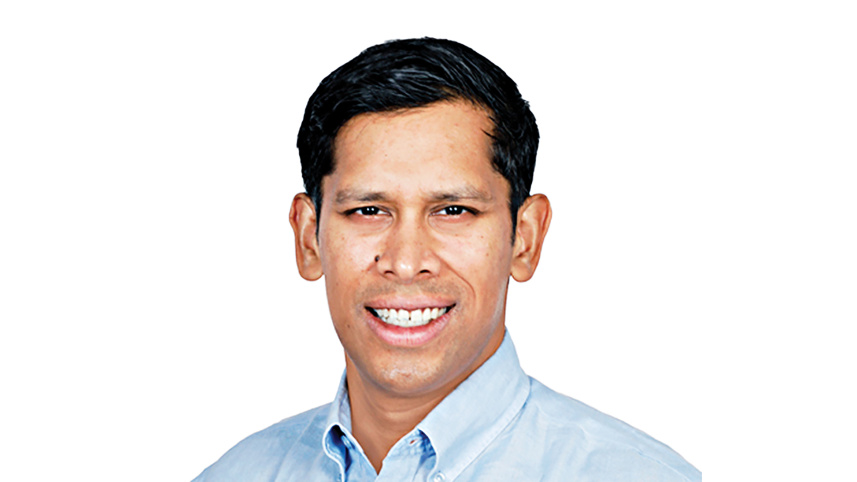
Shayaan Seraj
Group Director
Aqua Paints, Octagon Fibres & Chemicals Limited, Elite Group

Paint performance depends not only on the product, but also on correct product selection, surface preparation, primer usage, dilution, application method, drying time and maintenance. If customers, painters, contractors and dealers understand these areas better, the entire market benefits.
As the Bangladeshi paint market matures into a Tk 6,000-crore industry, the focus is shifting from simple aesthetics to long-term technical performance. In this interview, Shayaan Seraj, Group Director of Aqua Paints, discusses how the company is navigating global inflation through local manufacturing, leveraging AI for better design to meet the demands of today’s informed consumers.
The Daily Star (TDS): What is the single biggest shift you have seen in buyer behavior in Bangladesh’s paint market over the past years, and how has your company responded to it?
Shayaan Seraj (SS): The biggest shift we have seen is that customers in Bangladesh are becoming much more informed and conscious. Paint buyers today are comparing products, features, durability, application benefits.
At Aqua Paints, we have responded to this shift by strengthening both our products and our institutional credibility. We have also focused on improving compliance and quality systems. Recently, we achieved ISO 9001:2015 certification, also increasing third-party testing through institutions such as BUET.
TDS: How would you describe the size and potential of Bangladesh’s paint industry today?
SS: Current industry estimates place the market at over Tk 5,000 crore, with some recent estimates suggesting that annual sales may now be crossing Tk 6,000 crore. However, the more important point is not only the current size of the market, but the level of underpenetration. Per-capita paint consumption in Bangladesh remains significantly lower than in many regional and global markets. Bangladesh is still around 1.1–1.6 kg per person, according to different public estimates.

TDS: The sector appears to be under pressure from inflation and import dependence. Which of these has hit your business hardest, and how are you adjusting?
SS: Global volatility in oil and freight prices has driven up paint costs because key raw materials are imported. Aqua Paints mitigates this through backward linkage manufacturing resins and emulsions locally, which improves supply reliability and margin control. However, since the base chemicals for these binders are still imported, favourable duty policies are needed to encourage further local value addition. Aqua remains focused on managing costs through internal efficiency without compromising product quality.
TDS: What part of your product range is for budget, middle, and premium buyers, and how has that changed over time?
SS: Bangladesh’s paint market has shifted from comparing price-per-can to evaluating value-per-square-foot. Aqua Paints addresses this with tiered solutions: economy options like Aqua Outer Shield (~Tk. 4–5/sq. ft.) for budget buyers, and premium solutions like Aqua Defender (~Tk. 7–8/sq. ft.) or Aqua Platina (~Tk. 9–10/sq. ft.) for maximum durability. We are also expanding into industrial and institutional coatings to meet specific safety and compliance needs. Our focus remains on delivering reliable performance across all segments, ensuring every project receives the right balance of cost and quality.
TDS: What is the most important performance feature you focus on when developing paint for the Bangladesh market?
SS: In Bangladesh, durability is the priority due to extreme weather, humidity, and salinity. Aqua Paints focuses on long-term protection through products like Aqua Defender and Aqua Platina, but performance depends on more than just the paint. To ensure lasting results, we emphasize a complete painting system and are committed to educating homeowners and professionals on correct application standards.
TDS: Looking 3–5 years ahead, what would make you say the Bangladesh paint industry has truly matured?
SS: A mature paint industry will not only be measured by market size or sales growth. It will be measured by the quality of its systems — product quality, compliance, credit discipline, customer education, backward linkage and fair competition.
One important area is customer and channel behaviour. Bangladesh’s paint market remains highly credit-based, especially at the retailer and dealer level. Many retailers are still outside formal banking and digital credit systems, which makes it difficult for manufacturers to properly assess creditworthiness. In a more mature industry, this should change.
TDS: What are the most important innovations you are investing in right now?
SS: Aqua Paints innovates to solve Bangladesh’s specific climate and industrial challenges. We focus on anti-corrosive steel coatings, flexible elastomeric roofing for waterproofing, and high-performance binders manufactured via Aqua Resins & Emulsions. Additionally, digital tools like our AI-powered ColorSense platform simplify color selection, blending advanced chemistry with a better customer experience.
TDS: How much of your raw materials are locally sourced today, and what would need to happen for Bangladesh to reduce import dependence more meaningfully?
 For all latest news, follow The Daily Star's Google News channel.
 SS: Bangladesh’s paint industry is vulnerable to global price shifts due to heavy import dependence. Aqua Paints addresses this through backward linkage manufacturing binders locally via Aqua Resins & Emulsions to improve quality and supply control. To build a stronger local ecosystem, we need policy support that favors raw material imports over semi-finished products, encouraging true local value addition and technical self-reliance.
Comments