


When home loans move the economy
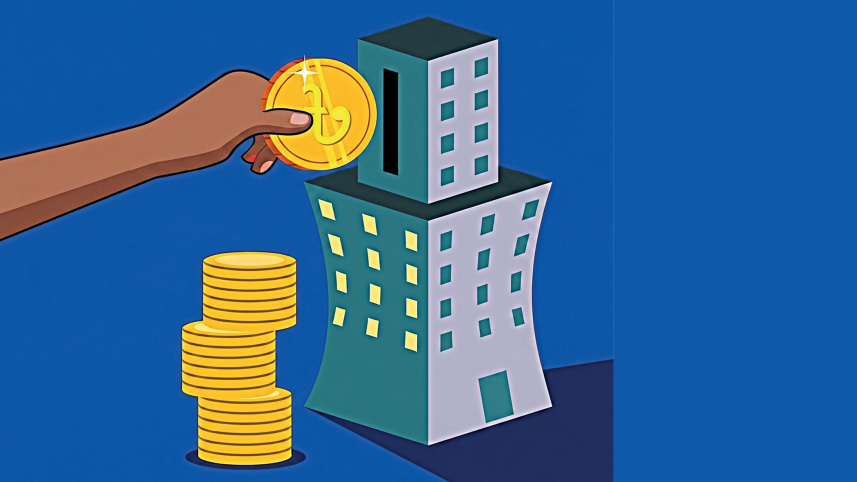
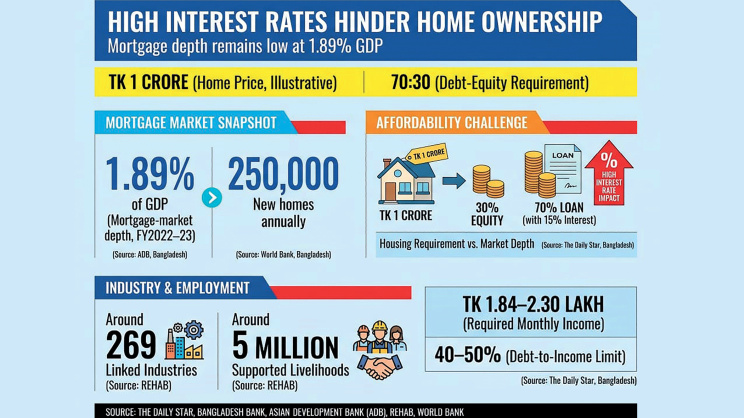
For a family buying a Tk 1 crore apartment with a home loan, the first hurdle arrives long before the keys do. Under Bangladesh Bank’s 70:30 debt-equity requirement, the buyer must put up at least Tk 30 lakh. Financing the remaining Tk 70 lakh at 15 percent over 20 years means a monthly instalment of roughly Tk 92,000.
For the borrower, that is a household-budget question. For the economy, the consequences can travel much further. When housing finance supports new construction, renovation or newly built homes, money flows into cement, steel, ceramics, electrical goods, furniture, transport and professional services. But that multiplier is neither automatic nor unlimited.

A loan that travels
Housing sits at the intersection of construction and real estate. BBS counts them separately, but their fortunes are closely connected. Provisional estimates put the contribution of real-estate activities alone at nearly Tk 4.8 lakh crore in FY2025-26, with the sector estimated to have grown 7.19 percent.
REHAB says real estate is linked to around 269 industries and directly or indirectly supports the livelihoods of roughly five million people.
Yet not every home loan produces the same effect. Financing a new house or newly developed apartment directly adds to demand for labour and materials. A loan used to buy an existing completed property mainly finances a transfer of ownership. Treating all mortgage lending as equivalent to new construction therefore overstates its immediate impact.
A shallow market
Bangladesh’s formal mortgage market remains small relative to the economy. The Asian Development Bank estimates mortgage debt at only 1.89 percent of GDP in FY2022-23 and says housing finance remains concentrated among higher-income households.
A World Bank assessment estimates Bangladesh needs around 250,000 new homes annually, while UN projections cited by the World Bank put the urban population at around 111 million, or 60 percent of the country, by 2050.
Affordability becomes the bottleneck
High interest rates have changed the calculation for middle-income buyers. The Daily Star reported earlier this year that rates of 14 to 16 percent had pushed much of the mid-market segment towards a standstill.
At 15 percent, a Tk 70 lakh mortgage over 20 years requires an EMI of about Tk 92,000. Industry practitioners say lenders typically keep total monthly debt obligations within roughly 40 to 50 percent of income. A household with no other debt would therefore need around Tk 1.84 lakh in monthly income even at the upper limit, after first finding Tk 30 lakh for the down payment.
That makes affordability a much more immediate constraint than the maximum amount a bank is legally allowed to lend.
Bigger loans come with conditions
In January 2026, Bangladesh Bank increased the maximum housing-loan ceiling from Tk 2 crore to as much as Tk 4 crore per borrower. Banks where classified housing loans account for up to 5 percent of the portfolio may lend up to Tk 4 crore; the ceiling falls to Tk 3 crore where the ratio is above 5 percent but no more than 10 percent, and remains Tk 2 crore above that level.
Bangladesh Bank’s Financial Stability Report 2025 shows Tk 361.4 billion in outstanding housing finance within the consumer-credit category, of which Tk 47.33 billion was non-performing, putting the gross NPL ratio at 13.1 percent.
Bangladesh tightened loan-classification standards during 2024 and 2025, so the increase cannot be read simply as a sudden collapse in household repayment behaviour. It nevertheless shows why expanding mortgage credit has to be matched by careful assessment of repayment capacity.
The long-money problem
Mortgages may run for 15 or 20 years, but much of the money banks use to fund them comes from deposits with far shorter maturities. The ADB says Bangladeshi banks rely largely on fixed deposits of one to three years to finance long-term home loans.
This maturity mismatch makes cheap, stable mortgage finance difficult. Longer-term funding through refinancing arrangements, housing bonds or a secondary mortgage market therefore matters as much as higher loan ceilings.
 For all latest news, follow The Daily Star's Google News channel.
 Growth but not at any cost
Housing investment supports economic activity, but policymakers also have to consider where scarce capital goes. Bangladesh Bank’s latest Monetary Policy Review shows construction accounted for 84 percent of gross fixed capital formation in FY2024-25, while the shares going into plant and machinery and transport equipment have fallen.
More housing finance can support jobs, construction and household asset ownership. But directing an ever-larger share of capital towards property would not necessarily deliver the strongest long-term productivity gains if businesses remain short of financing for machinery, technology and expansion.
The economic case for housing finance is therefore not simply a case for more credit. It is a case for finance that reaches households capable of carrying the debt, supports new housing where possible, and is backed by a financial system able to fund mortgages over the long term.
For a household, a home loan begins with whether the monthly instalment is affordable. For the wider economy, what happens after approval depends on where the money goes, what it builds, and whether both borrower and lender can carry it for the years that follow.
Comments