


Where discipline shapes the leaders of tomorrow
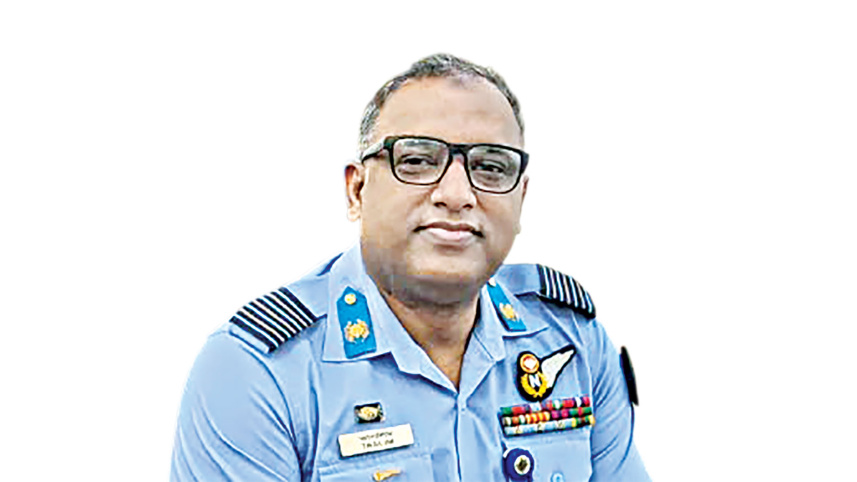
My vision goes beyond examination results. I want all our students to graduate ready to face global challenges and become global citizens while remaining national citizens.
From its establishment in 1992, under the direct supervision of the Bangladesh Air Force and its emphasis on discipline, academic excellence and holistic development to its adoption of the Cambridge International curriculum, BAF Shaheen English Medium College (SEMC) seeks to prepare students for a rapidly changing world while nurturing leadership, practical learning and cultural awareness. Group Captain Taslim Ahmed, Principal of BAF Shaheen English Medium College, speaks to The Daily Star about the institution’s disciplined learning environment, its Cambridge Curriculum and practical facilities, students’ leadership and extracurricular opportunities, collaboration with the British Council in ‘Teacher development’ and ‘examinations’, ‘its vision of preparing students to become both global and national citizens’ and so on.

The Daily Star (TDS): Could you give us a snapshot of a typical day at BAF SEMC ?
Group Captain Taslim Ahmed (TA): Discipline is the first thing we maintain. As an institution backed by a military organisation, ‘punctuality’ and ‘discipline’ are integral parts to our daily routine. The school starts at 8 am, followed by an organized rhythmic assembly. Unlike many English-medium schools, we have proper playground, huge fields which allow students to take part in everyday activities.
After the assembly, students go to their classrooms while I review the academic routine and visit classes. We also have CCTV facilities in all classrooms, allowing us to monitor the learning environment and provide guidance when necessary. Alongside regular classes, students participate in extracurricular activities through around 21 clubs.
Beside these regular works, at the final hours of the day, I need to handle student dismissal, catch up on quiet administrative works, and prepare for the next smooth day.

TDS: What is BAF SEMC’s unique ‘X-Factor’, and how does Cambridge support students?
TA: We initially had Edexcel when the school section was introduced in long back; later, we found Cambridge more comfortable and student-friendly for our context. We faced some challenges during the first two or three years at the beginning levels; however, our results subsequently improved significantly and outstandingly.
It is to be mentioned that ‘the practical nature of Cambridge’ is another advantage. We have laboratory facilities for physics, chemistry and biology, and our laboratory is one of the biggest among schools in Dhaka. This allows students to connect classroom learning with real-life situations. On the other hand, we simultaneously train our teachers to maintain the quality education in the classroom following the directives and expectations laid out by Cambridge International Education which ensures academic integrity, student welfare, and future readiness.
TDS: How do you ensure that English-medium students remain connected to Bengali culture?
TA: The perception that English-medium students are detached from Bengali culture is not necessarily true. We organise programmes related to Bengali culture and heritage and observe important national and cultural occasions all year round.
We are also part of the Shaheen network under the Bangladesh Air Force. Among the 10 Shaheen colleges, nine are Bengali-medium and ours is the English-medium institution. We therefore participate always in common programmes, including ‘Pohela Boishakh’ and other national and religious occasions. Being an English-medium college does not mean that we are disconnected from our national identity.
TDS: Which books have influenced your approach to leadership and education?
TA: Leaders Eat Last by Simon Sinek has influenced my understanding of leadership, teamwork and how leaders should work with people. Good to Great by Jim Collins also provides valuable lessons on discipline, institutional development and leadership.
For personal growth, I have read Dare to Lead by Brené Brown, which helped me understand vulnerability, empathy and courage in leadership. These ideas are particularly useful for me as being a principal is different from being a commander: understanding teachers, and students is an important part of the role.
I also believe physical books leave a lasting impression. Today, people consume enormous amounts of information through screens and social media, but reading books remains a powerful habit that expands knowledge, sharpens mind and reduces stress.
TDS: What opportunities do students need to have to develop leadership and other skills?
TA: We have around 21 clubs, including Model United Nations, Next Generation Leaders ( in the context of entrepreneurship), Oratory, Debate, Dance, Drama and Poetry Clubs which are mandatory, participation-based ECA where every student needs to be an active member through the session to grow his or her skill potentially.
The ‘Prefectship system’ is another renowned and popular system at SEMC that has been running for more than a decade. There are ‘Junior Prefects’ from ‘Standard-9’ and ‘Senior Prefects’ from ‘AS level’. Students are given responsibilities in organising programmes, managing junior students etc. These roles introduce ‘a layer of peer-led leadership’ through positions like College Prefect, Games Prefect, Cultural Prefect, and Band Leader.
Competition creates an urge to improve, while recognition and rewards provide additional motivation. Whenever there are competitions or awards, we identify students with particular strengths and prepare them through these dedicated clubs and particular training.
 For all latest news, follow The Daily Star's Google News channel.
 Our students also participate in Inter-Shaheens and Inter-English-medium-schools competitions. This kind of preparation and exposure helps students to develop confidence and prepares them for taking challenges beyond the classroom.
It is to be noted that our positive relationship with the British Council continues to thrive. The Partner School Network gives students opportunities to participate in various competitions and showcase their abilities alongside students from other schools.
TDS: How has the British Council’s professional development support benefited teachers?
TA: Being a British Council Partner School, we always take their expert guidance to improve the standards of International Education at SEMC.
We know, webinars and workshops give educators direct insights into global assessment criteria. This enables them to prepare students for international qualifications with much greater precision. With the direct supervision of the British Council’s professional development courses, our teachers are benefitted directly by participating time to time offered workshops and training and enriched themselves profoundly.
TDS: Could you speak about the importance of the British Council’s role in secure exam delivery? How efficiently is the examination administration handled, particularly during final examinations, and what positive impact does this have on the school environment?
TA: We are a Cambridge Examination Centre - organised through the British Council, and ‘security is one of our major strengths’. Being located within a military environment, it allows us to provide a safe and secure setting for candidates.
We isolate examination classrooms, known as ‘Exam Halls’ and have additional facilities for visiting examiners.
The number of candidates coming to our centre has increased, and guardians from other schools have expressed confidence in the environment.
At the same time, examination security is a global concern. Reports of question leaks and repeated examinations create anxiety among students and guardians. Stronger measures should continue to be taken to reduce such risks.
TDS: What achievement are you most proud of, and what is your vision for the future?
TA: I would not say we have achieved our ultimate goal yet. Our results over the past three years have been excellent, with a 100% pass rate, while the number of A* grades has increased significantly. One particularly satisfying achievement was having a student rank seventh in BUET admission, which is a significant accomplishment for an English-medium student. However, our global alumni network consists of high-achieving professionals driving innovation across diverse industries.
My vision goes beyond examination results. I want all our students to graduate ready to face global challenges and become global citizens while remaining national citizens. We are also seeing growing confidence among guardians. This year, around 139 applications were received for 15 seats in Standard I. That reflects the deep trust and confidence families place in the institution.
Going forward, we want to expand our facilities and explore opportunities to expand our presence elsewhere in the country. Our ultimate ambition is to make BAF SEMC the number one English-medium school in Bangladesh. With the continued guidance and support of the Bangladesh Air Force, we are working towards that goal.
Photo: Tahsin-Ul-Islam Samin
Comments