


Building for tomorrow’s leaders

Achievement gives students the confidence to take the next step. Once they realise that they can create something and succeed, they begin to see themselves as leaders.
At Chittagong Grammar School, athletics, student-led activities and environmental responsibility sit alongside academic learning. Ruhbayna Mahmud Chowdhury, Head of Upper Section, speaks to The Daily Star about the British curriculum, the value of positive leadership and how the British Council’s support for teachers, school leaders and examinations contributes to students’ development.

The Daily Star (DS): CGS has grown considerably since its beginnings in Chattogram. What does your typical day look like, and how do you stay connected with students and teachers?
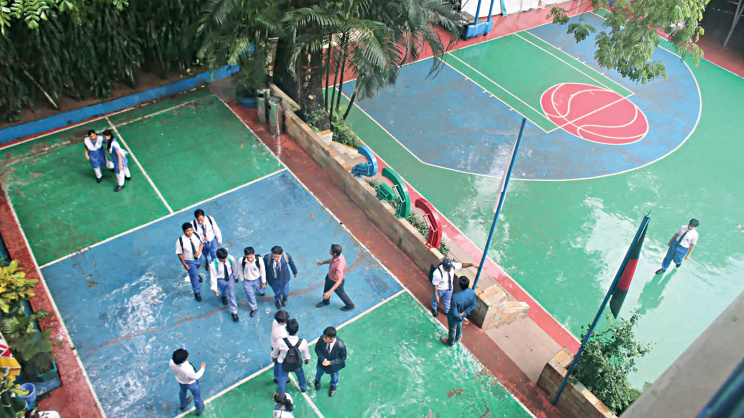
Ruhbayna Mahmud Chowdhury (RMC): I call myself a “floating principal” because I spend much of the day moving around school. I don’t really sit in an office and have meetings. My mornings usually begin with the athletics team on our basketball court, reviewing preparations for the various interschool sporting events that we host. I am a strong believer in athletics being a great contributor in shaping resilient individuals. So, we focus on various team and individual sports to help bring out the best in our students.
I then turn to administrative matters- the nitty gritty of running a school. I will often have scheduled meetings with students, parents and teachers. I also try to squeeze in a classroom observation as this gives me the clearest picture of what is happening. Quite often, I return in the evenings for school events.
DS: How do the British curriculum and Round Square IDEALS work together at CGS, and what makes this approach valuable for students’ long-term development?
RMC: The British curriculum provides an internationally recognized academic foundation. The curriculum is extremely robust and allows students to logically comprehend subject matter. With such a strong educational system as our backbone, we have the flexibility to engage in various extra-curricular activities which include the Round Square IDEALS, clubs and other experiences.
The RS IDEALS constitutes of Internationalism, Democracy, Environmental Stewardship, Athletics, Leadership and Service. With such a broad perspective on students’ growth, we focus on each individual and how we can work on their strengths. This allows us to shape our students based on their interests and passion. The British curriculum further enhances student’s individuality by allowing subject combinations that reflect individual interests, such as physics alongside economics and accounting.
With these two well established organizations guiding us, we are able to produce leaders who are educated, empathetic, and socially responsible.
DS: English-medium students are sometimes perceived as less connected with local culture. How does CGS help students understand their heritage while preparing them for a global education?
RMC: At CGS we strongly believe Students should understand where they come from while preparing to engage with the wider world. Hence Bangladesh Studies is mandatory at CGS. It covers the country’s history in depth, from before the Mughal period through the Liberation War. In fact, our Academic Director Mrs. Shereen Ispahani was one of the people to spearhead this subject into the British curriculum.
We also celebrate various Bangladeshi events like Ekushey February, Victory Day, Pohela Falgun, Pitha Utshob etc. Our Pohela Boishakh celebrations is a massive mela which also gives them opportunities to participate in local culture and experience it beyond textbooks.
DS: Which book has particularly influenced your leadership, and how have its ideas shaped your relationships with teachers and students?
RMC: Martin Seligman’s Flourish had a significant impact on me. When I joined CGS as a college counsellor, I sometimes wondered whether empathy and positivity made me too soft as a leader.
The book encouraged me to focus on positive engagement, appreciation, relationships and achievement. People responded well when they felt respected. That approach became central to how I lead.
DS: British Council programmes encourage students to participate internationally. How have competitions such as Your World helped them develop confidence and take ownership?
RMC: When Your World first came to us, I wondered who would make the video. Students approached me with their own ideas, and I encouraged them to proceed.
They received an award, which became a turning point. One student went on to lead a videography club, another an environmental club, while another started Erudite Exchange, a discussion club. Achievement gives students confidence to take the next step and see themselves as leaders.
DS: What changes have you seen in classroom practice following professional development through the British Council and its Partner Schools network?
RMC: All our teachers completed a four-day British Council training programme last year. One change has been the use of exit questions: after a lesson, students answer questions to demonstrate their understanding.
 For all latest news, follow The Daily Star's Google News channel.
 Even a brief response provides a starting point. The aim is to encourage participation and accomplishment without demanding perfection immediately. Students report improved engagement, particularly in business studies and economics, and teachers see the difference.
DS: Beyond teacher training, how has the British Council helped school leaders collaborate and address challenges facing English-medium education?
RMC: Meetings and open discussions with other principals have been valuable. One explored how to bridge the gap between the education ministry and the English-medium curriculum.
Hearing different approaches changed my perspective. Schools may work differently, but we share the objective of supporting the country’s young people.
DS: Parents depend on reliable examinations. How does the British Council support secure delivery, particularly when unexpected disruptions affect students?
RMC: Running examination centres requires separate infrastructure, staff and systems. Having the British Council manage that responsibility allows schools to focus on education.
During this year’s May-June examinations, severe rain and gridlock affected Chattogram. Its team helped students reach the venue and communicated with relevant authorities. For younger students sitting their first external examinations, that reassurance mattered. Independent administration also provides confidence through accountability and security.
DS: Looking at CGS’s development, which achievement makes you proudest, and what does it reveal about the kind of education you want students to receive?
RMC: Environmental responsibility has become part of students’ everyday thinking. After a recent landslide, they independently decided to collect and plant vetiver grass to help prevent further landslides.
Environmental Management began at O Level with a few students. We now offer it at A Level too, with around 17 students enrolled.
My greatest pride is seeing students become environmental stewards without being pushed. Education must help young people understand their responsibility to care for the planet.
Comments