


Japan’s Mitsui & Co’s Strategic Investment at Shwapno Marks a Turning Point for Bangladesh Retail
Mitsui & Co., Ltd. is one of Japan’s most respected multinational conglomerates and one of the world’s leading general trading and investment companies.
For more than a century, Mitsui has been associated with global trade, investment, industrial development and cross-border business partnerships. Operating across more than 60 countries, the company has built deep expertise across sectors such as consumer business, food, infrastructure, energy, chemicals, mobility, healthcare, technology and industrial solutions.
 For all latest news, follow The Daily Star's Google News channel.
 Its investment decisions are rarely viewed as short-term financial moves. For a company of Mitsui’s scale and history, a strategic partnership usually reflects long evaluation, institutional confidence and a clear view of a market’s future potential.
That is what makes Mitsui’s strategic investment in Shwapno significant.
The partnership is not only an important development for Bangladesh’s largest grocery retail chain. It is also a strong signal that one of Japan’s most influential business groups sees long-term promise in Bangladesh’s consumer economy and in the gradual transformation of the country’s retail sector.
Bangladesh’s grocery market has long been shaped by traditional bazaars, neighbourhood shops and fragmented supply chains. Fresh produce often travels through several layers before reaching households. Prices vary from one market to another, product quality can be inconsistent, and consumers frequently spend time and effort searching for reliable everyday essentials.
But the market is changing.
Urbanisation, busier lifestyles, rising awareness about food safety and growing demand for convenience are gradually reshaping how households shop. Consumers are increasingly looking for authentic products, fair pricing, quality assurance and easier access under one organised retail system.
At the centre of this transition stands Shwapno.
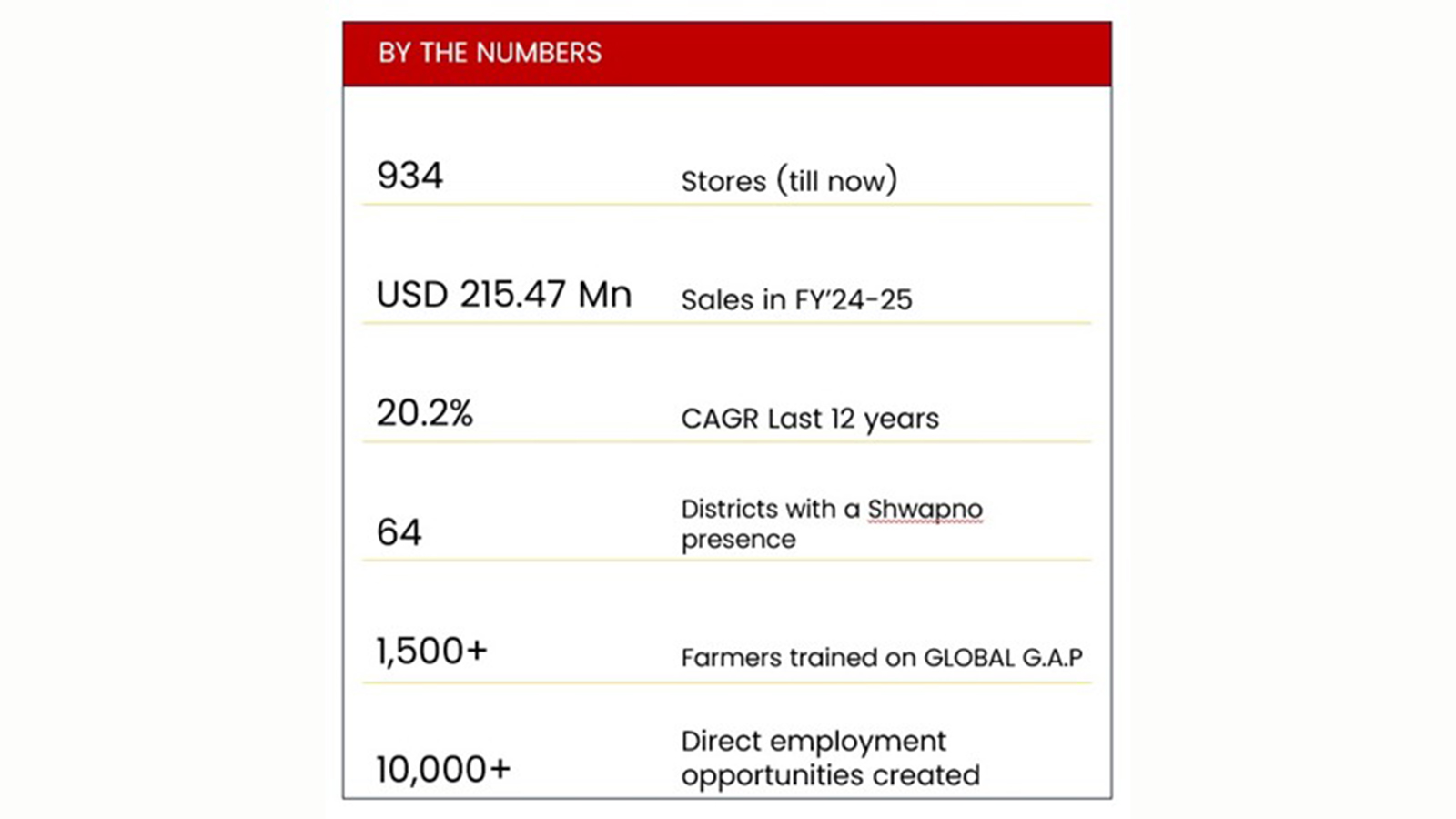
From its early days as a modern retail initiative, Shwapno has grown into Bangladesh’s largest grocery retail chain, with presence across all 64 districts and an expanding footprint in cities, district towns, thanas and union-level markets. Today, the company commands more than half of the country’s organised retail market and is pursuing a deliberate long-term ambition: to build an end to end fair, equitable, inclusive ecosystem with significant impact in life and lives of a market with TAM of over USD 20 billion.

The opportunity isn't in retail. It's in building the nation's food system foundation. Modern retail in Bangladesh isn't about replacing bazaars—it's about systematizing them.
The company’s growth has now received significant international validation.
Under an agreement signed on February 25, Mitsui will provide foreign currency-denominated convertible loans at comparatively low interest rates, supporting Shwapno’s expansion, technology, logistics and supply-chain development. The initiative is also backed by Shwapno’s parent company, ACI PLC.
For Shwapno Managing Director Sabbir Hasan Nasir, the agreement is not only about access to capital. It reflects recognition of a business model built around trust, convenience and value.
“People want authentic products, fair prices and easy access,” Sabbir said. “Our focus has always been to make quality products available near where people live.”
A relationship tested over time
The partnership was not the outcome of a short investment discussion.
According to company officials, engagement between Shwapno and Mitsui began nearly four years ago. During that period, the Japanese company conducted detailed reviews of Shwapno’s financial performance, expansion plans, sourcing model, governance structure, compliance practices, technology systems and long-term growth potential.
Mitsui representatives visited Shwapno outlets, met management teams, reviewed operational processes and travelled to farming communities connected to the retailer’s fresh produce supply chain.
The process reflected the disciplined approach often associated with Japanese investors. Before committing capital, Mitsui sought to understand not only the size of Shwapno’s network, but also the quality of the organisation behind it.
What emerged was a picture of a company trying to address some of the structural inefficiencies of Bangladesh’s grocery market.
At one end of the chain are farmers who often depend on fragmented markets and uncertain selling channels. At the other end are consumers who want safe, authentic and fairly priced products. Between the two, Shwapno has been building a more organised retail platform designed to improve sourcing, reduce waste, strengthen product standards and serve households more consistently.
This wider purpose appears to have shaped Mitsui’s confidence.
Shwapno’s work with farmers was one area that stood out. The company sources a significant share of fresh produce directly from farming communities across Bangladesh, allowing it to improve quality control while giving producers access to a more reliable buyer.
The company has also been promoting Good Agricultural Practices among farmers. It has trained more than 1,500 farmers on GLOBAL G.A.P protocols, with 15 GLOBAL G.A.P certified crops and 100 GLOBAL G.A.P certified farmers.
For a global partner like Mitsui, such initiatives indicate that Shwapno’s growth is not confined to store expansion. It is also connected to upgrading the upstream foundation of the country’s food value chain.
Mitsui also looked closely at the capabilities behind Shwapno’s scale: data-driven decision-making, category planning, inventory discipline, governance, compliance and leadership depth. The company’s food safety focus, reflected in its position as Bangladesh’s only HACCP-certified supermarket, added further credibility, while its teams across operations, supply chain, sourcing, finance, category, marketing, ESG and technology showed the organisational depth needed to scale.
Equally important was the culture of the organisation. Shwapno has combined commercial growth with social responsibility by supporting farmers, encouraging safer agricultural practices, creating opportunities for franchise entrepreneurs and including differently abled people within its workstreams. Its United Nations Global Compact membership further reinforces its commitment to responsible business practices.
Together, these elements helped position Shwapno not simply as Bangladesh’s largest grocery retail chain, but as a platform with the potential to shape the next phase of modern food retail.
A different model for grocery retail
In Bangladesh’s traditional grocery system, fresh produce often passes through multiple intermediaries before reaching consumers. Each layer can add cost, delay and uncertainty. Farmers may not always receive fair value, while shoppers may face inconsistent quality and fluctuating prices.
Shwapno has tried to narrow that gap by building direct links with sourcing regions. Dedicated teams work with growers to procure fresh produce, maintain quality standards and ensure steady supply to stores.
The model creates value on both sides.
Farmers gain access to a structured buyer capable of purchasing at scale. Consumers receive greater assurance on freshness, authenticity and consistency. The retailer also gains better visibility over product quality and supply planning.
For Sabbir, this is central to Shwapno’s purpose.
“Bangladesh's organised retail market is still nascent. But the trajectory is clear: as consumers demand consistency, safety, and fairness—and as farmers need structured buyers—the opportunity isn't in retail. It's in building the nation's food system foundation. Modern retail in Bangladesh isn't about replacing bazaars—it's about systematizing them. We're building the connective tissue between fragmented producers and conscious consumers. That infrastructure compounds."
This approach also reflects a broader shift in Bangladesh’s consumer economy. As households demand safer products and better service, the role of organised retail is expected to grow. At the same time, farmers and suppliers will need stronger links with formal channels that can reward quality, consistency and traceability.
Taking organised retail beyond traditional centres
Shwapno’s growth has not been limited to premium urban neighbourhoods.
The company has expanded into district towns and emerging local markets where access to organised retail was previously limited. Its outlets can now be found in areas that would once have been considered unlikely locations for a supermarket chain.
The strategy is based on a practical insight: convenience has economic value.
When customers can buy dependable products near home, they save time, travel cost and effort. For working families, elderly customers, students and households outside major urban centres, that access can make a meaningful difference.
This is where Shwapno believes modern retail can play a larger role in Bangladesh — not by replacing traditional markets overnight, but by introducing stronger standards of product availability, pricing discipline, service and trust across more communities.
Growth ahead of the market
Shwapno’s strategy has produced visible results.
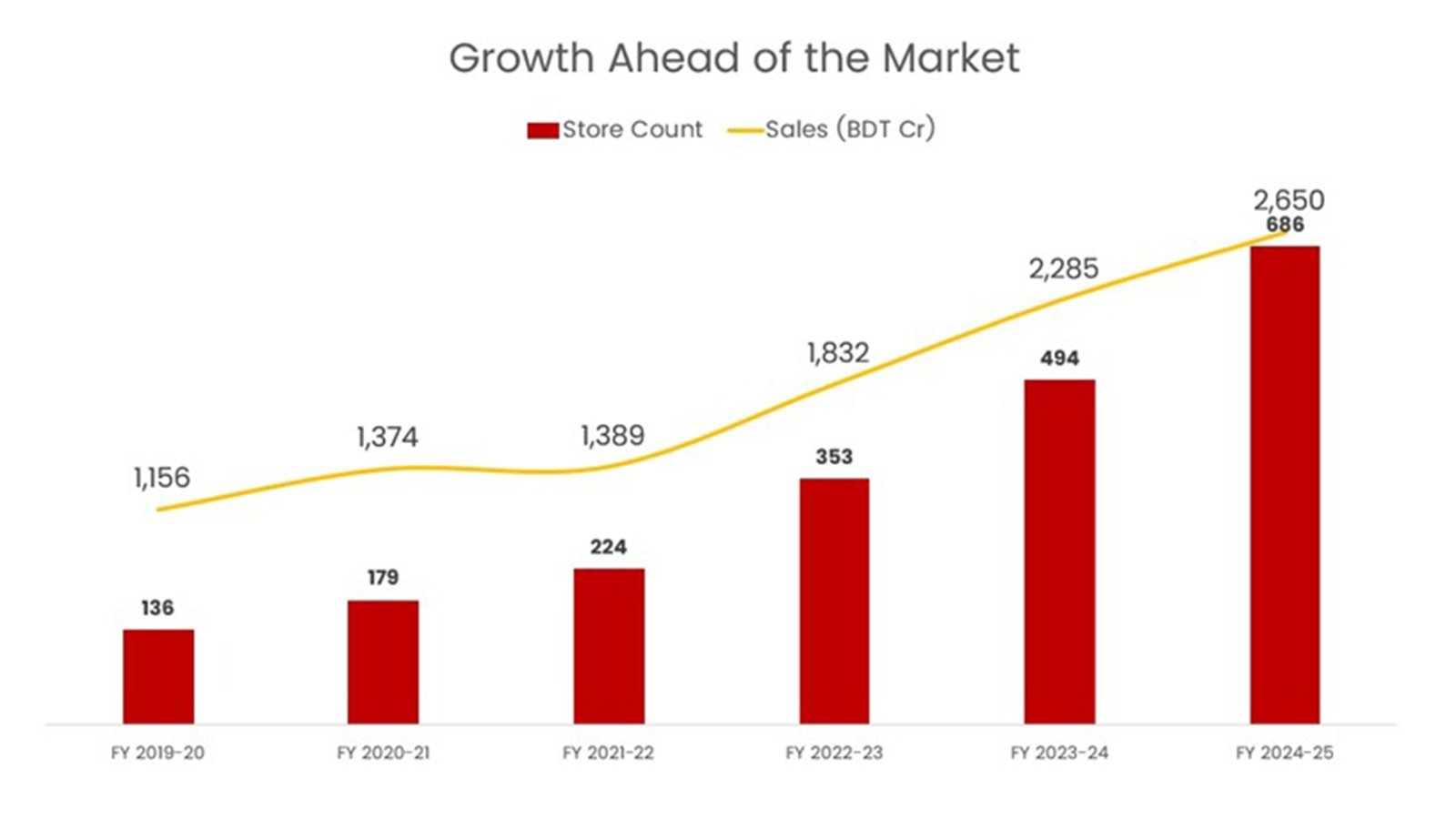
According to company officials, the company achieved a compound annual growth rate of around 20 percent over the last twelve-year period, surpassing the growth of the broader grocery market. Sales reached approximately Tk 2,650 crore in FY 2024–25, demonstrating the company’s ability to sustain growth despite inflationary pressures and evolving consumer spending patterns.
The company believes its performance reflects its deep understanding of evolving consumer trends and value chain.
More households are prioritising convenience. Consumers are becoming more conscious about food safety and product authenticity. Many are also willing to shift from traditional markets to organised retail if they see clear value in quality, assortment, price and service.
Yet organised retail still accounts for only a small portion of Bangladesh’s total grocery market. Traditional channels continue to dominate consumer spending, leaving significant room for growth.
For Shwapno, its vision is therefore linked to a larger transformation in how grocery retail may evolve over the next decade.
Expansion through local entrepreneurship
Shwapno is now preparing for its next phase of expansion, with plans to cover a significant section of the overall market.
A major driver of this growth will be the company’s continuous innovation in its business model.
Under the existing franchisee model, local entrepreneurs invest in store infrastructure while gaining access to Shwapno’s working capital, store management, brand, sourcing network, technology systems, product assortment, and operating standards.
Executives say the approach can help create a new generation of retail entrepreneurs while generating local employment and bringing structured grocery services into more neighbourhoods.
For entrepreneurs, the model offers an opportunity to participate in formal retail with the support of an established platform. For consumers, it brings greater access to organised shopping. For the broader economy, it supports the gradual formalisation of retail activity.
A strategic partner, not just a financier
Shwapno executives describe Mitsui not simply as a financial investor, but as a strategic partner.
For around two years, teams from both organisations have worked with deep collaboration.
The partnership covers technology, governance, and accountability.
As one of the world’s leading trading and investment companies, Mitsui brings global experience in sourcing, logistics, business systems and international partnerships. That experience could help Shwapno strengthen its operating model as it scales across Bangladesh.
The timing is important.
As Shwapno expands, scale alone will not be enough. Managing a nationwide retail network requires stronger systems, better forecasting, disciplined logistics, cold-chain infrastructure and deeper technology integration. These are areas where strategic knowledge can be as valuable as capital.
Investing behind the storefront
For shoppers, retail is experienced through aisles, shelves, checkout counters and delivery service. But the strength of a modern retail chain is often determined by what customers do not see.
Warehouses, distribution centres, cold-storage facilities, transport systems, demand planning tools, inventory platforms and quality-control processes decide whether products reach stores fresh, available and competitively priced.
As Shwapno moves into more locations, investment in these capabilities becomes increasingly important.
Fish, meat, fruits, vegetables, dairy and frozen products all depend on reliable cold-chain and logistics infrastructure. Maintaining consistent quality across a nationwide network requires disciplined systems and continuous improvement.
Executives say part of the support enabled by the Mitsui partnership will go into strengthening these areas, with the objective of maintaining service consistency across markets outside Dhaka as well as inside the capital.
Reducing financial pressure
The partnership also addresses a challenge common to many rapidly growing businesses.
Shwapno has invested heavily in expansion, supply chain, store infrastructure and technology over the years. While operating performance has improved, financing costs have remained a pressure point.
The lower-cost financing provided through the Mitsui agreement is expected to help ease that burden.
Management believes this will allow more resources to be directed toward customer service, logistics, technology, sourcing, farmer development and future expansion.
In that sense, the financial structure of the partnership could eventually translate into better operating capability and stronger service delivery.
A signal for Bangladesh’s consumer economy
For Mitsui, the partnership represents a confident and foresightful step into Bangladesh’s growing consumer market.
For Shwapno, it brings capital, credibility and strategic expertise at a time when the company is entering its most deliberate phase of expansion.
For consumers, the impact could be more visible through improved access to everyday essentials, better product availability and stronger quality standards. For farmers, the opportunity lies in deeper integration with a structured retail platform that values quality, traceability and better agricultural practices. For entrepreneurs, the franchise model can open new pathways into formal retail.
More broadly, the partnership signals that international investors are beginning to recognise the long-term potential of organised grocery retail in Bangladesh.
Shwapno’s present trend and vision attract attention, but the strategy behind it remains grounded in execution: strengthen the supply chain, in a disciplined way.
If Shwapno succeeds, its next phase of growth will not be measured only by revenue, store count or valuation.
It will also be measured by how effectively it helps modern retail reach more communities, improves the connection between farmers and consumers, and contributes to a stronger grocery ecosystem for Bangladesh.
That is the deeper promise at the heart of the Mitsui partnership: not just a larger retail chain, but a more dependable, inclusive and modern food retail network serving millions of households across the country.


Comments