


Before the monsoon had a name
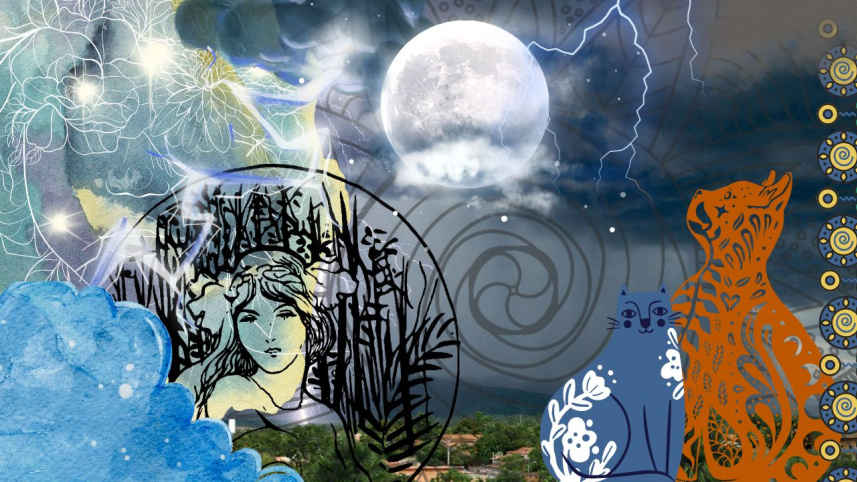
There is something unmistakable about the hour before rain, an unease so familiar that it feels almost inherited. Over the last few evenings, the downpour has battered our balconies while the fragile glass windows rattled in sudden bursts, making all of us look up at once.
When I was younger, I would wait for days like these with a kind of breathless excitement. My cousins and I would run out with buckets to collect the first hailstones, laughing as they bounced off the floor and stung our fingers with their tiny, icy weight. To my five-year-old self, they felt like strange little creatures dropped from another world, cold and impossible to hold for long before they slipped back into the water. I remember standing there with wet hair stuck to my forehead and my hands turning numb, wondering where the hails had come from and how the sky could hide such things inside it. At times like these, even the earth smells different as the dust begins to loosen itself. Perhaps that is why the coming of the rains has gathered so many stories around itself.

In Vietnamese folklore, the waters come with a grievance. The legend of Sơn Tinh and Thủy Tinh unfolds in a royal court, where Princess Mỵ Nương stands at the centre of a contest between two extraordinary suitors, the mountain lord Sơn Tinh and the water lord Thủy Tinh. The king declares that whoever brings the required bridal gifts first will marry his daughter. Some of those gifts are telling in themselves: a nine-tusked elephant, a nine-spurred rooster, and a nine-maned horse, treasures of the land rather than the sea. The game, in a sense, is rigged from the start. Sơn Tinh arrives on time. Thủy Tinh does not. It is a painfully human beginning for something so catastrophic.
One suitor is late, and suddenly the land must bear the consequences of his wounded pride. Thủy Tinh returns not with acceptance, but with thunder. Rivers swell past their banks. Rain lashes down. Water climbs over the land as though humiliation itself has learned how to flood. Against him, Sơn Tinh raises the mountains higher and higher, straining the earth upward in resistance. In many tellings, the legend has long been read alongside the yearly flooding of the Red River Delta, where generations of Vietnamese communities-built dikes against the waters as though reenacting Sơn Tinh’s own defence of the land.
The Kerala folklore surrounding rain is marked with a different kind of ache. In the old kingdoms of Chera, Chola, and Pandya, the soil is split with cracks, and the fields are exhausted. Hunger is never far from such a sky. The rival kings, known as the Muventar, were forced to set aside their wars and perform a collective penance to Indra, the God of Rain. When Indra finally answered, he granted each king four months of rain per year. The Chera king felt he needed more rain for his mountainous and forested terrain, while the Chola and Pandya kings felt four months was too much for their flatter lands. They returned to Indra, who allowed the Chola and Pandya kings to give two months of their rain each to the Chera king. As a result, the Chera kingdom, modern-day Kerala, received eight months of rain, while the Chola and Pandya kingdoms were left with two months each. The story feels compelling because it rises from the land itself. Kerala receives the first force of the southwest monsoon along the slopes of the Western Ghats, while regions farther inland remain much drier in their rain shadow.
If this story teaches us how closely monsoon is tied to need, the southern African folktale of “Rain and her Son” shows how quickly weather can turn personal. Rain is imagined as a woman who wears the rainbow as a girdle around her waist. She is married to Flame, the creator of the earth, and together they have three daughters and a son, Son-eib. When the eldest daughter goes down to the mortal world, falls in love, and chooses to remain there, Rain grows fearful of losing the others, too. So, when the younger children ask to travel the earth, they are sent under the watch of Hyena, who promises to guard them.
But Hyena is treacherous. Desiring the daughters for himself, he gathers the wicked people of a village and has the hut where Son-eib sleeps set on fire. Before the flames consume him, the boy releases a little red bird he had hidden under his cloak, and it flies upward carrying the news back to Rain.
The narrative of Manu and Matsya in Hindu mythology carries water into an even larger register, moving beyond monsoon into the realm of the mythic flood. The story begins almost quietly, with a small fish, the sort of creature one could easily overlook. Manu saves it. In return, the fish warns him that a flood is coming, one vast enough to destroy all life, and instructs him to build a vessel large enough to carry the seeds of life and the Saptarishi, so that even as the world drowned, the primordial sounds of the Vedas would remain sheltered within its hull. In Hindu tradition, the fish is understood as Matsya, an avatar of Vishnu. When the deluge comes, Manu fastens the boat to the fish’s horn and is guided through the waters while the world disappears beneath him. In later and fuller narrations, the serpent Vasuki serves as the tether, and when the waters finally recede, it comes to rest upon the Himalayas, the high roof of the world.
Placed beside one another, these folktales do not offer one neat answer to the coming of the rains. That is perhaps what makes the stories feel so real whenever monsoon draws near. The season itself is never one thing. For some, rain means relief, the first cool breath after weeks of suffocating heat, the permission to sleep without feeling the day still clinging to the walls. For others, it means dread. Roads disappear. Homes flood. Journeys turn fatal. A shower that sends one child running laughing to the balcony may be falling, at that same hour, over a ferry that has already taken lives.
Agnila Roy is a contributor.
 For all latest news, follow The Daily Star's Google News channel.
Comments