


The capacity-competence disconnect in Bangladesh's power sector

Somewhere in Bangladesh, a power plant stands ready to run but sits idle anyway. On most days, it remains offline not because fuel is scarce, but because of a commercial stalemate: decision-makers with dispatch authority lack the expertise to balance operational costs against a mounting revenue deficit. Recent fuel shortage is compounding the picture further as households endure hours of load-shedding while capacity payments accumulate. Either way, the turbines stay silent. This is symptomatic of systemic dysfunction.
Since 2009, installed generation capacity has grown from under 5,000MW to more than 30,000MW in 2025, and electricity access expanded from 47 percent of the population to over 99 percent. Yet, the reserve margin now stands at around 61.3 percent. Per a simplistic calculation, more than half of installed capacity draws capacity payments while generating nothing on a given day. Average unit generation cost has reached roughly Tk 12.35 against a bulk tariff of around Tk 6.63. Annual losses of Bangladesh Power Development Board (BPDB) rose from Tk 5,468 crore in FY2015 to Tk 50,565 crore in FY2025. Between FY2020 and FY2024, the resulting subsidies totalled Tk 1,26,700 crore. A government review found that capacity increased fourfold over the last 15 years while costs jumped elevenfold. Meanwhile, merit-order dispatch—that is, the basic principle of running cheaper plants first—is not consistently applied.

Bangladesh has poured billions into infrastructure, but this investment has not been matched by commitment to the human capital and governance frameworks essential for operational success. The Integrated Energy and Power Master Plan (IEPMP) 2023 maps a future that includes the Rooppur Nuclear Power Plant (RNPP), ultra-supercritical coal technology, and a massive scale-up of renewable energy. Each of these demands a qualitatively different capability, engineers who understand nuclear safety, grid integration of variable renewables, Supervisory Control and Data Acquisition (SCADA) and smart grid operations, and high-voltage systems. Above all, we need leaders who can outmanoeuvre political pressure with commercial logic. Shallow knowledge of energy economics, power purchase agreements (PPAs), and the regulatory framework risks locking the sector into contracts it cannot afford for decades.
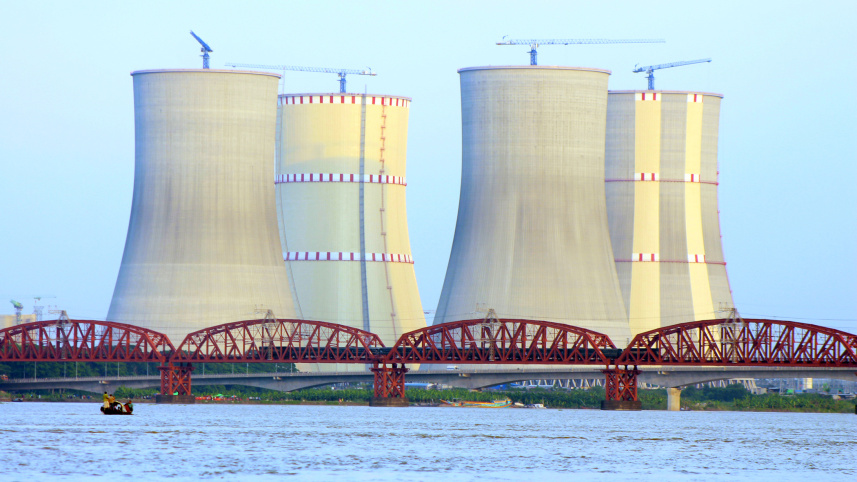
The clearest illustration of the competency gap is the 2,400MW RNPP project, financed largely by a $11.38 billion Russian loan. Its first unit secured a commissioning licence for fuel loading this month (which started on yesterday), marking a critical step towards operational readiness. However, a licence is not a substitute for local competency. It requires at least 1,600 trained engineers for safe long-term operation. Despite 1,000 personnel being trained since 2019 and ongoing specialised training, Bangladesh will remain heavily dependent on Russian engineers for the initial years of operation. This gap will reflect a heavy cost on operating margins, safety accountability, and strategic leverage that all remain, for now, in foreign hands.
However, Bangladesh Power Management Institute (BPMI) does act as the sector’s apex training body, offering programmes in power system planning, load flow analysis, PPA training and, more recently, solar PV project development and wind energy feasibility. A joint ADB-government-financed Power Sector Capacity Development Program (2007-2014) trained over 4,400 professionals and sent 335 personnel to the Asian Institute of Technology in Bangkok. The BPDB maintains its own training directorate, and the Sustainable And Renewable Energy Development Authority (SREDA) carries an explicit training mandate for the renewable energy transition.
But these are disconnected parts rather than a cohesive system synchronised for performance. BPMI operates from a rented facility in Purbachal, while its permanent 25-acre campus in Keraniganj remains unbuilt. With a workforce of tens of thousands, the BPDB finds its Training Directorate’s internal “on-site” capacity stretched thin. The ADB programme ended in 2014 and was never succeeded by a sustained equivalent. And SREDA lacks the institutional capacity to fulfil its own mandate, let alone an expanded one for renewable transition demands.
In contrast, India’s National Power Training Institute (NPTI), for example, has trained over 470,000 professionals across 11 regional centres, spanning smart grids, SCADA, thermal, hydro, renewable energy, and regulatory affairs. What separates NPTI from BPMI is not ambition but structure. Success at NPTI, South Korea’s KEPCO, or Malaysia’s Tenaga Nasional were built on consistent funding and the institutional independence to attract top-tier experts. They treated competency as a prerequisite for success, not a reward for it. Even as BPMI launches a new Renewable Energy Training Facility with German support, the core truth remains: we cannot govern what we have not mastered.
The solution lies in mobilising existing institutions, not creating new ones. BPMI must break ground in Keraniganj and fast-track the campus to full functionality under leadership with deep engineering credentials and a board that bridges public and private expertise. To meet the sector’s needs, annual training must scale up from a few thousand to tens of thousands. While the NPTI took five decades to train 470,000 professionals in India, Bangladesh lacks the luxury of time; our investment must be faster and far more aggressive. Furthermore, BPMI must establish a state-of-the-art laboratory to drive world-class training, testing, and research and development.
We must consolidate BPMI, the BPDB training directorate, SREDA, and Power Cell into a national framework rewarding competence over seniority. Certification for everyone, from operators to controllers, should be based on verifiable exams rather than mere attendance. Real gains happen when the system rewards measurable outcomes, not just time spent in a classroom.
It should also be noted that financial haemorrhaging starts at the top. The massive subsidy burden reflects mismanagement via opaque contracts and unchecked demand forecasts made without sound financial analysis. To mitigate this, we must equip a new generation of leaders with regulatory and contractual expertise required for the domestic market.
Bangladesh’s achievement of universal electrification in a single generation is remarkable. Yet, despite established institutions like BPMI and SREDA, the sector faces a stark reality: wholesale losses exceeding Tk 3 per unit, a 61.3 percent reserve margin coupled with persistent load-shedding, and a continued reliance on foreign expertise for its first nuclear plant. These factors signal a gap between our institutional frameworks and operational realities.
The country’s energy story is shifting from a race for megawatts to a quest for competence. The mission is no longer simply to build but to manage, negotiate and optimise. Since the country’s ability to construct at scale has been proven, the test now is whether it has the determination to govern too.
Dr Sabbir Ahmad is a researcher and expert in project delivery and engineering. He can be reached at sabbir@ieee.org.
Views expressed in this article are the author's own.
Follow The Daily Star Opinion on Facebook for the latest opinions, commentaries, and analyses by experts and professionals. To contribute your article or letter to The Daily Star Opinion, see our guidelines for submission.
 For all latest news, follow The Daily Star's Google News channel.
Comments