


Why FIFA's plan backfired and what it could mean for Infantino
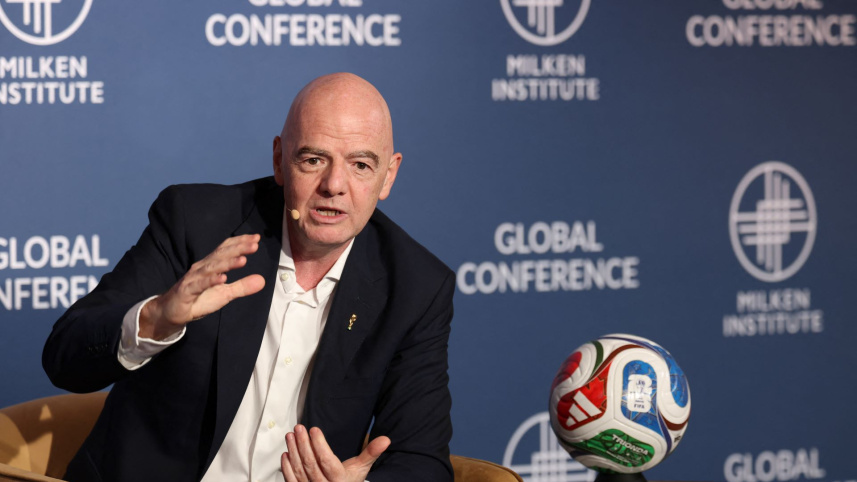
After causing a few days of uproar in the footballing community, FIFA president Gianni Infantino on Saturday scrapped the plan to sell stakes to private investors in FIFA-run events, including the World Cup.
But why did Infantino, who even a day earlier had vowed to press ahead with an "open and democratic" consultation with stakeholders, have to abandon it?

The answer lies in how quickly football's power brokers united against what many saw as the biggest structural change to the sport in decades. What began as an ambitious financial project soon turned into a political crisis that left Infantino increasingly isolated, forcing one of the most dramatic U-turns of his presidency.
At the heart of the controversy was what the core of FIFA’s plan entailed: the creation of a subsidiary named the FIFA Forward Enterprise (FFE), a new entity that would manage the commercial aspects of FIFA's flagship competitions, including the men's and women's World Cups, the Club World Cup, and other global events. FIFA planned to sell around a 20 percent minority stake in the venture to long-term private investors, valuing the FFE at roughly $20 billion while raising $4.2 billion by the end of this year.
In return, FIFA promised each of its 211 member associations an immediate payment of $20 million in early 2027, with the figure potentially rising to $40 million by the end of the 2030 cycle. Infantino even set a deadline of September 19 for member associations to come aboard.
The 56-year-old repeatedly insisted the proposal would unlock unprecedented financial support for football development while ensuring FIFA retained control through a non-controlling share sale.
Instead, it triggered a rebellion.
The fiercest resistance came from Europe, where UEFA and all 55 of its member associations threatened to boycott the World Cup if the governing body proceeded with the proposal.
CONCACAF's 41 member associations later unanimously rejected the plan, while the Asian Football Confederation (AFC) publicly aligned itself with UEFA and CONCACAF, saying it shared their serious concerns.
Even the Confederation of African Football (CAF), traditionally regarded as one of Infantino's strongest allies, stopped short of endorsing the proposal and instead urged its members to study it carefully.
The backlash extended beyond football administrators. British Prime Minister Andy Burnham accused FIFA of trying to hand football over to investors and later declared Infantino was "the wrong man" to lead the world governing body, adding further political pressure to an already growing storm.
The European opposition proved particularly damaging because UEFA's influence goes deeper. Europe's clubs and national teams dominate FIFA's marquee competitions like the World Cup and the Club World Cup, which generate the governing body's biggest revenues. Many feared that bringing in private equity investors would inevitably create pressure for even larger tournaments and an ever-expanding match calendar to maximise commercial returns.
For Europe's football ecosystem, that risk looked too damaging. More FIFA matches could threaten the value of domestic leagues and UEFA competitions, particularly the Champions League, while stretching an already congested calendar that has pushed elite players close to their physical limits. With broadcasters and sponsors already investing heavily across multiple competitions, many believed football's commercial growth had natural limits that private investors might not accept.
The proposal's political foundations weakened even further when doubts began emerging from inside FIFA itself.
Carlos Cordeiro, Infantino's senior adviser, former US Soccer president and ex-Goldman Sachs banker, resigned in protest after describing FFE as "a bad deal for FIFA's member associations, a bad deal for football, and a bad deal for the long-term future of the game."
That public rebuke was followed by an even more damaging intervention from FIFA Chief Operating Officer Kevin Lamour, who broke ranks by saying the proposal was not a genuine administrative initiative but "the project of one person." Lamour added that many FIFA staff members felt "deceived" by the way the project had been handled.
Those comments painted the picture of a president who had not only lost the confidence of major confederations but was also facing dissent within FIFA's own corridors of power.
US President Donald Trump's name also surfaced after The Times, which broke the news, reported that potential investors included Joshua Kushner -- brother of Trump's son-in-law Jared Kushner -- and an arm of JP Morgan Chase, the US bank that previously financed the failed European Super League project. Trump, however, dismissed suggestions of any involvement, saying on Friday that he had never held discussions with Infantino over the proposal.
The collapse of FFE could now carry consequences well beyond one failed commercial project.
FIFA's next presidential election is scheduled for March 19, 2027, in Rabat, Morocco. After being elected in 2016 and re-elected unopposed in both 2019 and 2023, FIFA's statutes allow Infantino to seek one final four-year term. However, the FFE proposal had also been viewed by many observers as a potential platform that could have given him an influential commissioner-style role over FIFA's commercial empire even beyond the end of his presidency in 2031.
 For all latest news, follow The Daily Star's Google News channel.
 More immediately, the episode risks reshaping the electoral arithmetic. A candidate would need a majority of FIFA's 211 member associations -- about 106 votes -- to win a contested election. While confederations rarely vote as unified blocs, alienating much of UEFA, CONCACAF, and AFC significantly complicates the political landscape for Infantino after years of consolidating support across world football.
The changing mood could also encourage challengers. AFC president Sheikh Salman bin Ebrahim Al Khalifa, who was only narrowly defeated by Infantino in the 2016 FIFA presidential election, was among the strongest critics of the proposal. Calling the lack of consultation "totally unacceptable", Sheikh Salman argued that a decision of such magnitude undermined football's global foundations. With candidates able to enter the presidential race until November 18, his criticism has inevitably fuelled speculation that he could once again emerge as a contender.
For now, Infantino has abandoned the proposal, acknowledging that the divisions it created had become greater than the “interest of the objective set out in the first place”. Yet the damage may already have been done.
FFE was conceived as a plan to secure football's financial future. But what began as an ambitious attempt to unlock billions for football's future ultimately ended as a bruising setback for Infantino. With the next FIFA election now looming, the fallout from FFE could shape not only his bid for another term but also the direction of football's global governance.
Comments