


The march of the microfascist

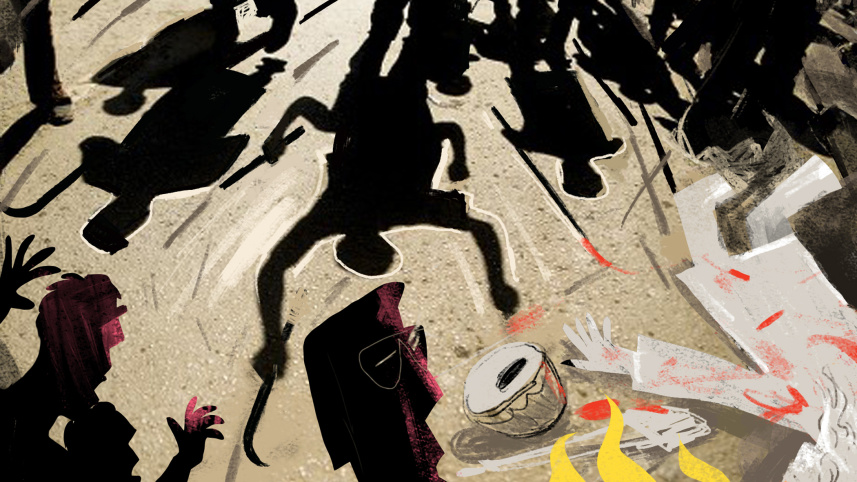
In Shahbagh, a group of friends sat at a tea stall on an otherwise unremarkable evening on April 10, somewhere between the rhythms of the city and the anticipatory hum of Pahela Baishakh. They were not doing anything that could be described as public controversy. They were, by all available accounts, simply there. Visible, perhaps in ways that rendered them legible to others as something else. That, it turns out, was sufficient.
A crowd gathered under the banner of “Azadi Andolon.” The slogans, each more incendiary than the other, left little room for ambiguity, and the sequence that followed was equally precise: identification, labelling, escalation, and then, almost predictably, assault. The violence was filmed, amplified, encouraged, and crucially, unimpeded in the immediate sense that matters—within a few yards of the Shahbagh Police Station.
 For all latest news, follow The Daily Star's Google News channel.
 The following day, in Kushtia, a Sufi pir was killed within the confines of his own dargah after the circulation of an old video, apparently for hurting religious sentiments. Here, too, there was police presence as well as a prior warning. Here, too, the line between anticipation and prevention proved to be more porous than one might expect from a state that continues to insist upon its authority.
There is something distinctly uncomfortable about how quickly all of this begins to feel familiar. Each new case appears to follow a pattern we have already seen, already debated, and, in some sense, already accommodated.
For years now, accusations of “hurting religious sentiments” have acted as a volatile currency in Bangladesh’s public sphere. The legal architecture surrounding such claims—especially the broad and ambiguously worded provisions of laws like the former Digital Security Act—has ensured that offence remains both subjective and actionable. One does not need to prove actual harm so much as simply claim it.
Under the Sheikh Hasina government, this elasticity was repeatedly weaponised. Teachers, students, performers, and ordinary citizens were drawn into legal and extralegal processes on the basis of claims that were often unverifiable, and almost always amplified. As of early 2024, approximately 528 cases had been filed under the DSA specifically for offenses related to “hurting religious sentiments,” according to data from the Centre for Governance Studies. Of course, no one ever quite figured out what hurting religious sentiment actually entailed. But with each case, a certain logic took hold—that the assertion of offence, particularly when aligned with majoritarian sentiment, could justify both state action and public hostility. Those accused were as likely to be “protected” through detention as they were to be prosecuted, while those mobilising outrage operated with far less scrutiny. From Ramu to Nasirnagar to Muradnagar, we saw entire communities being attacked on the basis of fabricated claims, their homes burnt or ransacked. Over time, the threshold for injury lowered, while the range of permissible responses expanded without meaningful containment.
Then came the post-uprising interim period, where we saw a disturbing revival of coercive orthodoxy. The interim government allowed, if not actively enabled, ultra-conservative forces to expand their reach and redraw the boundaries of what could be done in public view, often through the convenient alignment of religion and populist sentiment. Those who had previously operated with a degree of caution began to move with increasing confidence, carrying out their own forms of sovereign justice in broad daylight, at times with announcement of prior intent.
It is hard to forget how Dipu Chandra Das, accused of insulting the Prophet, was framed and later beaten mercilessly through the streets, hauled for over a kilometre, tied to a tree upside down on a busy highway, and set alight before a cheering crowd. Or how, in Rajbari, the grave of Nurul Haque—known locally as “Nurul Pagla”—was dug up, his remains exhumed and burned in public, an act the violence of which extended beyond the body to the very idea of sanctity. In Cumilla’s Homna upazila, multiple shrines—those of Kafil Uddin Shah, Abdu Shah, Kalai Shah, Hawali Shah—were attacked in a single village last September.
Between August 29, 2024, and April 11 this year, more than a hundred mazars and shrines across the country were attacked, vandalised, or looted, according to findings by the Human Rights Support Society (HRSS). Meanwhile, at least 197 people were killed in incidents described as mob violence in 2025, up from 128 the year before. By the interim government’s own admission, there were at least 46 incidents of temple-related violence. Dozens of cultural festivals were cancelled under duress, to say nothing of the countless daily acts of harassment that rarely entered official records. Entire communities (the “others”) began to anticipate violence as part of ordinary public life. Anytime people protested such acts, they were met with a familiar accusation—disloyalty to the uprising, foreign allegiance, or the charge of being “India’s dalal”—a discursive move that shifted attention away from violence and onto the supposed impurity of those who objected to it.
Then came the BNP government which, in its first week, proclaimed it would stop “mob” violence, terming the interim government as “weak” for having failed to do so.The attacks last week were allowed to unfold under the government’s watch, raising a question that cannot be deferred indefinitely: does the problem lie only in what was inherited, or also in how it continues to be handled?
These incidents mark the rise of a new politics—one where small men with clubs decide, in full view, who may pray, who may sing, who may sit at a tea stall, and who is allowed to belong. These incidents, in effect, are coordinated interventions into our socio-cultural landscape, revealing a decided shift (long in the making, of course, long before August 2024) from a society of syncretic coexistence to one where microfascists patrol the boundaries of belonging.
By calling such incidents “mob” violence, we miss their social and political character. A mob suggests spontaneity, excess, or a temporary breakdown of order. But what we are witnessing is far more durable and insidious: the production and proliferation of the microfascist. He is an intimate executor of a wider moral order now taking shape in plain view.
Microfascism does not necessarily operate through a centralised ideological project, nor does it require formal alignment with any singular doctrine. It takes shape through repeated dispersed acts that gradually realign sentiment, with religion providing both the language of justification and the terrain upon which authority is exercised. The result resembles, in effect, a vernacular form of authoritarianism—less concerned with doctrinal coherence than with regulating behaviour and disciplining difference, narrowing the space within which alternative ways of being can exist.
Ending impunity for the crimes committed against communities remains urgent, of course, and the government must, at long last, take exemplary action against those who incite and carry out such attacks. But the task runs deeper than enforcement alone. We are confronting a broader transformation, in which the pluralistic, improvisational textures of daily life are steadily giving way to something narrower and more punitive: the everyday social instinct to police the other. We need to understand microfascism as a method that is absorbed into ordinary life, enacted in small acts, until it no longer appears exceptional at all. And confronting it requires, above all, a reckoning with the microfascist within.
Sushmita S Preetha is a writer, researcher, and organiser.
Views expressed in this article are the author's own.
Follow The Daily Star Opinion on Facebook for the latest opinions, commentaries, and analyses by experts and professionals. To contribute your article or letter to The Daily Star Opinion, see our guidelines for submission.
Comments