


Bangladesh races for urea supply bypassing Hormuz

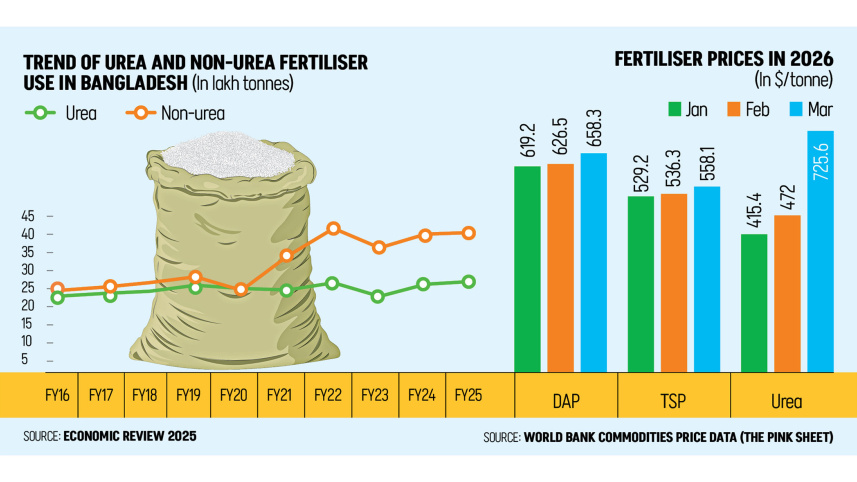
Bangladesh is scrambling to secure urea imports after an international tender floated last month failed to attract any bidders, with the Aman paddy, the country’s second-largest rice crop, due for planting in June.
Authorities met Russian representatives yesterday to explore a government-to-government deal. At the same time, Dhaka is approaching nearby producers such as Brunei, as well as more distant and less conventional suppliers, including Latvia and Ukraine.


The government has also asked Saudi Arabia, a regular supplier, to consider alternative shipping routes.
Since the US-Israel war on Iran on February 28, the Strait of Hormuz -- a key artery for global fertiliser trade -- remains closed. It disrupts flows, accounting for roughly 30 percent of global fertiliser shipments.
Requesting anonymity, a senior official at the state-run Bangladesh Chemical Industries Corporation (BCIC), said they are currently in discussions with Russia, Latvia, Brunei, and Ukraine to secure imports.
“We are looking to get the fertiliser from these countries as they can ship using routes bypassing the Strait of Hormuz,” he said.
After a meeting with Russian representatives yesterday, he said Moscow is expected to submit a formal proposal soon.
The urgency follows the shutdown of five of the country’s six urea factories because of gas supply concerns after the US-Israel war on Iran. The conflict has reverberated across the Middle East, a crucial hub for fertiliser exports and for natural gas used in domestic production.
Bangladesh needs more than 26 lakh tonnes of urea each year. About three-quarters of demand is met through imports, as local plants often operate below capacity when gas is diverted to other sectors.
Current stocks stand at around 300,000 tonnes, enough to meet demand until June. BCIC previously said it was working to build reserves to cover requirements in the second half of the year.
Saudi Arabia, the United Arab Emirates and Qatar are Bangladesh’s main suppliers, providing nearly 10 lakh tonnes annually. Since the war broke out, major producers in Qatar and Saudi Arabia declared force majeure and temporarily halted production.
In response to the US-Israel attack, Iran’s closure of the Strait of Hormuz has compounded supply disruptions, pushing up the cost of fertiliser and the natural gas used to produce it.
According to the World Bank’s latest commodity price data, urea prices have jumped by more than 50 percent compared with levels before the war began on February 28. The average price rose to $725.6 a tonne in March from $472 earlier.
Prices of other fertilisers, including diammonium phosphate (DAP) and triple superphosphate (TSP), have also surged.
In March, as prices climbed and the planting season drew closer, BCIC floated a tender to import 200,000 tonnes of urea. As it failed to attract any offers, a second tender is now underway with the closing deadline on Thursday this week.
Contacted, BCIC Chairman Md Fazlur Rahman said Saudi Arabia has agreed to supply 40,000 tonnes, but the shipment has yet to arrive because of the disruption in Hormuz.
“So, we have requested them to see whether the fertiliser could be shipped via alternative ports that would avoid the Strait of Hormuz and ensure delivery to Bangladesh,” he said.
Rahman said prices rose to $785-$786 a tonne last week and have climbed above $800 this week.
He said that higher prices would swell the subsidy bill, as the government provides urea and other key fertilisers such as DAP and TSP to farmers to ensure food production.
 For all latest news, follow The Daily Star's Google News channel.
 The government has set aside Tk 17,000 crore for fertiliser subsidies in the current fiscal year. Officials expect that figure to exceed Tk 30,000 crore next year if prices remain elevated.
Rahman said efforts are underway to restart factories closed because of gas shortages. “At present, the situation is quite complex and uncertain. We are making every possible effort to overcome this crisis.”
A blog published last week by the International Food Policy Research Institute said that rice production in countries, including Bangladesh, could suffer if fertiliser supplies remain disrupted.
“Rice is fertiliser-intensive and concentrated in South and Southeast Asia, regions heavily dependent on Gulf urea imports. India, Pakistan, Bangladesh, and much of Southeast Asia source a significant share of their nitrogen fertiliser from Gulf producers,” the authors wrote.
“If higher fertiliser costs persist into the second half of 2026 and coincide with an El Niño event, rice-producing regions could face both rising input costs and less favourable growing conditions at the same time,” it mentioned.
Comments