


Export rebound sputters out with 7% fall in May

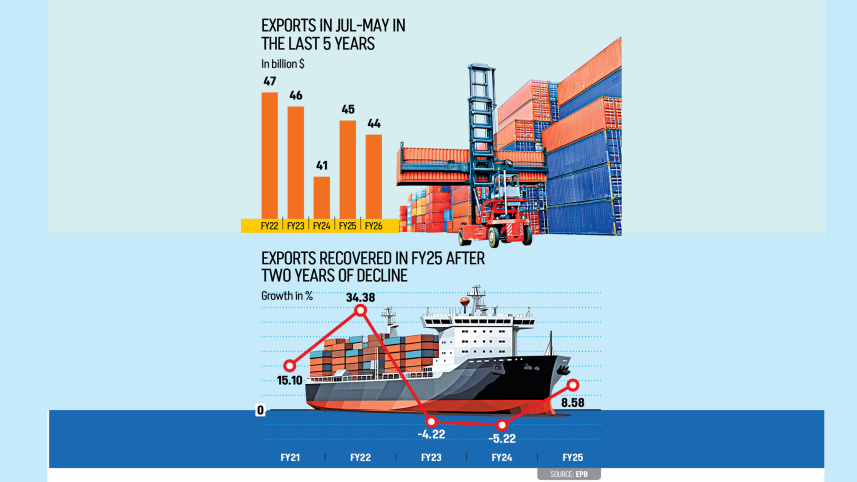
After a brief recovery in April, exports returned to a year-on-year decline last month, according to official data, as weak demand for apparel in key markets and lower order volumes from Western buyers weighed on earnings.
With merchandise exports dropping in May, overall shipments in the first 11 months of the current fiscal year also fell compared with the same period a year earlier.

Amid mounting external pressures largely caused by the war in the Gulf, exporters say a prolonged slowdown could put pressure on the country’s foreign exchange inflows and overall economic growth.
Meanwhile, with only one month remaining in the fiscal year, economists are questioning whether exports will end FY2025-26 in negative territory, reversing the recovery recorded in FY2024-25 after two consecutive years of decline.
In May, the country’s merchandise exports fell 7 percent year-on-year to $4.40 billion. As a result, exports in the July-May period of FY2025-26 declined 2.60 percent year-on-year to $43.80 billion, according to data released by the Export Promotion Bureau (EPB) yesterday.
The figure was down 2.6 percent from $44.95 billion in the corresponding period of the previous fiscal year, EPB data showed.
“Negative growth in May was expected,” said Mohammed Hatem, president of the Bangladesh Knitwear Manufacturers and Exporters Association (BKMEA).
The readymade garment sector generates more than 80 percent of Bangladesh’s export earnings.
During the first 11 months of FY26, garment exports fell 3.4 percent year-on-year to $35.31 billion. Knitwear exports dropped 4.3 percent to $18.78 billion, while woven garment shipments declined 2.4 percent to $16.53 billion.
The BKMEA president said export orders have remained sluggish for much of FY26 as buyers in major markets continue to place orders cautiously amid global economic uncertainty.
“The global market is still weak, and export orders are lower than expected. That is why the sector is posting negative growth,” Hatem told The Daily Star.
He also pointed to the Eid-ul-Azha holidays, which began in late May and reduced factory working days, affecting production and shipments during the month.
According to Hatem, the strong growth recorded in April was partly due to a favourable comparison with the same month a year earlier, when overall production hours were reduced by Eid holidays.
“This year’s April had more working days, so some growth was natural. But the market situation has not improved significantly,” he said.
Hatem said the apparel sector has been under pressure throughout the fiscal year and there are few signs of a sharp recovery in the coming months. “We do not see any strong indication that orders will rebound significantly in the near future.”
He added that a prolonged weakness in exports could put pressure on the country’s foreign exchange inflows and overall economic growth.
In the first 11 months of the current fiscal year, Bangladesh’s terry towel and linen exports fell 14 percent as manufacturers grappled with weak global demand and rising business costs.
M Shahadat Hossain Sohel, president of Bangladesh Terry Towel and Linen Manufacturers and Exporters Association, said the sector was being squeezed by multiple crises, including the lingering impact of the Russia-Ukraine war, conflicts across the Middle East and an inflation-driven slowdown in demand in key markets such as Europe and the United States.
He said many small and medium-sized factories had shut down since the pandemic, while larger firms were surviving largely on bank financing rather than profits.
Sohel also blamed soaring production costs, unreliable gas and power supplies, and a difficult business environment for eroding competitiveness.
 For all latest news, follow The Daily Star's Google News channel.
 According to him, without stronger policy support, similar to incentives offered by India to its textile sector, Bangladesh could lose further ground in global markets.
Abdur Razzaque, chairman of Research and Policy Integration for Development (RAPID), said it was still too early to conclude whether Bangladesh’s exports would end the fiscal year in negative territory, as one month remained.
“However, export growth is unlikely to improve significantly,” he said.
Razzaque said the prolonged weakness in exports was already affecting investment and the labour market. If exports fail to recover quickly, the adverse effects could persist for a longer period.
Citing data from the Bangladesh Bureau of Statistics (BBS), he said the country had been facing labour market challenges for the past two years, making a near-term recovery unlikely.
As Bangladesh’s exports are heavily concentrated in the readymade garment sector, any slowdown in apparel shipments has ripple effects across the broader economy, including backward linkage industries, said the economist.
Comments