


Are you aware of the hidden cost of writing on banknotes?

A friend recently received a Tk 500 note from a coffee shop after drinking coffee there. On it, written in blue ink directly across a security feature was the number "100." It appeared to be a marking made by a bank or a business for accounting purposes. A few days later, another friend received a banknote with a neatly written two-line poem. On other occasions, many of my acquaintances received notes covered with arithmetic addition, subtraction, multiplication, and division, as if the currency had been used as scratch paper.
These incidents may seem amusing. But how we treat our national currency is not. It reflects a broader issue of civic responsibility, financial culture, and respect for public property. A banknote belongs to the nation and circulates from one person to another. The note in your wallet today may be used tomorrow by a street vendor, a garment worker, a schoolteacher, or a farmer. Every unnecessary mark placed on it affects millions of transactions throughout its lifetime.

In Bangladesh, it is remarkably common to find banknotes covered with names, phone numbers, signatures, business calculations, seals, religious words, and random doodles. In contrast, such practices are relatively rare in many other countries, including neighbouring India, Singapore, Japan, and much of Europe. Besides stricter regulations, this difference also reflects greater public awareness.
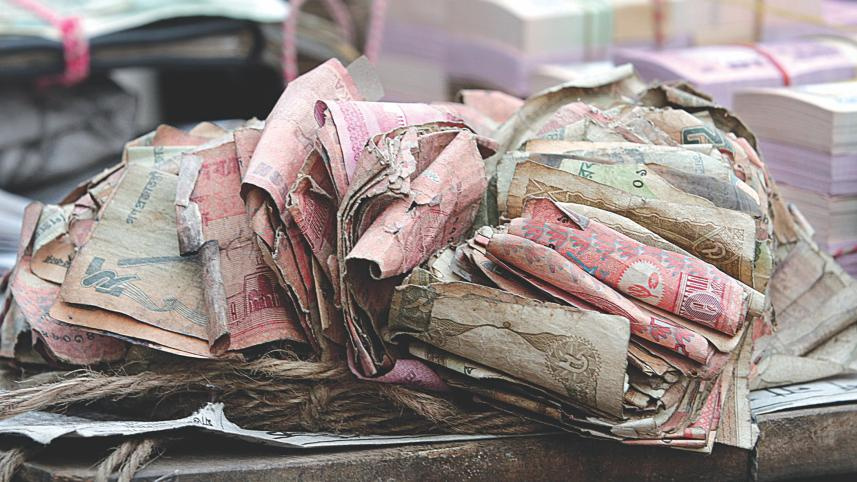
Bangladesh's climate makes the problem worse. The country experiences high humidity for much of the year, accompanied by heavy rainfall during the monsoon. During hot summer months, perspiration alone is often enough to soften paper currency carried in pockets. As banknotes absorb moisture, they become weaker and more vulnerable to tearing. When these already fragile notes are further damaged by writing, folding, stapling, or taping, their lifespan is reduced significantly.
The consequences extend beyond appearance. Every damaged note must eventually be withdrawn from circulation and replaced by a newly printed one. Printing banknotes is expensive. It requires specialised paper, advanced security features, sophisticated printing technology, transportation, storage, and distribution. The shorter the lifespan of banknotes, the more frequently the central bank must replace them, increasing public expenditure borne by taxpayers.
Writing on banknotes also interferes with their security features. Modern Bangladeshi banknotes contain watermarks, security threads, colour-shifting ink, microprinting, latent images, and other anti-counterfeiting technologies. These features help both the public and financial institutions distinguish genuine currency from counterfeit notes. When numbers, stamps, signatures, or ink markings are covered, it becomes more difficult to examine the authenticity of the note. Although writing does not necessarily invalidate a banknote, it can reduce the efficacy of these security measures and complicate counterfeit detection.
Recognising these concerns, Bangladesh Bank instructed scheduled banks in 2021 not to write on banknotes, stamp, or staple them as part of its Clean Note Policy. The objective was straightforward: extend the life of currency, improve cash quality, and reduce unnecessary replacement costs. However, despite these instructions, handwritten markings continue to appear frequently. Even more concerning is the condition of many notes dispensed through ATM booths. Customers often receive soft, worn-out, partially torn, or heavily soiled notes from machines that should ideally distribute clean and fit currency.
This raises an obvious question: why do people keep writing on money? The reasons are surprisingly ordinary. Some shopkeepers write figures to keep track of transactions. Some individuals write names or initials to identify their notes. Others scribble phone numbers, religious phrases, or calculations simply because a pen happens to be in their hand. These habits may appear harmless, but in the digital age there is no practical reason to use a banknote as a notebook.
More importantly, we often take less care of things that belong to everyone than of things we own personally. This can be seen in graffiti on public walls, littering in parks, vandalism on public transport, and, unfortunately, writing on national currency. The contrast is striking. Many people carefully protect a newly purchased smartphone with a cover and screen protector. They avoid even the smallest scratch on their personal possessions. Yet the same individuals may casually write on a banknote without considering that it will circulate through thousands of hands before it is withdrawn. Currency is not disposable paper; it is an essential public asset that facilitates economic activity every single day.
Addressing this issue does not require expensive reforms. It requires changing behaviour. Bangladesh Bank should strongly implement its Clean Note Policy while ensuring that ATM machines dispense clean and durable notes. Commercial banks should strictly prohibit staff from marking currency for internal accounting purposes. Businesses should adopt alternative methods for tracking transactions without using banknotes as writing surfaces. Most importantly, public awareness campaigns should encourage citizens to treat banknotes with care like other valuable national assets.
Small habits often reveal larger values. A nation's development is measured not only by its infrastructure, economic growth, or technological advancement but also by how responsibly its citizens care for shared public resources. A clean, undamaged banknote may seem insignificant, yet well-preserved notes save public money, improve transaction quality, and reflect a culture of responsibility.
A S M Rafad Asgar is research associate at Bangladesh Institute of Governance and Management (BIGM). He can be reached at rafad.asgar@bigm.edu.bd.
Samira Tasnim is research associate at BIGM. She can be reached at samira.tasnim@bigm.edu.bd.
Views expressed in this article are the author's own.
Follow The Daily Star Opinion on Facebook for the latest opinions, commentaries, and analyses by experts and professionals. To contribute your article or letter to The Daily Star Opinion, see our guidelines for submission.
 For all latest news, follow The Daily Star's Google News channel.
Comments