


2026: A year of repair, not miracles

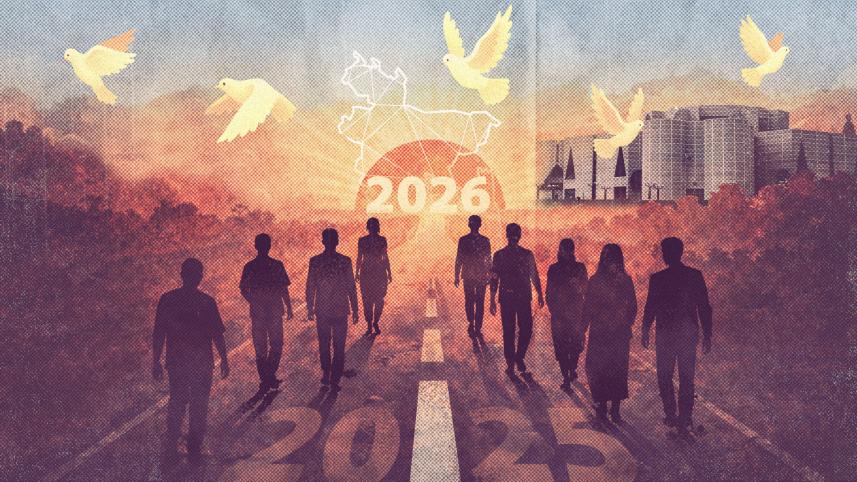
A new year often starts with personal reflection. Each of us reflects on what went wrong, what we endured, and what we hope to change. Every Bangladeshi has their own story of loss, small gains, and ongoing struggles. While I can't relay each individual's story, I can try to tell our shared one: what went wrong for us as a country last year, what went right despite the challenges, and what we can reasonably expect from 2026.
A year before, on August 5, 2024, the Hasina government was ousted. It was not a sudden storm but the delayed result of over a decade-long suppressed anger. Many of us hoped that something fundamental might change. We hoped that the republic was getting a second chance.

To be fair, some hopeful things did happen. We saw political parties sit in the same room, discussing a framework for transition. On television talk shows and social media, people began uttering aloud the names of individuals and institutions that many would only whisper about at home earlier. Family members of enforced disappearance victims sat in front of cameras and told the country what had happened to their dear ones. It did not bring anyone back, but it broke the silence. It reminded us that this country still has a bit of conscience left.
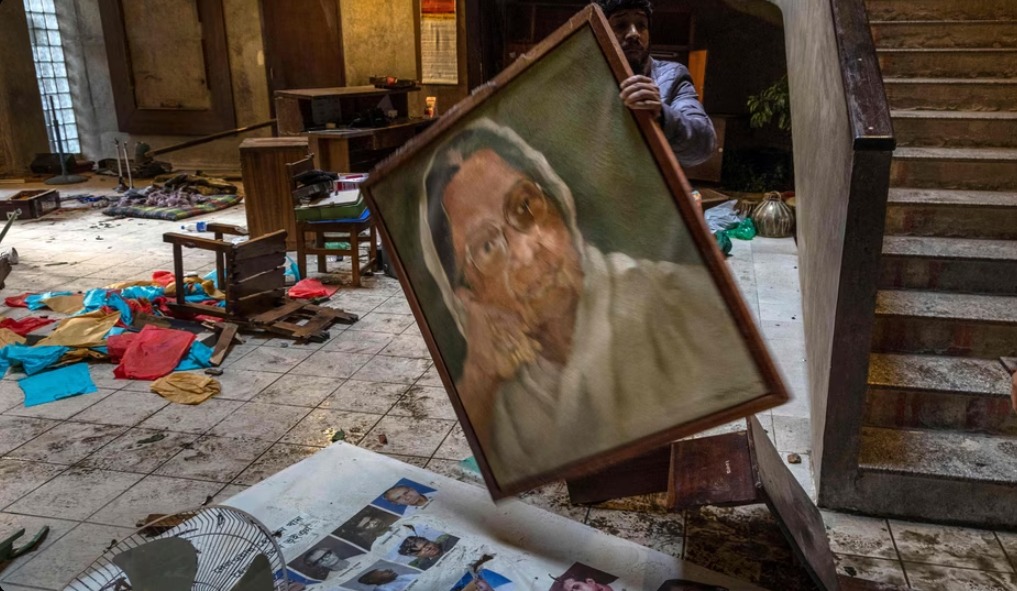
But the promise of better law and order quickly collided with the reality of weak institutions. We saw a political leader shot in the head in broad daylight. Revenge attacks turned entire localities into zones of fear. In the name of protecting religion, angry groups beat and burned people alive. Shrines and homes were once again targeted in 2025, becoming convenient outlets for intolerance and political frustration. Newspapers and cultural organisations were attacked and set on fire, as if silencing newsrooms and burning cultural centres could somehow fix the country's crisis.
In some cases, the state did act. There were events when police intervened quickly to save targeted minorities or disperse violent crowds. However, in most cases, we saw a state that often stood on the edge of the scene rather than at the centre. A sense grew that the interim government was reacting to events rather than shaping them—a vacuum filled by a familiar cast of actors, including local strongmen, religious demagogues, as well as political businessmen and ideological entrepreneurs, who push ideologies on digital platforms to gain followings. They have learned that a few charged words on Facebook or a fiery speech at a rally can be converted into very concrete gains on the ground. The language of sanity and logic was frequently drowned out by the louder sound of anger and past humiliation.
This brings us to the core problem that 2026 will have to confront: the collapse of public trust in state institutions. During its tenure, Awami League abused institutions such as the judiciary, police and civil administration. Most of the time, the opposition responded by attacking the ruling party and questioning the institutions. But during the July uprising and its aftermath, the institutions themselves came under attack. In other words, the institutions were abused from above and delegitimised from below. The result is a country where many people no longer believe that going to court or filing a complaint will lead to justice. Instead, they look for "big brothers" who can solve a problem through pressure, money, or violence, regardless of their motive for doing so. Groups with muscle, money and social media influence are happy to play that role. They mobilise under the banners of religion, nationalism, or justice, and take the law into their own hands. Violence on the street becomes an informal dispute-settlement mechanism.
Against this background, what can we reasonably expect from 2026? By February-March, we hope to see a democratically elected government in office. No one should romanticise the task that the new government will face. It will inherit a society where political fatigue lives alongside political rage, where some actors quietly believe that they benefit more from instability than from calm, and where divisions along lines of nationality, religion, ideology, and class have deepened rather than softened.
Bangladeshi citizens have the right to expect that the coming election will be genuinely competitive, free, fair, and participatory. That independent voices will observe and report on the election without being harassed. Without such an election, every later promise about reforms will stand on shaky ground.
But beyond elections, one expectation stands above the rest. The next government must treat rebuilding institutions as its central task, not as a decorative slogan. Restoring the credibility of the judiciary, the police, and the civil administration is not a technical reform programme; it is a survival strategy for the state. That means the government should remove political elements or influence from the routine business of state institutions as much as possible, enforce written protocols and laws, and promote individuals based on competence rather than party loyalty. People should find themselves in a system where they no longer have to rely on informal phone calls to access and receive public services. If ordinary citizens start to believe that a court case, a formal complaint, or a visit to a police station will be handled according to law rather than according to party colour, half the journey towards stability will already be made.
Stability in this sense is not a substitute for forced order imposed through fear. Bangladesh does not need the kind of "stability" where dissenting voice and opposition is beaten off the streets, and journalists are forced into silence. The stability we need in 2026 is different: predictable institutions, fair procedures, and a basic sense of safety for all communities. A Hindu family in a small town, an Ahmadiyya mosque in a village, a Christian hospital in a remote district, an Indigenous community in the hills, a Bihari camp, a secular blogger, a conservative imam, a labour organiser in an export factory, a business owner in a district town—all of them should feel that the state protects their right to exist and speak rationally, even when they disagree with each other.
If the next government fails to restore stability and rebuild trust in institutions, the country will face a grim future. Street clashes will become routine. Politics will turn into a permanent emergency rather than a method of governance. Talented young people will quietly leave the country for better opportunities. Those staying behind will try to adapt to a life where insecurity is normal. This is not the future anyone can possibly ask for.
As citizens, we make choices every day. We choose which leaders to support, which stories to share online, and whether to hold onto anger or revenge. We also decide which lines we won't cross. If we want strong institutions instead of angry groups, our actions, both online and offline, need to reflect that, even when we're upset.
Perhaps, the best way to look at 2026 is not as a magical turning point, but as a year for patient repair. We won't see all our dreams come true in just 12 months. What we can hope for is simpler: that people in power and regular citizens try to work together and rebuild some basic safety and trust by fixing our broken institutions.
Asif Bin Ali is doctoral fellow at Georgia State University. He can be reached at abinali2@gsu.edu.
Views expressed in this article are the author's own.
Follow The Daily Star Opinion on Facebook for the latest opinions, commentaries, and analyses by experts and professionals. To contribute your article or letter to The Daily Star Opinion, see our guidelines for submission.
 For all latest news, follow The Daily Star's Google News channel.
Comments