


Removing barriers to women’s access to public toilets is long overdue


Access to clean public toilets is not only a basic human right, it also draws a distinction between a life of dignity versus one of humiliation. With the way most public toilets in this country are maintained, it is difficult for anyone to feel human using them. For women, who are disproportionately impacted by not only having to worry about hygiene but also their safety, this experience becomes almost trauma-inducing.
Dhaka, a city of 20 million residents and commuters, has only 198 public toilets combinedly under the two city corporations. Most of these facilities are unsafe, unclean and not gender-segregated. A 2025 WaterAid report found that 35 percent of women actively avoid using public toilets when outside their homes, and of those, 74 percent reduce their water intake to cope. These statistics should ring an alarm for the government. But the irony is that even government establishments lack adequate toilet facilities for women. According to a study conducted by Brac, of the 192 subordinate courts across 64 districts, only 24 percent have separate female toilets. If women are becoming victims of inaccessibility in a court of law—the very institution responsible for safeguarding their rights—who can ensure that their rights will be upheld in the streets, markets, or factories?

Even middle-class and upper-middle-class women are not spared from this systemic horror. So, one can only shudder at how disproportionately this burden falls on marginalised women, the invisible workforce that keeps cities functioning. The 2022 Joint Monitoring Programme for Water Supply, Sanitation and Hygiene assessment shows only about 59.3 percent of people in Bangladesh have access to a "decent toilet of their own," which means millions remain dependent on shared, inadequate, or non-existent facilities.
Garment workers endure excruciatingly long-hour shifts with too few toilets meant for thousands. Construction labourers spend full days on sites, often with no facilities. Street vendors cannot leave stalls; domestic workers are sometimes denied employer bathrooms; women commuters often travel for hours with no safe stops. Women in slums share overcrowded latrines, many without locks or lights; women with disabilities face physical barriers; transgender and hijra women risk harassment in gendered spaces. This is a testament to how infrastructure actively restricts half its population from full participation in public life.
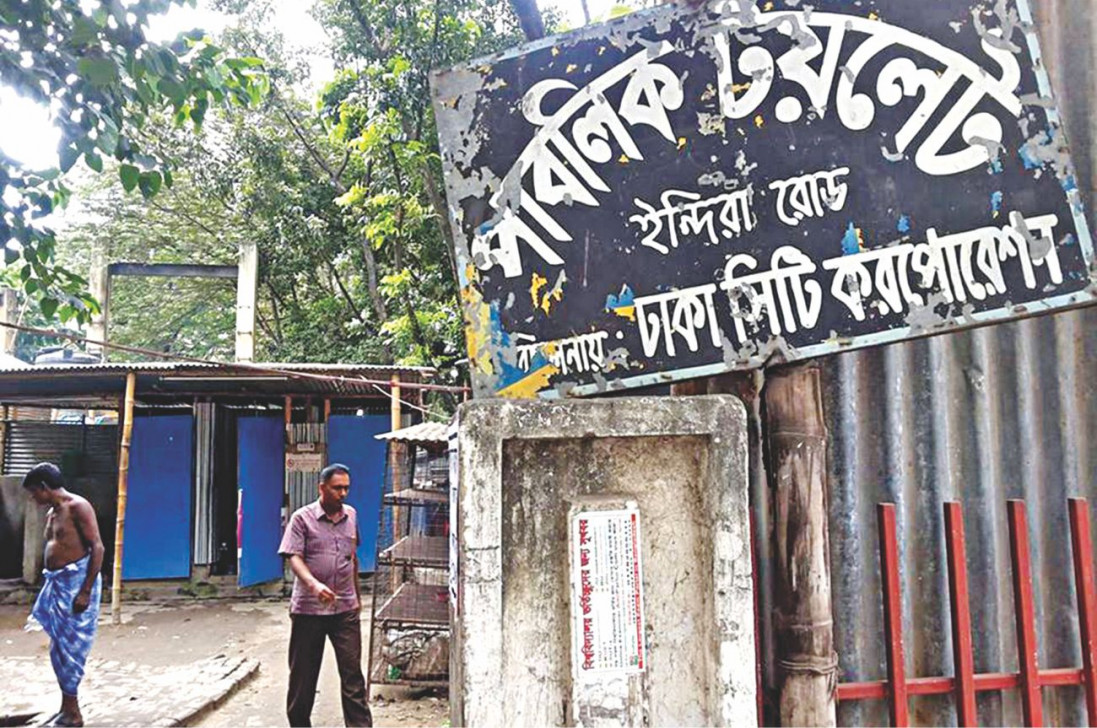
As unpalatable as it sounds, there is a brutal social practice mostly ignored and angrily tolerated, popular in our part of the subcontinent: a significant section of men, often those involved in the informal sector, resort to urinating in the open, by drains, or on footpaths. That is filthy and wrong, but still an option. Even though it sounds harrowing, women do not even have that option without risking harassment or assault. The city's sanitation failure becomes a gendered violence of omission.
The consequences of such dysfunctional machinery get translated into health crises. Women, compelled to remain dehydrated or suppress urination, suffer a cluster of health problems that are quietly becoming epidemic. Urinary tract infections, kidney complications and chronic dehydration among young working women are common conditions now found among Dhaka's female populace. A recent comprehensive hospital-toilet survey found low cleanliness and dangerously high user-to-toilet ratios in both government and private hospitals, undermining infection control inside healthcare facilities themselves.
We obviously overlook the psychosocial harm as well. The fear of harassment or assault when seeking a toilet, the traumatic aspect of it, is never accounted for in our data. Development statistics may celebrate "toilets built," but they rarely capture how many women avoid them out of fear. For instance, public toilets in Farmgate, Sadarghat, Gulistan, New Market, Jatrabari and Kamalapur, some of the busiest junctions in the country, are routinely avoided by women due to being dark and unguarded.
As a lawyer and a woman who moves in public spaces, I find it deeply troubling that something as basic as a toilet still determines how freely women can participate in society. This is not simply a matter of infrastructure but of justice. Dignity is not a privilege reserved for the few; it is a right owed to every woman, whether she stands in a courtroom or sells vegetables at a street corner. And those of us with influence must stop treating sanitation as an embarrassing subject, because silence is what sustains suffering.
Admittedly, this issue cannot be changed overnight. However, if prioritised properly, it is solvable within an accepted timeframe. Facilities must be designed with women in mind, and social awareness must dismantle the taboo and the unsafe and unhygienic practices surrounding public sanitation. WaterAid and municipal partnerships have piloted modern public toilets used millions of times; Brac-supported social enterprises such as Bhumijo have converted dark, filthy blocks into clean, women-friendly spaces within weeks. Bangladesh has even piloted star ratings for public toilets to incentivise quality. These are living proofs that the problem is not a technical impossibility but a priority failure.
If we are serious about dignity, gender equality and public health, the policy response must be immediate and non-cosmetic. First, public toilets must align with national women-friendly standards. To start with the very basics, ensure proper locks and lighting, running water and soap, menstrual-waste disposal, ramps for mobility and female attendants. Workplaces like factories, markets, bus and rail stations, courts and hospitals must be legally required to provide safe, accessible toilets, with enforceable penalties for non-compliance. Instead of a one-off construction budget, funds should be allocated for continuous maintenance.
Success would reflect in the form of metrics that count usability for women, not just an increase in the number of toilet facilities. How many toilets are open at night? How many have locks and water supply? How many are used by women safely and consistently?
On this World Toilet Day, let policymakers, industry leaders and city managers stop celebrating "coverage" on paper and start delivering usable dignity on the ground. The question is not whether we can fix this. The question is if and when we will finally decide to do so.
Peya Jannatul is an advocate at the Supreme Court of Bangladesh.
Views expressed in this article are the author's own.
Follow The Daily Star Opinion on Facebook for the latest opinions, commentaries, and analyses by experts and professionals. To contribute your article or letter to The Daily Star Opinion, see our guidelines for submission.
 For all latest news, follow The Daily Star's Google News channel.
Comments