


Why is there a wide gap in measles vaccination?
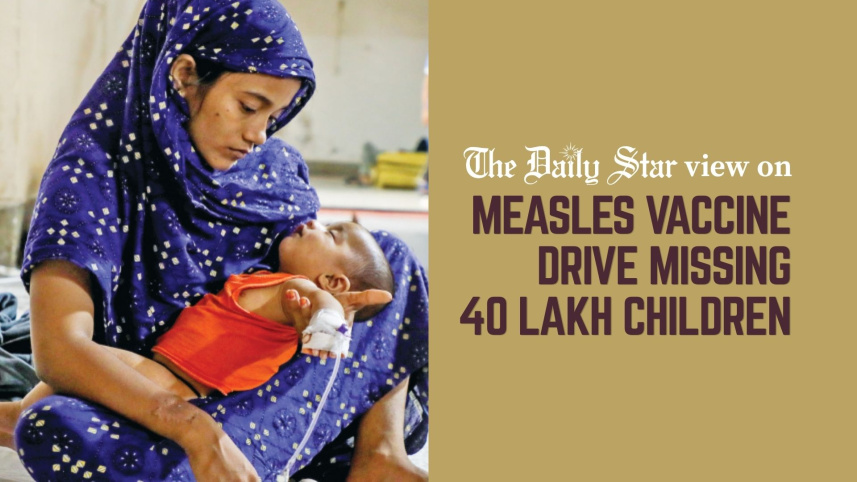
Bangladesh has lost more than 700 lives, mostly children, to measles or measle-like symptoms from mid-March till the end of June. We now know that these deaths have been largely attributed to interrupted vaccination that started during the Covid pandemic but was most conspicuous during the interim government’s tenure, when a time-tested model was unnecessarily stalled. The newly elected BNP government launched an emergency measles-rubella vaccination campaign in April, getting around 1.84 crore children aged 6-59 months vaccinated. However, this has not ensured a significant slowing of the infection rate because, according to a report by this daily, nearly 40 lakh children have been left out of the coverage due to some miscalculation in targets.
Because of this gap, the measles outbreak has not been contained as expected. In May, the average number of daily hospital admissions for measles was 1,023, which dropped to 925 in June—not a significant difference. The Directorate General of Health Services (DGHS) also acknowledged this wide gap and said they were investigating the matter. We urge them to look into this with utmost diligence. The official data shows that 2.23 crore children have received Vitamin A capsules in late June, a precaution that boosts immunity against diseases such as measles. Why did all those children who received the Vitamin A capsules also not get inoculated against measles and rubella?

There is another concern regarding hospital capacity. Measles is a highly contagious disease and patients have to be isolated. What’s worse, the country is entering the peak season of dengue infection; a surge in dengue detection has already been reported. The risk of a dengue outbreak poses another challenge: isolating the dengue patients from measles patients. When dengue is at its peak, our healthcare system gets stretched thin, as we have seen in recent years. The 600-bed DNCC Dedicated Covid-19 Hospital, for example, accommodated 7,205 dengue patients last year. Since being converted into a dedicated measles hospital in mid-March, it has stopped admitting dengue patients. If the dengue surge worsens and the measles outbreak continues as is, how will this hospital, and others, cope with the patient load?
The complication of a prolonged measles outbreak along with a dengue outbreak cannot be emphasised enough. The government must take urgent steps to close the gap in measles vaccination with speed and ensure 95 percent coverage, which is necessary to interrupt measles transmission in the country. At the same time, as recommended by health experts, the health authorities must establish makeshift treatment facilities and dedicated dengue units around the country in preparations for expected rise in cases. An intensified larvae control campaign must also be carried out in dengue-prone areas to control dengue. Unless drastic steps are taken, we may have two health crises going out of control.
 For all latest news, follow The Daily Star's Google News channel.
Comments