


How long must Ramu wait for justice?

It has been 14 years since the horrific attacks on the Buddhist community in Cox’s Bazar’s Ramu upazila took place, but justice remains as elusive as ever. In 2012, mobs destroyed 12 ancient Buddhist monasteries and 34 Buddhist settlements in Ramu on September 29-30. Moreover, 50 houses of Buddhist residents, relics, ancient Tripitaka manuscripts, and over 300 statues of the Buddha were vandalised or looted. Attacks were also carried out in Ukhiya, Teknaf, and elsewhere. The violence was triggered by allegations that a local Buddhist youth had posted an image on Facebook that was deemed offensive to Islam—claims debunked by an investigation from this daily, which found that the image in question had been photoshopped and used to frame the youth and incite the attacks.

The subsequent investigations should have provided a clear path to accountability and justice. A judicial inquiry identified 298 people as responsible and found evidence of failure by local administration, intelligence and law enforcement agencies. A police probe, too, found that the then Cox’s Bazar SP and Ramu OC had failed to take appropriate measures, while a home ministry probe discovered that the violence had been planned at least 10 days before. Yet, as of 2026, there has been no considerable progress. A total of 19 cases and two writ petitions were filed in the wake of the attacks, of which one was settled and four were withdrawn during the interim administration. The remaining 14 cases have yet to receive verdicts. No one is currently under arrest or in jail. The writ petitions haven’t been disposed of either.
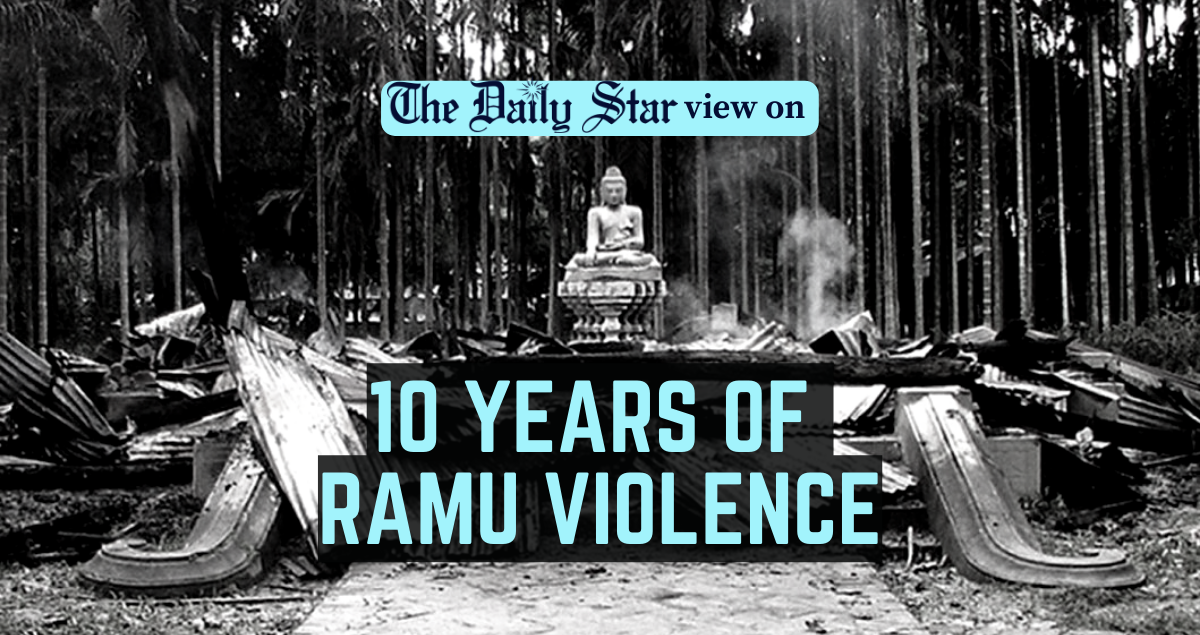
If the state cannot ensure accountability even after investigations have identified perpetrators and institutional failures, what assurance of justice do vulnerable communities have? The Ramu residents have not only been traumatised, but they are constantly living in fear and insecurity. Some even left the country to regain their stolen sense of safety. Meanwhile, the attackers remain free. This is completely unacceptable. So is the explanation that the police and prosecution have repeatedly failed to produce witnesses before the courts. Witnesses in communal violence cases may face fear, intimidation, or pressure. The state must ensure their protection and safety. The cases must be expedited, the pending High Court proceedings addressed, and every credible lead pursued. The residents of Ramu must not be made to wait any longer for justice.
 For all latest news, follow The Daily Star's Google News channel.
Comments