


Online tax, offline refund

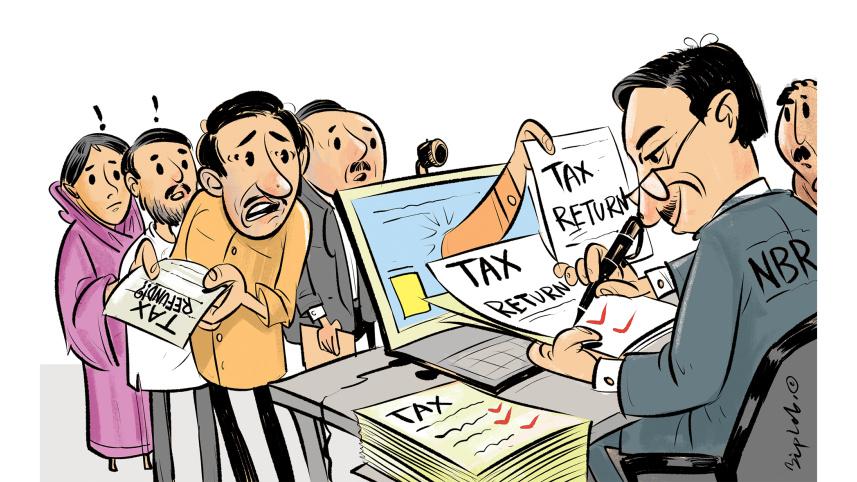
Taxpayers, including individuals, continue to face difficulties in getting back overpaid taxes, as minimum tax provisions remain in place and the refund process is still manual and complex.
Although the National Board of Revenue (NBR) has made electronic tax return filing mandatory for individual taxpayers this assessment year, it has yet to introduce an e-refund system.

This has left many taxpayers frustrated as revenue authorities in other countries transfer refunds directly to accounts once tax liability is assessed.
Citing the NBR’s online filing portal, a banker said that when a taxpayer claims a refund, a message appears reading, “Claim bank transfer of refund?”. Clicking further brings up another message, “Integration of this page under process.”
“It is annoying,” he said, requesting anonymity.
Under the current system, taxpayers often overpay through tax deduction at source (TDS) or advance income tax (AIT), particularly businesses, professionals, and salaried individuals.
According to the law, any excess should be refunded if the final tax liability is lower. In practice, however, refunds are rarely paid on time, if at all, according to taxpayers and analysts.
Instead, the NBR allows taxpayers to carry forward excess payments to the following assessment year for adjustment of future tax liabilities. While this provides limited relief, it does not solve the main problem: taxpayers are effectively denied access to their own money.
Take the case of Mamun Ahmed from Sylhet. His total tax liability for the current year was Tk 7,000, yet Tk 12,000 had already been deducted at source from his fixed deposits and savings certificates.
This is not an isolated incident. Rather, many other taxpayers earning below the tax-exempt threshold face similar issues in bank deposits, savings certificates, and other deposit instruments.
Banks and financial institutions deduct 10 percent AIT on interest income if a depositor submits proof of submitting a tax return. Without this proof, taxpayers face a 15 percent deduction.
Analysts question the logic of deducting AIT from individuals who earn below the tax-free threshold.
Most source taxes have been classified as “minimum tax” under the Income Tax Act 2023, making refunds largely inaccessible.
Snehasish Barua, chartered accountant and director of SMAC Advisory Services Ltd, said that Bangladesh’s tax refund mechanism is currently paralysed by the classification of most source taxes as “minimum tax”.
Under the law, this prevents taxpayers from claiming refunds unless amended, he added.
“While provisions for future tax adjustments exist, they remain subjective and impractical in a market where consistent profit growth is not guaranteed,” said Barua.
He added that despite legal requirements to issue refunds within 60 days, procedural gaps persist. “To resolve this, the government must integrate the individual online filing system with the national treasury to enable automated, intervention-free transfers.”
“This is just unfair,” said Mohammad Abdur Razzaque, chairman of Research and Policy Integration for Development. “Collecting tax in the name of advance income tax without allowing proper adjustment amounts to double taxation and penalises compliant taxpayers.”
Globally, excess tax is refunded within a reasonable timeframe. In Bangladesh, however, the process remains manual and cumbersome. While income tax filing has been digitised, the refund system has not, frustrating taxpayers and eroding trust in the system, he said.
“If the government is serious about modernising the tax system, fixing the refund mechanism is a basic reform, not an optional one,” he said.
 For all latest news, follow The Daily Star's Google News channel.
 For comment, The Daily Star approached NBR Chairman Md Abdur Rahman Khan. But he could not be reached by phone.
In a press briefing in the first week of January, Khan acknowledged a large amount of pending tax refunds.
“This is the taxpayer’s rightful money. They often borrow at high interest to pay taxes, and making them run from office to office for refunds is deeply unjust,” said the NBR chairman.
“Worldwide, filing a tax return is a celebration because taxpayers get refunds. Here, refunds are rare due to the hassle involved. If the process is transparent and excess tax goes automatically to their bank account, compliance will improve, and more people will file returns.”
He said the authority currently holds around Tk 4,000 crore in outstanding refund liabilities across taxes and VAT. “We have launched the VAT refund system, and the tax refund process will begin soon,” he added.
In January, the NBR introduced an online system allowing VAT refunds to be credited directly to taxpayers’ bank accounts.
A senior revenue official said, “The NBR is working to install software to automatically send refunds to taxpayers’ accounts. Once it is ready, these difficulties will be resolved soon.”
Comments