


Gas rationing shuts five urea factories

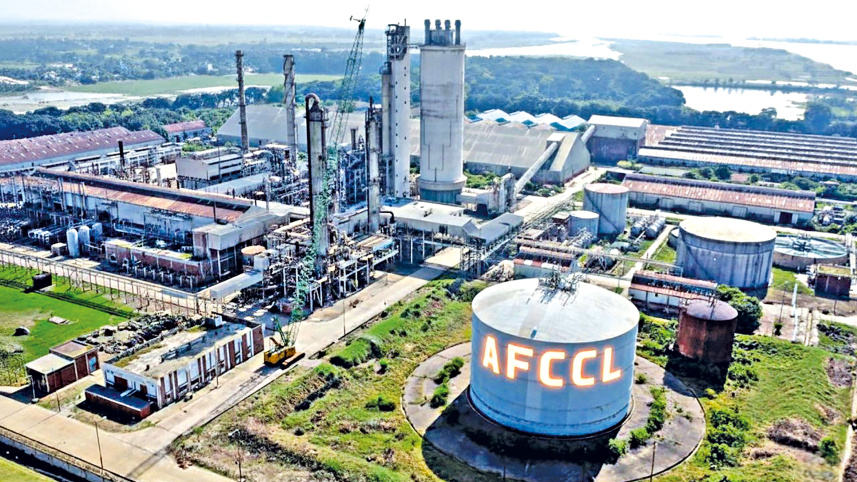
Authorities have shut five of the country’s six urea fertiliser factories as a precaution amid fears of gas supply disruptions caused by the widening war in the Middle East and Iran’s closure of the Hormuz Strait, a key global energy route.
From Wednesday, gas supplies to the urea plants, including one privately owned unit, were suspended as part of an energy rationing, said officials at the state-run Bangladesh Chemical Industries Corporation (BCIC).

The corporation runs seven fertiliser factories, including four producing urea.
The factories affected are Ghorashal Polash Fertiliser Public Ltd Company, Chittagong Urea Fertiliser Factory Ltd (CUFL), Jamuna Fertiliser Company Ltd, Ashuganj Fertiliser & Chemical Company Ltd, and the privately run Karnaphuli Fertiliser Company Limited (KAFCO). Of these, production has remained suspended in the Ashuganj factory for months.
Officials say that now only the Shahjalal Fertiliser Factory remains operational, though even this may not continue for long.
However, two state-owned non-urea factories that do not rely on gas remain open.
The country meets nearly 30 percent of its gas demand, equivalent to 2,650 million cubic feet per day (mmcfd), through imported liquefied natural gas (LNG) as domestic output continues to fall short.
Officials said about 197 million cubic feet of gas per day are required to run the five urea factories at full capacity. The factories were already suffering from an inconsistent gas supply before the shutdown.
The suspension of urea output comes at a critical time for farmers planting Boro, the main dry season rice crop, which accounts for more than half of Bangladesh’s annual 40 million tonnes of grain.
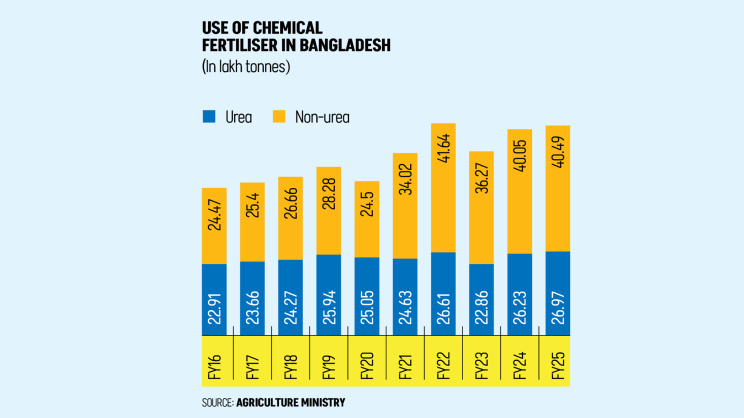
Bangladesh requires more than 26 lakh tonnes of urea each year. Around 40 percent is produced locally, while the remainder is imported from Middle Eastern countries including Saudi Arabia, the UAE and Qatar.
Two-thirds of the annual urea demand falls between November and March, mainly for Boro rice cultivation.
Contacted, Md Moniruzzaman, director of production and research at BCIC, said the corporation currently holds 468,000 tonnes of urea in stock, enough to cover demand for the rest of the Boro season.
“So, there will be no shortage of the fertiliser during the current Boro rice cultivation season,” he said.
The BCIC officials said they were asked to keep production shut for 15 days. The closed factories together have a total daily capacity of around 7,100 tonnes. This means more than 1 lakh tonnes of urea production will be affected.
Although the target for fertiliser output in the 2025-26 fiscal year was 10 lakh tonnes, only 550,000 tonnes have been produced in the eight months to February, according to officials.
One of them expressed doubts about meeting the target in the remaining four months.
Engineer Syed Abu Naser Md Saleh, general manager of the engineering services division at Karnaphuli Gas Distribution Company, said that gas supply to the two fertiliser plants has been suspended since Wednesday in line with government instructions.
“Around 70-80 million cubic feet of gas used to be supplied to the two plants,” he said.
Riaz Uddin Ahmed, executive secretary of the Bangladesh Fertiliser Association, said the urea factory closures are unlikely to affect the current Boro season.
Planned imports of non-urea fertiliser for this fiscal year have already been completed, he added.
 For all latest news, follow The Daily Star's Google News channel.
 “So, I see no problem until June-July of this year. We have to be ready for the later months. If the crisis [in the Middle East] lingers, there will be a problem,” he said. “We should start exploring alternative sources to avoid any risk.”
Comments