


From land to sea: Rethinking our future in a fragmented world

The world today has changed the fundamental premises and contours of global politics from what was established and has guided international relations since the end of World War II. But are we ready for this dramatically changed world? Living in the present and planning for a better future requires some deep introspection of the past.
I was born at a time when the world was at war with itself, in a country in the grips of the worst famine in its recent recorded history. World War II had not yet ended.

After the end of the war, I grew up with the myth that the entire world had now emerged into a magical post-colonial “New World Order,” with rainbows lighting up the horizon of our future. It was many years later that the harsh process of demystification started sinking in. There was a growing realisation that, post-1945, former colonised peoples like me had actually become denizens of a post-colonial neo-Westphalian world disorder.
In 1971, Bangladesh wrested its independence at the height of the Cold War. In a sense, its birth was midwifed by the Cold War, and its politics also wet-nursed by it, leaving a lasting impact on its collective mindset and transforming us into a schizophrenic polity. However, the Cold War, at its height, also awakened and unleashed on the world a genie named Globalisation. This genie effectively telescoped time and space across our planetary domain, making them almost irrelevant.
The Cold War ended in the early 90s with the replacement of the earlier bipolar world by a unipolar world, with only one superpower that increasingly surveyed the rest of the world as its own playground, endeavouring like an Olympian god to fashion in his own image the global domain that it surveyed. It did not easily brook any challenge to what it viewed as its sole prerogative. However, perhaps as an unintended consequence of its policies and actions, the world has also witnessed in the last 40 years the gradual rise of a China determined to build resilience for itself from within and positioning itself as a counter-balancing power now threatening unipolarity.
Now, we see yet another cold war waging around us. I see Europe fulminating, at the precipice of a likely continent-wide conflict. Our own region is even more sharply divided, with hostilities barely concealed. I see Bangladesh as a brittle walnut, squarely caught in the jaws of two nutcrackers: one regional, that is India and China; the other global, namely the Indo-Pacific narrative and the BRI counter-narrative. What should we do then?
Let us begin with a frank acknowledgement: while our world is more interconnected than ever before, it is also more fractured than ever, with divisions running deep and cutting across nations and communities. Social media, while connecting billions, often amplifies echo chambers that risk being as false as true, and simultaneously intensifies our sense of separation. Peoples and communities have become disconnected from each other like distant proximities.
If we are to build now for a better future, the first step is to learn from both our triumphs and failures. The past has shown us that division leads only to stagnation and pain—be it wars, discrimination, or exclusion. But history also teaches us vital lessons: that empathy is powerful when we genuinely listen to others’ stories and pains; that dialogue over debate can be convincing and plays a pivotal role in reconciliation; and that a shared purpose can be uniting.
How do we apply these lessons in our daily lives and in societies? We must all build bridges together, not walls. Embarking on this mission will require courage, humility, abstaining from self-righteousness, and persevering in our efforts with endless patience. So, can we dare hope for a better tomorrow?
I do believe that the gates to our future do not proclaim on a forbidding billboard the dire warning to “abandon all hope, ye who enter here!” Despite the seemingly insurmountable challenges, there are many signs of hope. Young people around the world are leading movements for climate action, social justice, equality with equity, good governance, and peace. Our hope for the future will ultimately rest on our willingness to see difference not as a threat, but as a strength.
So how should Bangladeshis look at their future?
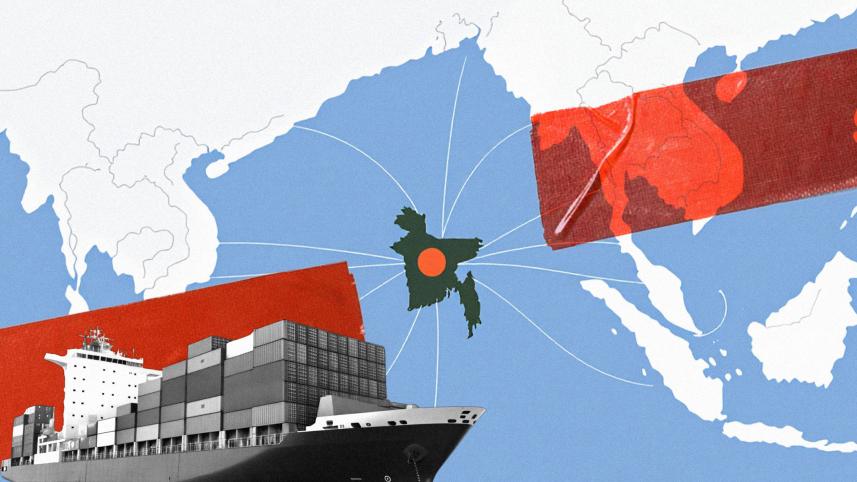
They need to shift their fixation with and attention away from myopic regional land-centricity to gazing at their oceanic domain that has historically defined and nurtured them. They must recentre their attention on the largest bay in the world, the Bay of Bengal, which is named after their land but which they have, for far too long, blind-sided from their vision. The Bay of Bengal is, after all, at the heart of the Indian Ocean, which is the great Middle Bay in our blue planet. More importantly, in today’s world, it finds itself at the very heart of the two competing narratives: the US-led Indo-Pacific Economic Framework for Prosperity (IPEF) and China’s Belt and Road (BRI) initiative. Why?
Through the Strait of Malacca, the Bay of Bengal links the Indian Ocean to the Pacific, amplifying its strategic value. Its blue water location connects West and South Asia with Southeast and East Asia. The interests of several major global powers also converge here, with military, economic, and strategic concerns. The region’s resources and shipping lanes are now crucial in the geopolitical calculus of these actors. The Bay of Bengal serves as a major route for global trade, handling about half the world’s container traffic and 33 percent of world trade. Its ports are vital for the economic interests of its surrounding countries and external powers.
In the vortex of the current global churning, Bangladesh is caught squarely between major powers, particularly the US, India, and China. Perhaps, being at the epicentre of this configuration, it still lacks self-awareness of its strategic importance or potential. Bangladesh’s foreign policy must continue to prioritise, first and foremost, its own national interests and its own overall societal development. Doing so will require positive engagement with all powers—whether small, medium, large, or super in scale. But while nurturing relations with all, it must abstain from the temptation of siding with any one power against any other.
As an emerging potential middle power itself, Bangladesh must work with other regional middle powers, endeavouring to form a fraternity with all its neighbours in South, Southeast, and East Asia, developing not only domestic self-reliance but also forming a collective regional autarky at the same time. It can, and must, play a seminal leadership role in regional diplomacy, working actively with its neighbours in its immediate west, north, and east towards realising the vision of a “Bay of Bengal Economic Cooperation Community.”
For success in this endeavour, Bangladesh must tread upon a razor-thin path of “strategic autonomy” that walks hand in hand with “active neutrality.” But it can aspire to do so only if its people first arrive at domestic consensus. If we, the people, desire change in the global order, that change must begin with us at home first.
Tariq Karim,
a former ambassador of Bangladesh, is adviser to the Centre for Bay of Bengal Studies and the School of Liberal Arts and Social Sciences at the Independent University, Bangladesh (IUB), and concurrently distinguished visiting research fellow at the Institute of South Asian Studies of the National University of Singapore (ISAS-NUS).
 For all latest news, follow The Daily Star's Google News channel.
Comments