


How patriarchy continues to limit women’s political role
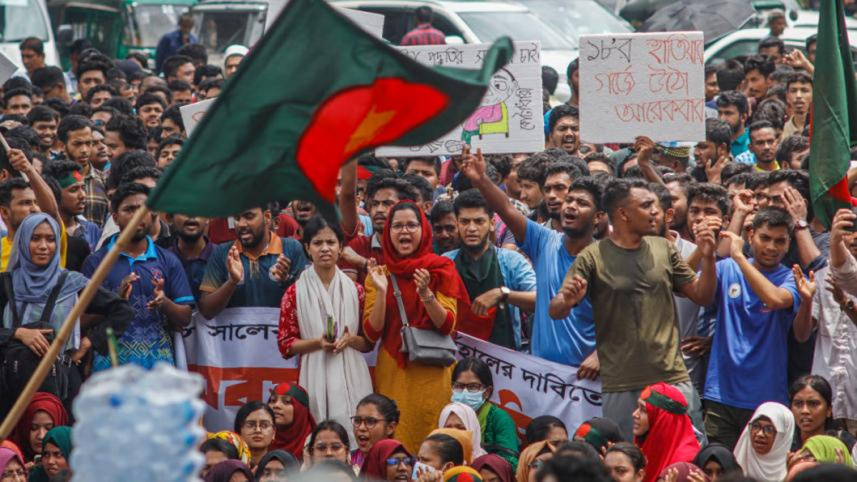
Women were at the forefront of the July 2024 uprising, but in the subsequently formed political structures, insecurity and social backlash gradually pushed them aside. Female students from universities across the country, including Dhaka University, were not only leading participants in the uprising, but they also became victims of attacks and lawsuits by law enforcement agencies. However, the number of female candidates in the post-uprising Dhaka University Central Students’ Union (DUCSU) election remained limited, and those who did contest faced extensive cyberbullying.
There were only 62 female candidates in the DUCSU election, accounting for merely 13 percent of the total candidates, even though 48 percent of DUCSU’s voters are female students.

Women’s participation in the Liberation War of 1971 was similarly undervalued in the post-war era. The title Birangana, rather than honouring their contributions, foregrounded the trauma and humiliation they had endured, while obscuring the critical roles they had played on the frontlines. This reflects a long-standing social failure to recognise women’s agency, a problem that persists to this day.
Although women participants of the uprising were subjected to humiliation by members of Chhatra League during July-August 2024, in the post-uprising political climate, they faced widespread cyberbullying. In fact, nearly all female DUCSU candidates reported experiencing online harassment during their campaigns. One woman who filed a petition challenging the candidacy of a Shibir-backed GS nominee received threats of “gang rape.” When the issue of women’s harassment arises, political parties across ideological divides often appear united in their silence. The cyberbullying faced by female leaders and candidates during and after the uprising was not merely personal abuse; it was a direct form of gender policing.
Khadijatul Kubra, who was arrested and imprisoned under the controversial Digital Security Act during the previous regime, recently contested in the Jagannath University Central Students’ Union election. Following the announcement of her candidacy, she publicly expressed deep frustration over the scale of cyberbullying she had encountered. In a Facebook post, she wrote, “Even after spending 15 months in prison under the Digital Security Act, I have not been as mentally disturbed as I have been in the past few days.”
Most of the abuse directed at female candidates was vulgar, gender-based, and overtly sexist. The absence of accountability on social media, combined with the ease of operating through fake identities, has made perpetrators increasingly reckless. The dominant psychology driving these online attacks can be summed up in a familiar refrain: “Why enter politics as a woman? Stay at home.” This narrative is a clear manifestation of gender policing, whereby society seeks to confine women to a prescribed role and behaviour. It is rooted in the perception of women as sexual objects rather than as political actors, reflecting an effort to deny women agency, legitimacy, and visibility in public spaces.
Last year, Jamaat-e-Islami Ameer Dr Shafiqur Rahman announced that if his party came to power, it would introduce a new work policy for women, allowing them to work five hours a day while being paid for eight. Although the proposal may appear women-friendly at first glance, if implemented, it has the potential to curtail women’s careers. If men continue to work eight hours while women work five, men will inevitably accumulate more output, experience, and institutional capital, ultimately dominating leadership and decision-making positions. Realistically, why would any institution reserve senior roles for individuals producing only a fraction of the required labour?
Such proposals are detached from socio-economic realities. Bangladesh’s garment sector, driven primarily by women, continues to struggle with low wages and unsafe working conditions. In this context, providing eight hours’ pay for five hours’ work for millions of women is economically unsustainable.
This proposal—a structural restriction disguised as welfare—could very well confine women to the domestic sphere. This stands in contrast to feminist thinkers John Stuart Mill and Harriet Taylor’s argument that economic participation outside the home is essential for women’s emancipation.
But subconsciously, society has normalised the idea that women can be insulted and subjected to sexually suggestive remarks. Women in positions of power are systematically targeted in efforts to “clip their wings.” As a result, even women in the upper echelons of society are not immune to humiliation. Former Prime Minister Khaleda Zia’s personal grooming and private life were once criticised on the floor of parliament, in an unmistakable example of political misogyny. Although women’s participation in government, political parties, and public administration has increased over the years, patriarchal impulses to undermine their authority persist.
The persistent salary disparity faced by the national women’s football team is another manifestation of this structure. In this way, patriarchal systems create conditions in which women are routinely humiliated across cyberspace, workplaces, and social settings. Gender-based differentiation is also embedded in culture and language. Sufia Kamal, Rokeya Sakhawat Hossain, and Kamini Roy are routinely described as “female poets,” while no male poet is ever labelled a “male poet.” Such linguistic practices reinforce the notion that active women are exceptions rather than equals.
While some progress has been made in empowering women at higher levels, empowerment at the grassroots remains elusive. Even when women legally inherit property, social structures often obstruct the realisation of that right. This gender-based structural disempowerment continues to limit women’s freedom and security.
A number of steps must be taken to change the discrimination women face. First, the state must adopt effective policies to prevent violence and discrimination against women. Second, schools and colleges should provide training on digital safety, responsible use of cyberspace, and gender studies for students of all genders. Establishing a dedicated cybersecurity agency and a cyber police helpdesk is also essential. Third, institutional protection of women’s leadership in public administration must be ensured for women to exercise independent decision-making.
Policy reform alone is insufficient; societal attitudes must also change. The role of the younger generation is crucial. By raising awareness in cyberspace and beyond, a strong social foundation for women’s safety, freedom, and leadership must be built.
Shahadat Shadhin has completed his MA and MPhil in international relations at South Asian University in New Delhi.
Views expressed in this article are the author's own.
Follow The Daily Star Opinion on Facebook for the latest opinions, commentaries, and analyses by experts and professionals. To contribute your article or letter to The Daily Star Opinion, see our guidelines for submission.
 For all latest news, follow The Daily Star's Google News channel.
Comments