


“Buddha of Bengal” returns with a larger conversation on sacred art
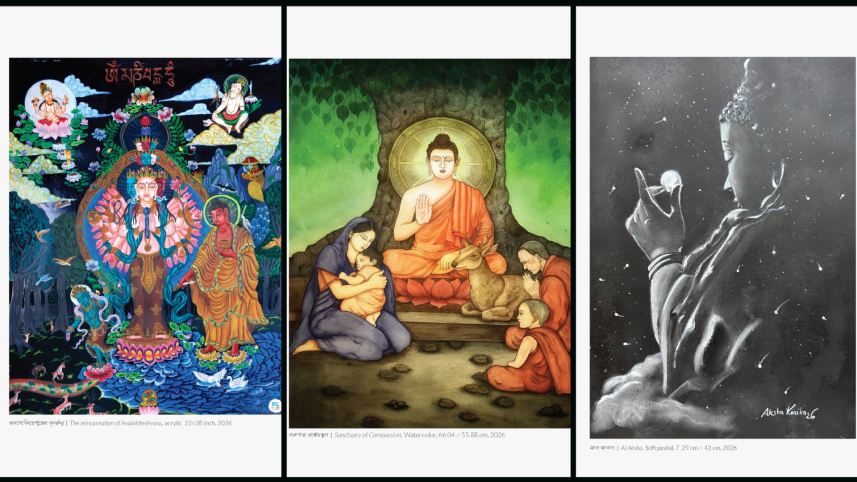
The fourth edition of “Buddha of Bengal: Our Sacred Community” opens on April 28 at 6 PM at La Galerie, Alliance Française de Dhaka, and will continue until May 6. Over the years, the exhibition has developed into an important platform for Bengali Buddhist art, especially at a time when sacred visual traditions are rarely given sustained public space.
This year’s exhibition is built around the idea of Sangha, the Third Jewel of Buddhadharma, usually understood as the sacred community. Through 91 works by 80 Bangladeshi artists, the exhibition explores themes of fellowship, compassion, contemplation, shared humanity, and interconnectedness. Instead of presenting spirituality as a purely personal experience, the show focuses on collective reflection and coexistence.

A wider field of participation
One of the striking aspects of this year’s edition is the range of participants. The exhibition includes artists working in watercolour, gouache, tempera, sculpture, miniature, batik, appliqué, woodcut, nakshi kantha, ceramics, printmaking, and metalwork. Alongside established practitioners, students and faculty from 15 universities and institutions are also part of the exhibition, including the University of Dhaka, University of Rajshahi, University of Chittagong, Jahangirnagar University, and Khulna University. Participants from Bulbul Academy of Fine Arts and Yunnan Art University in China have also joined.
This broad participation matters because the exhibition is not treating Buddhist art as a static or isolated tradition. Instead, it places it inside a living, evolving conversation across generations and institutions.
That significance is reflected in the words of Eliza Chowdhury of Chattogram, a student of Dhaka Art College, who sees the show as a meaningful learning space, as well as a public exhibition. She notes that initiatives like this help younger artists engage with a tradition that is often overlooked in mainstream art discussions and make them think more seriously about the philosophical depth behind sacred imagery.
Sacred art beyond the gallery wall
What gives “Buddha of Bengal” additional relevance is that it moves beyond the format of a standard exhibition. Every day includes a programme of performances and discussions, from flute recitals and Bharatanatyam to sarod, violin, dotara, Charyagaan, guided tours, watercolour-wash workshops, and presentations on sacred art and Buddhist philosophy.
This creates a more layered experience for visitors. A person may come for the artworks and stay for a performance, or attend a philosophy discussion and then return to the paintings with a different frame of mind.
A platform with continuity
The exhibition will conclude with its first Best Artists Awards, with cash prizes for first, second, and third place, as well as a separate award for best student artwork. That addition signals a long-term investment in the field rather than a one-time display.
At its strongest, “Buddha of Bengal” is not simply an annual exhibition. It is a growing platform that connects art, philosophy, and community, while making a strong case that Bengali Buddhist traditions still deserve active space in the cultural present.
 For all latest news, follow The Daily Star's Google News channel.
Comments