


Everything has a class system, except load shedding

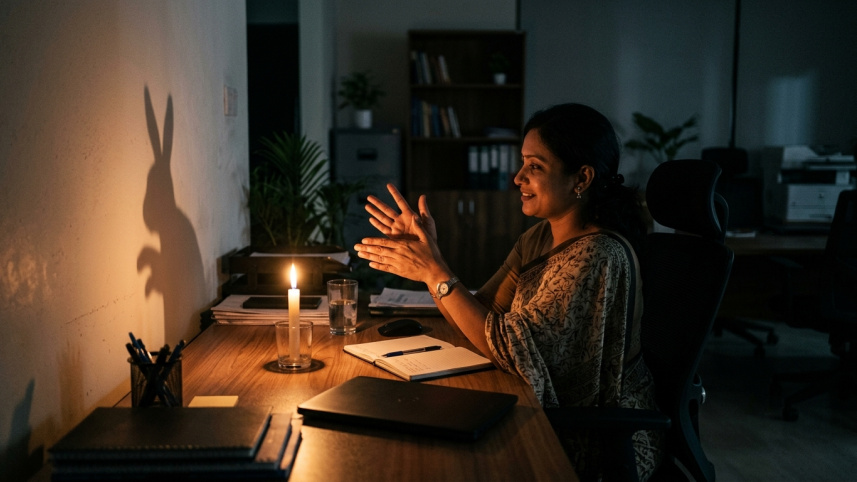
At 7:43 on Tuesday evening, Runi’s fan stopped moving. She stared at it. The fan stared back. “Again?” From the drawing room came Aunty Farzana’s voice. “Load shedding is good for you.”
Of course it was. Aunty Farzana had an IPS, a generator and the remarkable ability to find character-building opportunities exclusively in other people’s suffering.

“In our time,” she continued, “we studied by candlelight. Taught us the value of things”
“In your time, Aunty, there was also no global warming,” Runi replied.
“Exactly. We were happier.” The Wi-Fi died. Runi’s husband groaned from the bedroom. He had been on a Zoom call explaining Bangladesh’s enormous potential to a Singaporean investor when Bangladesh disconnected him. His laptop still had 62 per cent battery. His optimism had considerably less. Outside, Dhaka was conducting its nightly experiment in involuntary minimalism.
The building opposite had already switched to generator power. Somewhere below, a generator coughed into life with the enthusiasm of a seventy-year-old chain-smoker. The pharmacy glowed. The tea stall did not. A restaurant across the road flickered back on while the tiny tailoring shop beside it remained dark. Electricity, Runi realised, had developed a class system.
The wealthy had generators. The middle class had IPS batteries, rechargeable fans and anxiety about when both would die. The poor had windows!
“Why don’t they just buy an IPS?” Aunty Farzana asked. Runi looked at her. This was the same woman who had once suggested that Dhaka traffic could be solved by “buying houses closer to work”.
Downstairs, Kalam, who ran the small photocopy and printing shop, was sitting outside, visible through the veranda. “No current, Apa. Three orders waiting.”
“Generator?” He laughed. Not because Runi had made a joke. That was the joke. His machines needed electricity. His rent did not. Neither did his employee’s salary, his daughter’s school fees or tomorrow’s grocery bill.
Across the city, variations of Kalam were sitting in darkness. Tailors waited beside silent sewing machines. Small workshops stopped production. Grocery owners watched freezers warm. Office workers hunted for charging points. Students attempted to finish their thesis while perspiration slowly erased their commitment to higher education. Even Runi’s beauty salon had messaged: Dear Ma’am, due to load shedding, your appointment may be delayed.
Civilisation, apparently, had reached the point where even eyebrows depended on national energy policy.
Then the water stopped. “Runi!” Aunty Farzana shouted. “There’s no water!” The pump needed electricity. There was silence. This development had finally transformed the energy crisis from a national inconvenience into a personal emergency. “But I need to shower.” Runi smiled in the darkness.
At 8:31, the electricity returned. The building erupted into tiny celebrations. Fans spun. Routers blinked. Pumps began humming. Chargers were inserted into sockets with the urgency of emergency surgery.
Aunty Farzana immediately switched on the air conditioner. Runi looked down at Kalam’s shop. The lights were back. He rushed inside and switched on the printer. He now had no idea how long he had before everything stopped again.
Perhaps that was the cruellest part of load shedding. Darkness was inconvenient, certainly. But uncertainty was expensive.
Aunty Farzana settled comfortably under the AC. “See?” she said. “Only forty-eight minutes. People complain too much.”
At 8:39, the fan stopped again. Aunty Farzana looked up. For once, she had nothing to say. Bangladesh had achieved what generations of relatives had failed to do. It had silenced an aunty.
 For all latest news, follow The Daily Star's Google News channel.
Comments