


Why ‘Musafir Cafe’ feels so personal to millennials and Gen Z


“Musafir Cafe” starts with a very beautiful scene: a warm coffee shop in the mountains, filled with stories. As Neel Adhikari's playback flows across the screen, one of the series' most courageous characters, Preety, says in the background, "For every musafir, the journey truly begins when they find a true companion. Sometimes that companion stays, sometimes they leave after changing you forever." From that very moment, the series introduces us to a group of musafirs, each carrying a journey of their own. And through the journeys of these characters, almost every relationship dilemma of this decade gradually unfolds.
Based on Divya Prakash Dubey's novel “Musafir Cafe”, the series, written and created by Sharanya Rajgopal, has sparked conversations across social media and film blogs since its release on Netflix. While many celebrate its emotional honesty, others have criticised the way it treats the different layers of its characters. Yet that is precisely where “Musafir Cafe” finds its greatest strength – the audience cannot ignore the show.
Through the life of Chander, a dreamer who left software engineering for the corporate world, and the two defining relationships he shares with Sudha and, eight years later, Preety, the series unfolds a story layered with love, ambition, timing, responsibility, and uncertainty. As Sudha unexpectedly walks back into Chander's dream cafe, the lives of the three characters are thrown into an emotional equation that is almost impossible to describe without giving away spoilers. Perhaps the only way to explain it is through Richard Feynman's words: "I can live with doubt and uncertainty and not knowing. I think it's much more interesting to live not knowing than to have answers which might be wrong." Perhaps the biggest reason behind the popularity of “Musafir Cafe” is that it speaks to a generation that has grown up in a world of uncertainty. Love, career, migration, ambition, and family expectations constantly pull people in different directions. The series doesn't present relationships as fairy tales or tragedies; instead, it portrays them as complicated, fragile, and often shaped by timing rather than intention. Many viewers feel they are watching versions of conversations they have had, decisions they have made, or people they have lost.
One of the greatest strengths of the series is the way it quietly slips into the lifestyle of millennials and Gen Z. Then again, on another level, the series presents a reality about how seriously Gen Z takes the search for a life partner. This is a generation that has grown up in a global reality where even drinking water comes at a price, and breathing fresh air often demands paying for it. In a generation shaped by growing individualism – where many people are unwilling to give even a single extra minute to their workplace beyond office hours – the one place where they seem most willing to invest themselves is in finding the right partner. And once they do, the endless negotiations, compromises, and emotional dealings required to carry a relationship forward are visualised by “Musafir Cafe” with a deeply personal touch.
Unlike many romantic dramas where protagonists are larger than life, the characters in “Musafir Cafe” are remarkably ordinary. They make mistakes, avoid difficult conversations, overthink simple situations, and struggle to express themselves. They are neither entirely right nor completely wrong. This moral ambiguity makes them believable. Instead of judging the characters, audiences often find themselves empathising with them because they recognise their own flaws in them.
The way “Musafir Cafe” captures the fundamental transformation in the lifestyle of an entire generation deserves discussion. In this series, Sudha stands as a powerful representation of the growing aspiration among millennial and Gen Z women to become independent – an aspiration that continues to reshape society, where marriage is no longer the biggest priority in a woman's life. When Sudha says, "The problem with life is that people like you always arrive too late," and Chander replies, "Then again, women like you never stay for long," that conversation quietly takes us into the world of 'situationships', where many viewers will inevitably begin to see reflections of their own lives. From that mechanical life that begins with piles of kindergarten homework and gradually grows into an adulthood where individuality almost disappears, Preety's philosophy of simply living in the moment feels like one of Gen Z's greatest discoveries. These are the very things that make the series so well-crafted.
In an era dominated by fast-paced thrillers, shocking twists, and constant stimulation, “Musafir Cafe” slows everything down. Much of its storytelling happens through pauses, glances, unfinished sentences, and quiet moments. A subplot can end with a dialogue as simple as, "Divorce happens long before people reach the courtroom; the rest is only a formality," and yet it leaves you with the feeling that so much has already been said. The series trusts the audience to understand emotions without excessive explanation. For some viewers, this pacing feels refreshing, almost therapeutic, while others find it slow. But even those who criticise it, acknowledge that its rhythm is different from the usual OTT formula.
The series isn't only about romance; it's about memory. It reminds viewers of friendships that faded, relationships that ended without closure, dreams that changed with time, and people who quietly disappeared from their lives. Rather than focusing on dramatic heartbreak, it explores the quieter pain of wondering how life might have unfolded if one decision had been different. Much like Chander's line, "When there is nothing left to say, one should talk about the weather," the series is filled with simple yet deeply sorrowful metaphors. That feeling of nostalgia is something almost everyone carries, making the story deeply personal.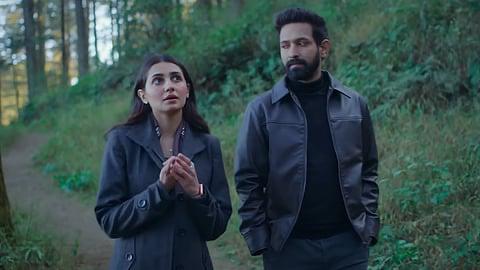
Vikrant Massey is widely praised for portraying vulnerability and emotional restraint. Vedika Pinto and Mahima Makwana have also received appreciation from viewers, especially for making the relationships feel believable. As Preety, Mahima delivers such a bold yet remarkably restrained performance that many people literally took to social media to express their disappointment over how little screen time her character received.
The popularity of “Musafir Cafe” isn't driven only by the series itself. Instagram Reels, Facebook posts, TikTok edits, and short dialogue clips have turned it into an online phenomenon. People aren't simply recommending the show – they're sharing scenes with captions like, "This is exactly what happened to me," or "I wasn't ready for this." As thousands of people publicly relate to the same moments, watching the series becomes a way of joining a larger emotional conversation.
Another fascinating aspect of the series is Neel Adhikari's music. Over the past decade, indie acoustic has carved out a distinct space in the musical landscape of the subcontinent, which explains the extraordinary popularity of musicians like Anuv Jain and Prateek Kuhad. Neel brings that very musical language into “Musafir Cafe”. Along with that, the female playback track “Rozaana” and the way it has been visualised give the female lead a remarkable emotional dominance, something that has sparked a fresh wave of discussion among audiences.

Ultimately, the phenomenon surrounding “Musafir Cafe” isn't simply about its screenplay or cinematography. It's about recognition. The series gives language to emotions that many people struggle to articulate: the loneliness of growing older, the distance between dreams and reality, the weight of choices, and the lingering memories of people who once mattered. Whether one considers it an exceptional series or an overrated one, its greatest achievement is that it has made thousands of viewers feel seen. And in today's crowded streaming landscape, that kind of emotional connection is perhaps the strongest reason behind its extraordinary hype.

 For all latest news, follow The Daily Star's Google News channel.
Comments