


Silence, faith, and the unseen: Jon Fosse in conversation
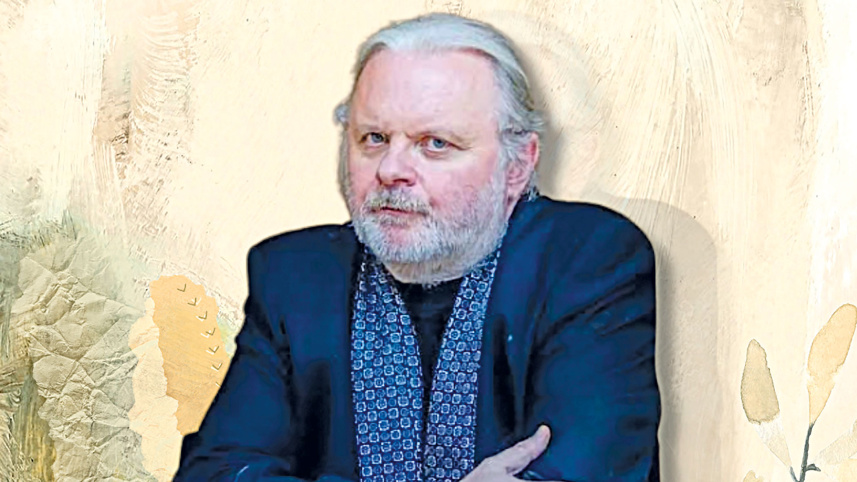
In early September, I met Jon Fosse, Nobel Laureate in Literature 2023, at Oslo’s Kunstnernes Hus (Artists’ House), a cultural landmark situated opposite the Royal Palace gardens. The quiet atmosphere of the building seemed fitting for a writer whose work has become synonymous with silence, repetition, and the unsaid.
Only a short walk away stands Grotten, the honorary residence granted by the Norwegian state to distinguished contributors to national culture and where Fosse now lives. The proximity between the writer’s home and the symbolic centre of Norwegian public life reflects the place he occupies in the nation’s cultural imagination.

Fosse’s relationship with Norwegian theatrical tradition is both intimate and distinct. He has written “Suzannah” (2026), a play centred on Henrik Ibsen’s wife, and translated “Peer Gynt” (1867) into Nynorsk for Robert Wilson’s acclaimed production. Yet his own dramatic vision differs markedly from Ibsen’s. Where Ibsen built drama through conflict and revelation, Fosse creates tension through silence, repetition, waiting, and what remains unspoken. His recent works—Våim (2025), Våim Hotel (2026), and The Play (2025)—continue this trajectory.
I first met Fosse in 2007 while pursuing an MPhil in Ibsen Studies at the University of Oslo. When we met again on September 4 of this year, he surprised me by recalling that encounter. Not the details, as he later explained, but its atmosphere. That distinction between fact and feeling, memory and mood, perhaps offers the clearest insight into Fosse’s artistic world.
What follows is an edited excerpt from our hour-long conversation.
Your new work—Våim, Våim Hotel, and The Play—seem to form a progression: origin, transition, and distillation. What binds these books together?
They are connected by a movement toward simplicity. Våim is the beginning—not a narrative beginning, but an existential one. It is about the first gesture, the first awareness. Våim Hotel is a place of suspension, where characters linger between what they know and what they fear. And The Play is the most reduced of the three. It is an attempt to see how little language is needed for something essential to remain.
Silence is central in your writing, but it can also be evasive. In these works, is silence a refuge, a confrontation, or something else entirely?
Silence is not a refuge, and it is not a confrontation. It is a condition. It is the ground from which language emerges. When I write, I listen to the silence first. If the silence is closed, the writing becomes closed. If the silence is open, the writing becomes open. Silence is not passive; it is active. It shapes the rhythm, the breath, the pauses. Silence is the space where truth becomes audible. I listen to silence, to memory, to the unseen.
Some critics argue that your characters are passive—that they wait too much, hesitate too much, endure too much. Do you see them as passive, or is their stillness a form of action?
I don’t think they are passive. They are searching. Action is not always movement. Sometimes action is staying, or refusing to leave, or enduring oneself. My characters act through endurance. They confront their fears by remaining with them. That is a kind of courage. Literature often celebrates dramatic action, but human life is mostly made of quiet decisions. I write about those.
You often describe writing as a spiritual practice. But spirituality is a contested word. What does spirituality mean in your work?
Spirituality, for me, is simply the awareness that something exists beyond what can be said. I am not interested in doctrine or theology. I am interested in the experience of the unseen — the sense that something is present even when it cannot be named. Writing is my way of approaching that presence. It is a form of listening. If spirituality appears in my work, it is because I write from that listening.
You have written “Suzannah”, a play about Ibsen’s wife, and you have engaged with “Peer Gynt”. Yet you once said you were reluctant to write anything connected to Ibsen. Could you talk about that reluctance, and how you eventually approached these works? And how do you see yourself in relation to Ibsen and the Norwegian theatrical tradition?
Yes, I was reluctant—very reluctant, actually. When NRK first approached me about writing something related to Ibsen, I said no. I felt Ibsen was too monumental, too established, too present in Norwegian culture. I didn’t want to add to the mountain of Ibsen commentary. And I didn’t want to be trapped inside his world. I write from a different place. But eventually I agreed, because the challenge itself became interesting. I realised that if I were to write anything about Ibsen, it had to be from an angle that was not Ibsen’s own. “Suzannah” is almost absent in the biographies, but she is present in the shadows. I wanted to bring her out of the shadows. I wanted to show Ibsen through her tone, her silence, her endurance. Her refrain, “I am Ibsen”—I had read it in one of the biographies. It struck me because it reveals something essential: she was not only his wife; she was part of his identity. She carried him, supported him, and in some ways, created the conditions for his genius. It stayed with me.
As for “Peer Gynt”, I was again reluctant. I didn’t want to touch Ibsen’s language. But I was asked to translate it into Nynorsk, and the challenge was enormous. I had to strip Ibsen’s Danish‑Norwegian of its rhymes, its musicality, and yet keep it as close as possible to the original. It was like walking a tightrope: remove the ornamentation, but preserve the soul. That challenge—the difficulty of bringing Ibsen’s text into my own linguistic world—was what convinced me to do it.
The Nobel Prize changed your visibility dramatically. Has it changed your writing or your relationship to your work?
No. Recognition is external. Writing is internal. The prize is an honour, but it doesn’t enter the silence where the writing happens. That space remains untouched. If I allowed expectations to enter that space, I wouldn’t be able to write at all.
You write often about fear—fear of loss, fear of disappearance, fear of the self. Are these your own fears?
Yes, of course. All writers write from their fears. Fear reveals what we care about. I write to understand my fears, not to escape them. Fear is a form of truth. It is a way of seeing.
 For all latest news, follow The Daily Star's Google News channel.
 This September, “Suzannah” will be staged in Bangladesh—translated into Bangla jointly by Subah Binte Ahsan and myself, and directed by me during the Henrik Ibsen–Jon Fosse Festival 2026 at Independent University, Bangladesh. This will be the first staging of a work by Fosse in Bangladesh. Is there anything you would like to say to the production team?
I hope everyone listens to one another—the director, the performers, and the audience—so that the performance comes together.
Ahmed Ahsanuzzaman is professor of English and Director, Kazi Nazrul Islam and Abbasuddin Ahmed Research & Study Centre at Independent University, Bangladesh (IUB). Fosse’s play “Suzannah” is set to premiere under his direction at IUB on 30 September. He can be reached at: ahsanuzzaman@iub.edu.bd.
Comments