


‘A museum of genocide’: ‘Nimojjon’ depicts the darkness of human history

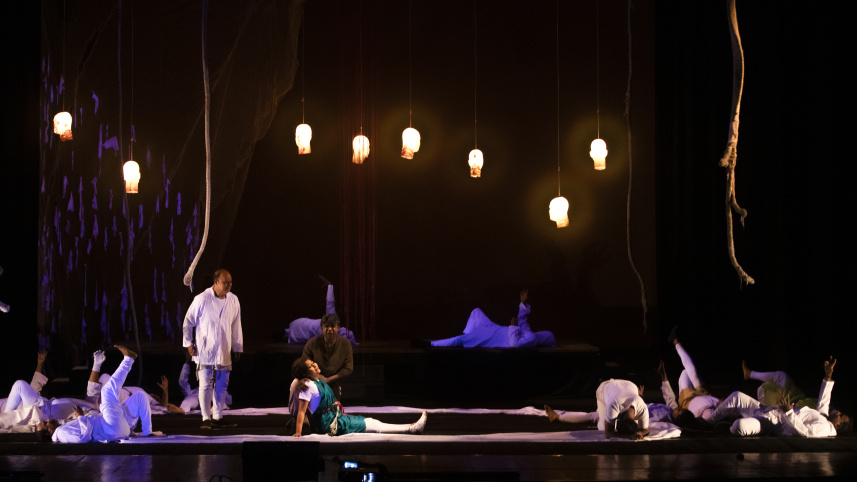
A lone traveler arrives in a strange country, guided only by a letter from an old friend to meet him after decades. The state has no name; it is neither here nor there. An ominousness hangs over every scene as the traveler navigates this unfamiliar land.
Even the audience cannot locate exactly which nation this play is taking place in. Is it Bangladesh? Rwanda? Palestine? Or is it everywhere all at once, yet none at all?

It matters not, for this strange nation bears the signs of human atrocity and cruelty across history.
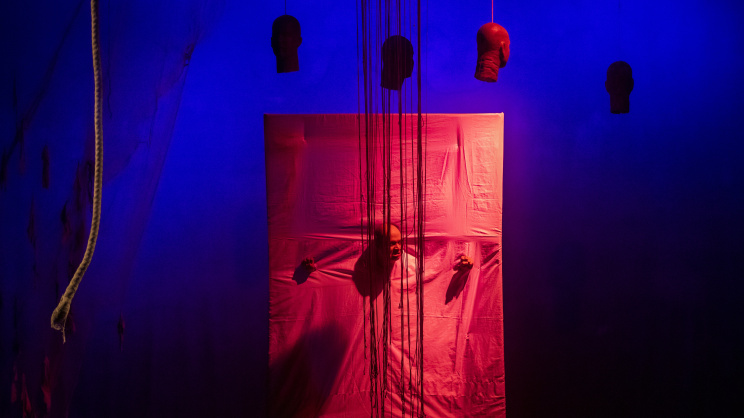
As the world traveler searches for his friend, a professor, he embarks on a journey bearing witness to what seems like the reenactment of global genocides and barbaric cruelty. He sees corpses being pulled from the river—women, men, and infants, all murdered in the water. Another man laments how the hands that were once used for playing instruments are now used to retrieve the dead.
The traveler continues onward and sees tormented women with torn abdomens, reminding him of all the sexual violence that occurs during genocide and conflict. The world traveler has a difficult time recalling the beauty of the world during his travels, his memories overshadowed by the history of human violence.
Just as his friend states, “History may not repeat itself; only genocide repeats itself.” It is this unsettling idea that lies at the heart of “Nimojjon”.
In commemoration of renowned playwright Selim Al Deen’s 77th birth anniversary, Dhaka Theatre and Bangladesh Graam Theatre organised a three-day program starting on 18 August at the Bangladesh Shilpakala Academy. On its opening day, Dhaka Theatre staged “Nimojjon” at the National Theatre Hall. Written by the eminent playwright and theatre practitioner Selim Al Deen, this 1-hour and 45-minute play was directed by Nasiruddin Yousuff. Despite lacking a conventional storyline, the play acts almost like a "museum of genocide." In this fictional world, the traveler, who has roamed the globe for 30 years, encounters human atrocities reminiscent of every genocide in human history.
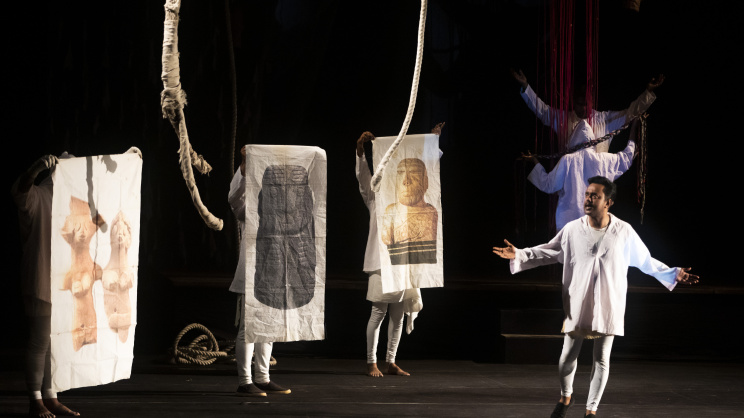
It is a chronicle of the anguished cries of the dispossessed, the oppressed, and those slaughtered for standing against oppressive regimes. From Hitler’s concentration camps and the nuclear devastation of Hiroshima and Nagasaki to the Rwandan genocide, the war in Bosnia, the plight of Ramallah, Gaza, Kandahar, Ayodhya, the Spanish Civil War, Sudan, and the 1971 genocide in Bangladesh, the play depicts how those in power have repeatedly exploited the vulnerable and slaughtered millions of innocent people.
In a chilling scene, the traveler witnesses the corpses of 51 babies slaughtered simply because they belonged to a different religion—an order from the authorities. The traveler becomes distraught, recalling how Hitler slaughtered millions for a similar reason. When he finally meets his friend, once a comrade-in-arms and a professor, he learns that the authorities have hammered a nail into his spine simply because the scholar raised questions. He meets another academic who lost an arm because he used his pen to document the truth.
Many scholars become complacent regarding state violence, murmuring that politics and literature are mutually exclusive. The play does not shy away from showing how the state defangs dissent through brute force or other forms of violence. Selim Al Deen's play notes that even books suffer genocide, showing how oppressive regimes constantly seek to trample people’s voices. A young child has her tongue cut out so she cannot testify to the horrors she has witnessed.
The play does not hold back in depicting how sexual violence is used as a tool of oppression, both in this imaginary town and in historical records. Regardless of age, women and girls are subjected to it.
None of the characters in “Nimojjon” have names, only roles, allowing the harrowing narrative to weave together the story of an imaginary nation and historical events. The play posits that violence is a tool used by those who rely on "religion, state, and ideology" to justify unceasing cruelty.
In its climax, the play realises that human civilisation is built upon tears, blood, injustice, and destruction. The audience witnesses violence tearing through the imaginary state: houses are set on fire, and blood soaks the bedsheets. The genocides of the past and the violence of the present blur together. People—men and women, victims of humanity's horrors—curse those who have committed genocide and oppression as the litany, “No forgiveness for murderers,” echoes across the stage.
The play suggests that such a civilisation is on the brink of decay. As the light dims upon the stage and the society it depicts, it feels as though civilisation is submerging into the abyss, much like history's victims. This abyss of darkness, collective moral decline, and descent—driven not just by violence, but by complicity and submission to the state—is aptly reflected in the play's title, “Nimojjon”, which means "submersion." The play suggests that “genocide means destroying the future while keeping history as a witness.”
However, despite the carnage and destruction, the play ends with a silver lining as the narrator speaks of a new human who may bring forth a different future.
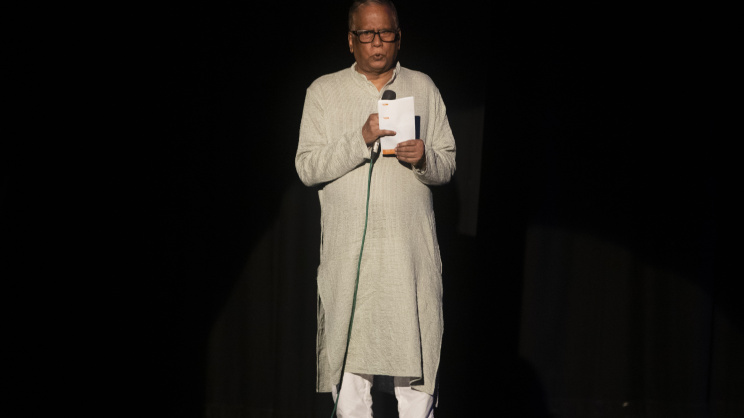
Before the play began, director Nasiruddin Yousuff recalled his days with the playwright and the inception of “Nimojjon”. “Around the year 2000, I asked if we could create a play without a story, questioning how long theater must remain a slave to storytelling,” he said. “While story is its own art form, theater and film remain uniquely dependent on stories. I felt that if such a departure from storytelling could happen in film, I could achieve it in theater through direction.”
Following the discussion, the playwright spent years studying genocides before finally writing “Nimojjon”, a production that gathers genocides from all over the world into one place. Years of day-and-night work went into creating this massive production. “The original work takes seven to eight hours to perform, but since we lack the environment for such a long play, we have edited it down to one hour and forty-five minutes,” Yousuff said.
Yousuff also noted that because the play lacks a traditional story, the audience will experience events that allow them to construct their own narrative.
Discussing the programme celebrating the playwright, he mentioned that the play “Ek Shathe Choli, Ek Shathe Bachi” will feature both disabled and non-disabled actors on the final day of the event. “We want to create an inclusive theatre where disabled and non-disabled people perform together on stage,” he said.
 For all latest news, follow The Daily Star's Google News channel.
Comments