


Belonging, stitched in steel and memory

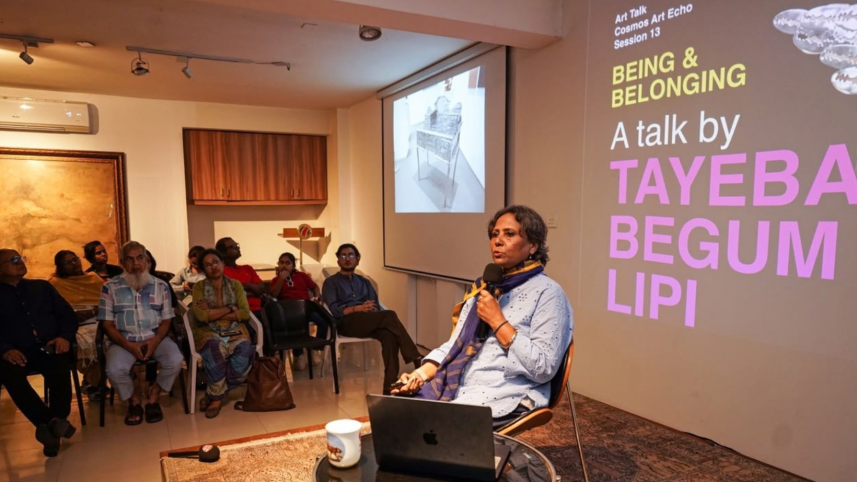
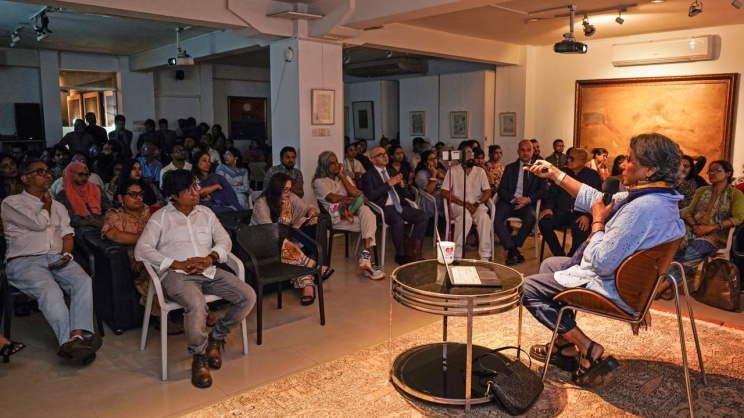
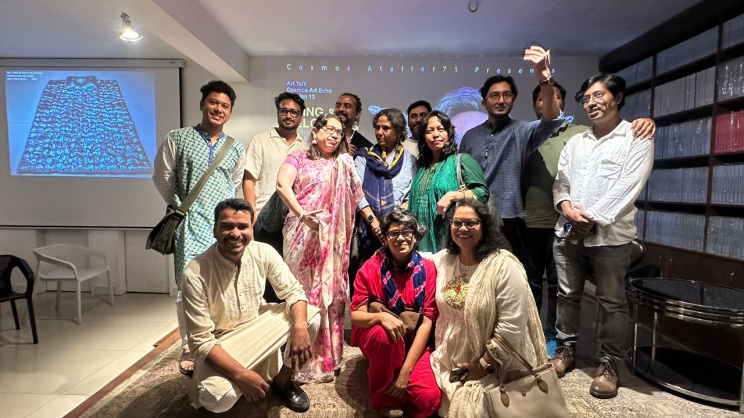
Rain pressed against the windows of Cosmos Centre on Friday evening, but inside, a small, attentive gathering of artists, diplomats and art lovers had settled into a different weather: the quiet, searching climate of memory. The occasion was the 13th session of Cosmos Art Echo, where Tayeba Begum Lipi delivered a talk titled “Being & Belonging”.
Lipi, one of Bangladesh’s most distinctive contemporary artists, did not begin by discussing her art. Instead, she began with a reluctance. It was her elder brother, now a professor at Rajshahi University, who encouraged her to enrol at the Institute of Fine Arts at the University of Dhaka. Having attended several schools in Rajshahi and completed her higher secondary education in Gaibandha, she arrived at the institute unsure of what lay ahead. She left, she said, having discovered freedom.
That freedom took her far. Art tours took her to Kathmandu, Jaflong and the Sundarbans, where a group of young artists encountered robbers at the forest’s edge but carried on regardless. “We never really sat idle; we were always doing something,” she recalled.
Her work subsequently crossed borders. She undertook a residency at the Irish Museum of Modern Art in 2000, worked on a project exploring indigo cultivation at Gasworks in London in 2005, and conducted research on political prisoners on Taiwan’s Green Island in 2007.
Back home, her art became increasingly intimate. Everyday objects began to carry personal histories: her grandfather’s gramophone, her mother’s dressing table and wheelchair, and a steel suitcase associated with her wedding. Razor blades and safety pins, small, sharp and humble objects, became part of her artistic vocabulary, expressing fragility and endurance in equal measure. She later explored performance and large-scale works, including pieces created during the Covid years.

Then came the most difficult chapter of her life.
“After Covid, I had a lung infection and I suffered a stroke. Towards the end of 2023, I was diagnosed with cancer. I am now well, and I am on medication,” she told the audience, speaking plainly and without embellishment.
She also spoke about her husband, prominent artist Mahbubur Rahman, co-founder of Britto Arts Trust, whom she met while studying at the Institute of Fine Arts. Their marriage, she explained, was built less on convention than on companionship.
“We are still much like friends. Being able to come this far together is a great achievement,” she said.
The couple have also preserved many belongings of writer Shawkat Osman in the home they now occupy.
Lipi concluded her talk by announcing plans for her next exhibition, which is scheduled to take place at Bengal Gallery in 2027.
Enayetullah Khan, chairman of Cosmos Foundation and editor emeritus of UNB, paid tribute to the artist during the evening. He described art as a way of bringing people together amid the pressures of modern life.
“Art is everything. Art is conversation,” he said.
Khan recalled earlier initiatives such as Art Against Genocide, Art Against Fake News and Art Against Terrorism, and announced his intention to organise an initiative titled “Art Against Corruption”.
With a wry note, he recalled wondering as a child what people who took bribes looked like. “But now the question seems to be what people who don’t take bribes look like,” he said.
He added that he always wanted to remain close to artists, whom he considers essential to bringing about positive social change. Just as people practise their respective trades, artists, he said, practise beauty. Reflecting on Lipi’s work, Khan noted how artists like her help society become more sensitive by encouraging people to see familiar realities from different perspectives.
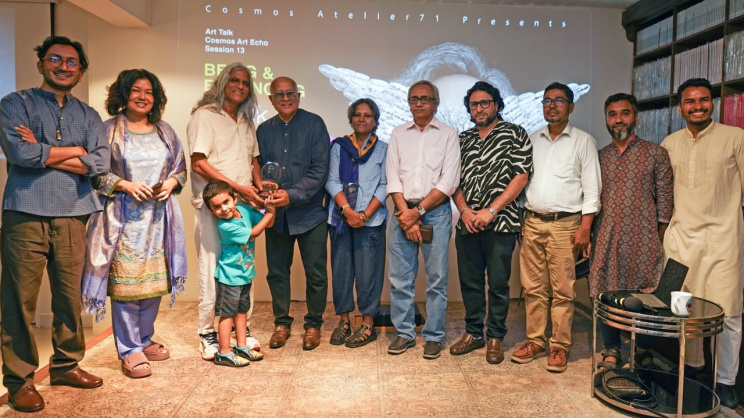
Khan then presented mementoes to Lipi and Mahbubur Rahman in recognition of an evening marked by candour and reflection. It was a small gesture of gratitude to a couple who have spent a lifetime creating art while making room for each other.
As the evening drew to a close, the rain seemed a fitting companion to a conversation about roots and shelter, about what we carry with us and where we belong.
 For all latest news, follow The Daily Star's Google News channel.
Comments