


‘Where My Darlings Lie Buried’: Navigating grief with Sufia Kamal through poetry

I first understood that grief has a separate grammar long before I could find words for it. It was in the way a feeling would just sit inside the chest—not loudly, not dramatically, but with the quiet, insistent weight of a stone that has been there so long the body simply grows around it like a grapevine. And then, somehow, a poem would arrive. Not to remove the stone. Not to explain it. But to sit beside it, to name it, to say: I see you. You are real. And you are not the end of this story.
This is what poetry has always done for me, for those of us who find that ordinary language sometimes fails at the borders of extraordinary pain. And very few in Bangla literature understood this more deeply, or practised it more faithfully, than Begum Sufia Kamal.

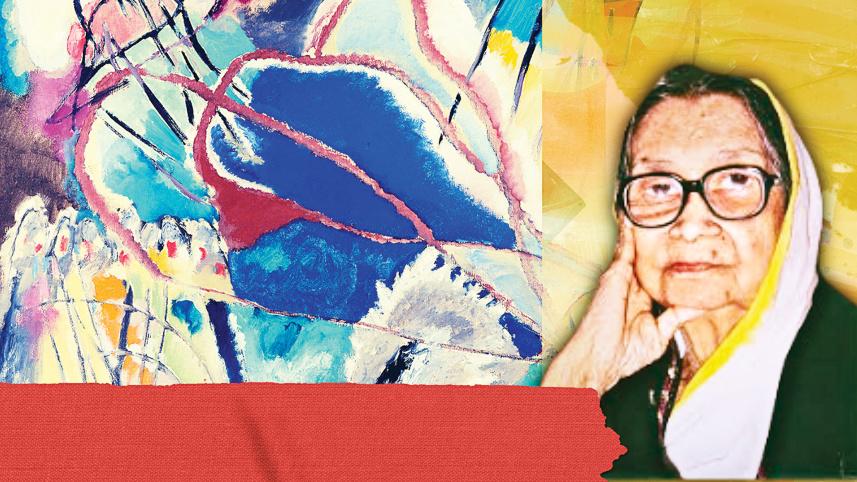
Sufia Kamal, born on June 20, 1911, was a woman built by losses that would have silenced most of us. At 21, she was widowed. Her first husband, Nehal Hossain, died suddenly of tuberculosis, leaving her with a young daughter and a grief too large for the small rooms of regular speeches, endless silences. It was into this silence that her poetry had entered. And it was from this silence that Sanjher Maya (1938) was born. It is her first poetry collection, which drew a foreword from Kazi Nazrul Islam and moved Rabindranath Tagore to write to her that she held “a high place in Bangla literature, as constant and fixed as the Pole Star.”
Sanjher Maya opens in the hour of dusk—the melancholic threshold between day and night, between what is and what has been taken. And this is where Sufia Kamal would plant herself as a poet, not in the daylight nor in the dark but in the honest in-between. The place where grief and beauty can coexist without apology. This is the choice every poet who has ever written through pain must make, not to look away, and not to be consumed, but to remain in the difficult light and describe exactly what they see. The words of grief climbing painfully through the vine-like veins and still flowing as strong as the darkened ink.
I know this choice. I have made it myself, in the lines that come not when I am fine, but when I am most undone. There is a kind of strength that is only born in that place of undoing. Her “Taharey Pore Mone” and the quiet waiting for something that will never return, held the hand of grief in a silent but equally vibrant winter afternoon, where she acknowledges the ultimate loss of her loved one, but still announces with the strength—that she will always remember her loved one, whatever form the weather takes.
Emily Dickinson, writing across the world and across the century, understood this same twilight instinctively. In “After great pain, a formal feeling comes”, Dickinson mapped the numbness that follows devastation, the way the body goes mechanical, the way the nerves sit ceremonious like tombs. What both poets knew, separated by oceans, is that grief does not announce itself with drama. It arrives quietly, and it rearranges everything.
By 1970, when her collection Mrittikar Ghran arrived, Sufia Kamal’s sorrow had grown beyond the personal. The intimacy of Sanjher Maya, had expanded outward, stretching toward the soil of Bengal itself, toward women’s bodies and their suffering, toward the wounds of a people living under occupation. In collections like Maya Kajal, Abhijatrik, and Udatta Prithibi, she had been tracing this expansion, learning what every poet who survives long enough eventually discovers: that personal grief and collective grief are not separate countries. They share a border. And sometimes they are the same country, just wearing different names.
During the Liberation War, Sufia Kamal remained in Dhaka while her daughters joined the Mukti Bahini. Her son Shoeb Kamal went missing that year and was never found. The Pakistani military threatened her life. She was brought a document to sign, stating that no massacre had taken place in Bangladesh. She refused. “I would rather die,” she said, “than put my name to a lie.”
She kept two diaries through those months: Ekatturer Diary, an account of the war in prose form, and a poetic diary she titled Mor Jaduder Samadhi Pare (Where My Darlings Lie Buried). That title alone unravels me every time I encounter it. Four words that hold a universe of love and loss. ‘Jaduder’ means darlings, beloved ones—and they are buried. And yet she is writing. In these wartime poems, her grief becomes an act of resistance. She addresses the martyrs directly—she tells them she will not disturb their sleep, but will leave a kiss on the green mounds of their graves. She managed to make martyrdom intimate.
Sylvia Plath did something similar, although far more introspective—in “Ariel” (1965), she weaponised her own suffering, turning personal anguish into a language so precise and so ferocious that it still reads like a wound that won’t close. Plath and Anne Sexton, her friend and fellow confessional poet, both showed the literary world that a woman’s inner devastation was not a minor or decorative subject—it was the subject, with the full weight of history inside it. But where Plath burned inward, Sufia Kamal burned outward. Her grief was never only hers. From the very beginning, it belonged to whoever needed it.
Every poem I have ever written from a place of grief has taught me this too. Melancholia, when you sit inside it long enough and with enough courage, does not hollow you out. It deepens you. It clears away the noise until only the essential remains. And what remains, if you are lucky and if you keep writing, is something that looks very much like clarity. Like survival. Like a voice that is yours and no longer afraid.
Sufia Kamal passed away on November 20, 1999. She was the first woman in Bangladesh to receive a state funeral. But she has not gone anywhere. Not really. She is still in the evening light of Sanjher Maya, still in the soil-fragrance of Mrittikar Ghran, still in those green mounds of Mor Jaduder Samadhi Pare. She is proof, the most enduring kind, that poetry does not merely document what we suffer. It teaches us how to survive it.
Tahseen Nower Prachi is a Lecturer of Media Studies and Journalism and a writer whose head is a koi pond of micro tales too scattered to come down to her keyboard. For more of her little pieces, follow The Minute Chronicles on Facebook.
 For all latest news, follow The Daily Star's Google News channel.
Comments