


Of faith, desire, and the threshold between
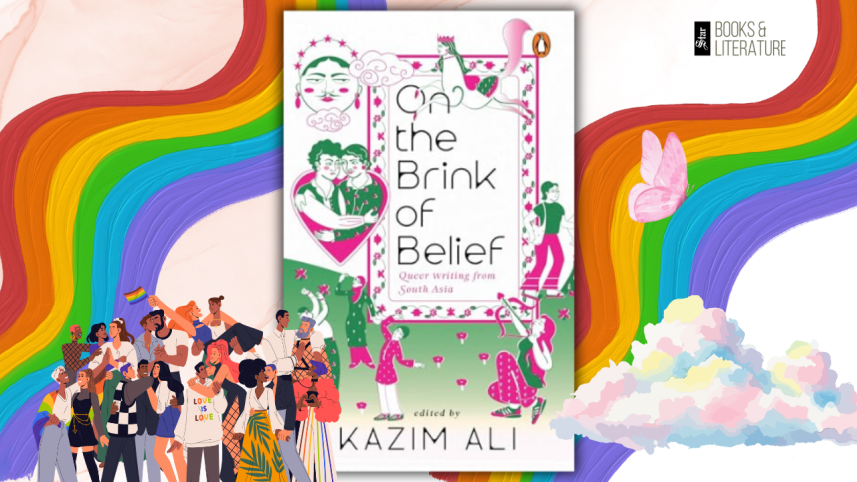
I feel like there are two types of anthologies. There are anthologies that feel like arguments, and there are anthologies that feel like third spaces where people have gathered to speak without the pressure of being understood. On the Brink of Belief is the second kind. Edited by Kazim Ali and born from The Queer Writers' Room (a literary initiative by The Queer Muslim Project in partnership with the International Writing Program at the University of Iowa), the collection brings together 24 LGBTQ+ writers from South Asia. What holds them together is a shared refusal to choose between their queerness and their identities.
The secularised west has a standing assumption that faith and homeland is the enemy and that queer freedom requires leaving it behind. This anthology runs against that assumption on every page. These writers are living through it and they find in it something that mainstream queerness has never quite offered: a sense of belonging rooted in where they actually come from.

For readers in Dhaka, the collection announces its stakes early. Kancho’s pieces “Work Meeting, Tuesday Night, Humid Rains, Traffic In Front of The Sheraton” and “Vertical Interrogation” place us inside a near-future Dhaka thick with power cuts, DGFI surveillance, and the long shadow of enforced disappearances. The second piece is structured as an interrogation transcript, a love story conducted in the cold language of the state, desire traced through the blind spots of a security system. Inspired by Bhanu Kapil's clinical prompts, Kancho makes the interrogation cell into a place where desire is extinguished, but where it quietly persists. A fair reading must ask whether using a state intelligence cell as a literary device risks aestheticising actual terror. That question is worth sitting with. But the piece owns the discomfort it creates.
Nil's “Hahakar” takes the same political anxiety inward. Memory in this story is contamination, something that corrodes. Read together, the two pieces form a portrait of what it costs to be queer in a city that watches.
But to read this anthology only through the lens of survival and cost is to miss something the collection insists upon. The Queer Muslim Project has always stated that it centers joy alongside struggle. Begum Taara Shakar's “Even Shaitan Showers” is funny and sensuous, reclaiming the bathroom floor (theologically feared as the devil's territory) as a space of intellectual play, recasting God and Shaitan as star-crossed lovers. Anna S. traces a queer romance across six reincarnated lifetimes, connected only by a map-shaped birthmark below the left eye. moving through the registers of science fiction and fairytales. Isurinie Anuradha Mallawaarachchi's “To the American Suddi” is a sharp, funny mockery of western academic tokenism, aka ‘the expectation’ that brown queer writers will perform their difference on cue, exotic and grateful. These pieces treat joy and humor as a subject in its own right, making the anthology richer.
In the domestic interior, the anthology is at its most assured. Ipsa's “On This Afternoon, Like Every Other” takes the shakchunni, the Bengali folk icon of an unhappily married woman, used for generations to keep women in line, and returns her transformed into an emblem of lesbian tenderness and ordinary domestic warmth. Sara Haque's “A Fever, A Djinn And The Collectibles Of Grief” strips the djinn of its decorative mysticism and recasts it as a container for inherited family loneliness, the kind passed silently down through generations alongside amulets and unspoken histories.
These are acts of reclamation. But I'll be honest, the anthology does not fully reckon with those for whom reclamation is not possible. As in those for those whose survival has required not reinterpretation but distance. The book also moves largely across the experiences of Muslim and Hindu writers; caste, though named in its framing, surfaces unevenly in the actual writing, and its relationship to queerness in the subcontinent deserves more than the occasional mention it receives. These are real gaps in an anthology that aims to be comprehensive. The anthology spans flash fiction, memoir, lyric poetry, speculative prose, and metafictional interruption. That range and the collection's ambition to contain 24 voices means some pieces feel under-edited, whereas others feel fully formed.
On the Brink of Belief is flawed and uneven, and at its best, extraordinary. It does not offer comfort or resolution. What it offers instead is a record. Of survival, yes, but also of tenderness, desire, formal experiment, theological argument, and erotic joy. Across this region, in these conditions, with these stakes, people are writing. This anthology insists you take it seriously, and it earns that insistence on almost every page.
Kazi Raidah Afia Nusaiba is a contributor.
 For all latest news, follow The Daily Star's Google News channel.
Comments