


In conversation with Sonia Bahl: Author of ‘Eighteen Inches Apart’
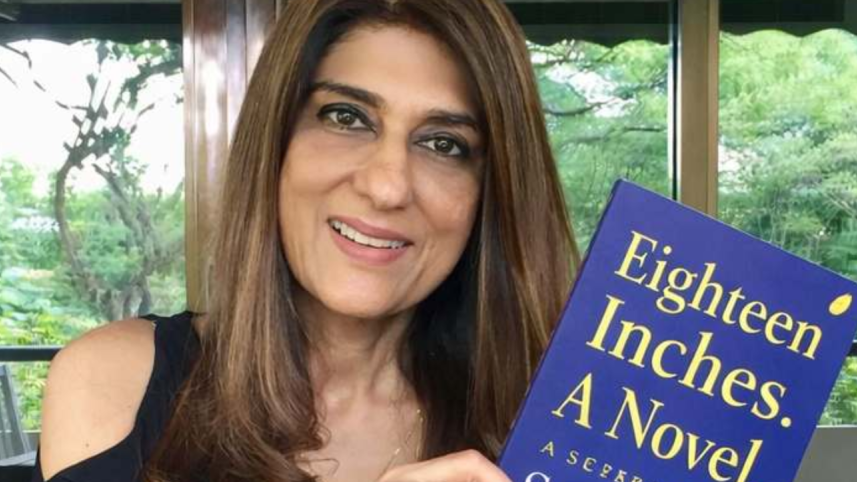
Across her fiction, Sonia Bahl has remained deeply interested in emotional transience: the fleeting encounter, the interrupted conversation, the stranger who enters a life briefly yet leaves behind an enduring emotional residue. From her debut novel The Spectacular Miss (Fingerprint! Publishing, 2016), a coming-of-age story attentive to memory, performance, and emotional becoming, to A Year of Wednesdays (Fingerprint! Publishing, 2019), which explored the lingering afterlife of a brief connection between two strangers, Bahl’s work has consistently returned to the fragile architecture of human relationships that exist outside conventional definitions of intimacy. Her novels are less concerned with permanence than with emotional imprint and the ways seemingly incidental encounters continue to reverberate across a lifelong after they have ended.
With Eighteen Inches Apart (Fingerprint! Publishing, 2026) however, Bahl appears to move beyond the architecture of chance encounters into something more expansive and formally meditative. Moving between Calcutta and London, memory and immediacy, intimacy and estrangement, the novel examines how people continue to inhabit emotional moments long after time itself has moved on. In conversation with Kitaab, Bahl reflects on narrative rhythm, restraint, revision, loneliness, and the invisible emotional threads that quietly bind lives together across cities and continents. What emerges is a portrait of a writer deeply attentive not merely to story, but to emotional atmosphere, what she calls the weather of a chapter, the reverberation of a moment, and the delicate space between seeing and feeling.

What becomes increasingly evident across Bahl’s three novels is her sustained fascination with the emotional significance of almosts and maybes. Relationships that nearly happened, lives that could have unfolded differently, moments that arrive accidentally yet alter perception permanently. In A Year of Wednesdays, this manifested through two strangers whose brief encounter leaves a lasting emotional imprint and in Eighteen Inches Apart, those concerns deepen into a broader philosophical inquiry about coincidence, longing, grief, and hope. The emotional terrain remains recognisably Bahl’s, but the scale feels larger, the silences more confident, the interiority more patient.
The conversation that follows offers illuminating insight into the emotional and philosophical terrain beneath her latest novel.
The novel moves across cities, timelines, and perspectives with remarkable fluidity. How did you approach structuring a narrative built less on plot mechanics and more on emotional resonance?
I consider plot a necessary intrusion on what I really want to do, which is write snappy dialogue.
The incomparably brilliant screenwriter Aaron Sorkin's words have always resonated. For me, plot often gets in the way of emotions. While plot mechanics are useful scaffolding, I lean into emotional momentum. Does this moment reverberate into something later? The dual perspective was never a structural decision so much as an emotional necessity. Two people, two cities, two interior worlds. The only way to make the invisible threads between them visible was to let the reader inhabit both simultaneously. Also, I can’t help but think of chapters less as plot units and more as emotional states. Each one has its own weather.
Eighteen Inches Apart feels attentive to rhythm in a musical sense—certain images, moods, and emotional motifs recur almost like refrains. Do you think about prose musically when you write?
I love the line: “music is what language would love to be, if it could”. But really, I’d give the highest of fives to the years spent in advertising. As a copywriter, one worships at the altar of brevity—even in long copy ads, especially in long copy ads!—and rhythm. And crafting that twist in the tail to bring you back to where you started. Perhaps that’s what translates to a musical syntax that the reader picks up on? I definitely don’t have the talent to compose prose the way a musician scores a piece. But 12 years of writing for an audience that would give you about three seconds of their attention teaches you to use rhythm as seduction. It gets into your bones. After a while you stop hearing it consciously, it just becomes the beat to which you write.
Your characters often seem suspended between memory and the present moment. Are you interested in how people narrativise their own lives internally, even when outwardly very little appears to happen?
Completely. Aren't outer lives mostly predictable posturing of who we think we ought to be? It's the inner life that's rich and complex. Both Leela and Neel are outwardly functioning: moving through the world, making decisions, showing up. But internally they're living completely out of sync with their own present moment. Leela is still in the street where she saw him. Neel is still in the room where he lost her. And I think that's true of most of us.
We're all somewhat unreliable narrators of our own lives—constantly reshaping memories and coincidences into stories that help us endure. We romanticise, minimise, mythologise. We turn chance encounters into signs and losses into meaning. It's the gravitational pull toward hope. Or as Ellie Chu put it: "Gravity is matter's response to loneliness".
There’s extraordinary restraint in the novel. Important emotional shifts happen in pauses, glances, unfinished conversations. How difficult is it to write silence convincingly on the page?
Honestly? It's probably a happy byproduct of living in constant dread of boring the reader. Or doing them the disservice of underestimating them. If I've managed to write silence convincingly, it's less a conscious craft decision and more a survival instinct. Trust the reader. Get out of the way. Let the moment breathe.
The book contains vivid sensory details without ever becoming overly descriptive. As a writer, how do you decide which details deserve permanence in a scene?

I begin with one manuscript and it quickly morphs into two. The second one is the temporary resting place for the darlings I kill. The truth is, I rarely go back to create a Lazarus moment and bring any of them back to life. What survives are the parts with emotional meaning. A detail earns permanence if it reveals something about longing, loss, or who a person is becoming. To borrow from Sally Rooney: “The details that survive are often the ones that expose vulnerability”.
In many ways, this novel trusts the reader deeply and resists over-explaining emotion or motivation. Do you think contemporary fiction sometimes underestimates readers’ emotional intelligence?
In this time of mass distraction, receiving attention is an act of pure luxury. It's a monumental privilege when a reader chooses to pick up the book and affords you the time and space to inhabit your world. Don't we all read the same book but arrive at different meanings? Every reader brings their own life, their own emotional furniture, their own way of making sense of the world to the page. To over-explain intention would be such a lost opportunity. It would mortify me to rob a reader of the chance to find their own meaning in the story.
 For all latest news, follow The Daily Star's Google News channel.
 Compared to your earlier work, did this novel require a different emotional or technical discipline from you as a writer?
They say, “third time's a charm”. Not for me. The first two moved from the first page to publishing in what felt like an effortless blink. This one sat as a tentative first draft, coddled in doubt, for a long time. It might have something to do with having written it during the pandemic. A time when we felt utterly distanced from the people we loved and strangely connected to people, we'd never met. Which, when you think about it, is exactly the beating heart of this story. It was also a time of immense grief and despair, and that seeped into the writing. I just couldn't let it become the story. The story I had in my head was about hope. That tension became the emotional climate of the book. Protecting that balance felt harder than anything I've written before.
You’ve written about people whose lives intersect briefly but indelibly before, yet this novel feels more expansive and meditative. Do you see Eighteen Inches Apart as part of an ongoing conversation across your books?
I've lived in nine cities across four continents. With home being everywhere and nowhere, I developed a deep belief in the power of the moment. In the idea that unexpected human connections can alter the course of a life. That belief seems reluctant to leave my writing.
The plots and protagonists across my three novels couldn't be more different. But the common thread is invariably about people living in maybes. Lives where chance, serendipity, and the connections they never saw coming end up mattering most. The best moments in these characters' lives are almost always the ones that nearly didn't happen, with someone they never expected, in a place they never planned to be.
What does revision look like for you? Are you someone who discovers emotional truth in the first draft, or does it emerge slowly through rewriting?
I'd be hopelessly lost if I weren't carrying the emotional core of the story from the get go. That part doesn't emerge through revision, it has to already be there, it's my compass.
What revision looks like, however, is a kind of obsessive subtraction. I cannot look at a page and feel it's done. Every time I read it back, I see flab. Cut, chop, censor, tweak. Then do it again. And again. I become a ‘kill your darlings’ virtuoso.
Antoine de Saint-Exupéry said: "Perfection is achieved not when there is nothing more to add, but when there is nothing left to take away."
I could keep taking away forever. At some point the inner critic simply has to be talked down from the ledge.
Namrata is a writer, a digital marketing professional, and an editor at Kitaab literary magazine.
Comments