


Kishwar Chowdhury on Bangali culture and culinary storytelling

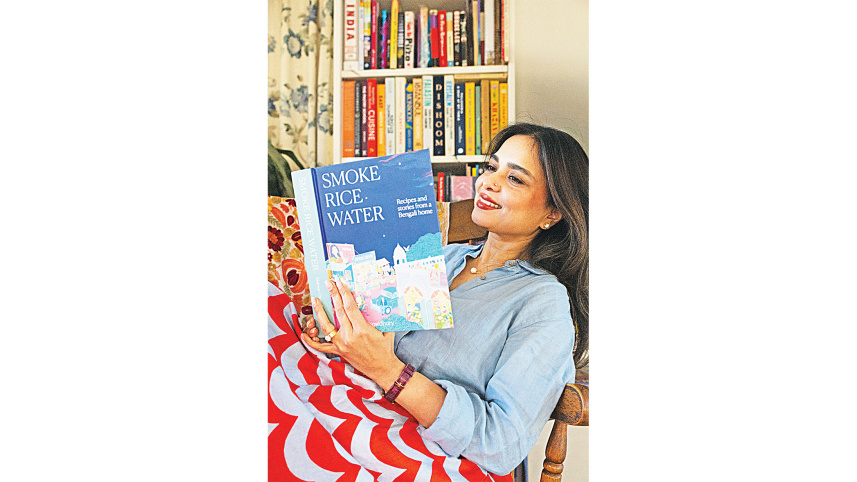
When the MasterChef favourite Kishwar Chowdhury and writer Samai Haider caught up to talk about Chowdhury’s debut cookbook Smoke, Rice, Water (Hardie Grant Books, 2026), the conversation quickly morphed into something much larger than publishing deadlines and recipe testing.
What unfolded instead was an intimate discussion about memory, migration, and the emotional weight of preserving culture through food. As the two authors compared notes on the writing process, the stories behind the book slowly unravelled in the interview—one memory leading to another, one dish opening the door to an entire history.
 For all latest news, follow The Daily Star's Google News channel.
 Food holds such an emotional place in our hearts. Even when people are gone, we still chase those flavours because they connect us to memory and belonging. That’s really what I wanted this book to become—a way of carrying those stories and tastes forward for the next generation.
Writing a cookbook often sits somewhere between memoir and instruction. How did you find your voice on the page, and did it differ from how audiences saw you on MasterChef?
The storytelling aspect really began on MasterChef. I realised very quickly that people didn’t have a reference point for what I was cooking or even where Bangladesh was. Sometimes people would ask me, “Is Bangladesh in India?” and I’d have to explain, no, it’s an entirely separate country.
So, storytelling became necessary. To understand the food, people first needed an introduction into my world. I had to explain why this wasn’t North Indian food, where Bengali food sits culturally, and why we eat the way we do.
There are almost 300 million Bengalis in the world and yet we’re still largely unseen in global consciousness. Once I understood that gap existed, I felt a responsibility to tell those stories properly—not just for myself, but for future generations too.
When you first sat down to write the book, what kind of story did you want to tell beyond the recipes?
I knew very early on that I didn’t want this to simply be a collection of recipes. I wanted to show the breadth and diversity of Bengali food because people often reduce everything from our part of the world to just “curry”.
I really dislike that word because it flattens everything into one singular idea. We learn French food terminology so easily, but Bengali dishes all become “curries”. A rezala, the rich, fragrant Mughlai style meat dish, becomes a “curry.” Haleem, the slow-cooked stew of meat, lentils, barley and wheat, also becomes curry. Even a stir-fried pumpkin bhaji, somehow becomes curry.
I wanted the book to show how layered Bengali food culture really is—the Mughlai influences, the importance of freshwater fish in this riverine delta, street food, home cooking—all these different threads that make up Bengal.
There’s so much history tied into the food: Persian influence, Chinese migration, British colonialism, the rivers, the sea. I could honestly write three volumes and still only be scratching the surface.
Many of your dishes are rooted in memory and oral tradition. What was the process of translating those intuitive, inherited recipes into precise measurements and methods?
That was probably one of the hardest parts because Bengali cooking is so instinctive. We learn through phrases like “a little bit of this” or “cook until the smell changes”. My mum would say things like, “turmeric should be seen and not tasted”; that’s how our mothers and grandmothers taught us. That tells you much more than simply writing “half a teaspoon turmeric”. So, while the recipes needed measurements for a global audience, I also wanted to guide readers through the why behind the cooking: why we’re using certain spices; what flavour balance we’re aiming for; how something should smell or feel when it’s ready. I wanted readers to feel as if someone were standing besides them in the kitchen, guiding them.
Food writing relies heavily on sensory detail. How did you work to capture the smells, textures and the atmosphere of your cooking in words?
For me, it was about setting the scene. Take Dhaka’s kacchi biryani. Of course, the recipe is there, but I also wanted readers to feel the experience around it—flying to Dhaka in winter, wrapping yourself in a shawl, going to weddings where famous baburchis are cooking giant vats of biryani. Or something like fuchka (crispy, hollow dough balls stuffed with spiced mixture or potatos and chickpeas). Yes, I can teach you how to make it at home, but honestly, part of the experience is standing beside the fuchka cart while the vendor adjusts the spice and tamarind water exactly to your taste.
The recipes matter, but so do the memories attached to them. Food is transportive. Smell especially carries memory in such a powerful way.
As writers, we sometimes grow attached to what we create. Were there recipes or stories you simply couldn’t bear to leave out?
Absolutely. Leaving out the recipe for peyaju nearly broke my heart. I had beguni and pumpkin flower fritters in the book already, but peyaju idn’t make the final cut. It’s such an important comfort food for us, not just during Ramadan, but all throughout. I still think about it. But maybe that just means there needs to be a second book!
As writers, we often focus on the words, but this feels like a deeply visual, collaborative work too. Could you talk about the illustrators, photographers and other creatives you worked with, and how their contributions shaped the book?
I really wanted the book to be created through a Bengali lens; I didn’t want it interpreted entirely through a western publishing framework. The photographers, illustrators and designers understood the emotional core of the project immediately. We worked with artists in Bangladesh and Kolkata who captured river life, markets, food stalls and everyday moments that felt deeply authentic to us. The cover has all these tiny details and Easter eggs woven into it. It became more than design work—it felt like everyone involved emotionally invested themselves into telling this story properly.
Writing a cookbook requires discipline as much as inspiration. How did you balance creativity with deadlines and structure?
Deadlines were actually useful because otherwise I probably would have kept editing forever. But the process itself was relentless. Writing a cookbook isn’t just recipes. It’s storytelling, research, editing, testing, restructuring—all while life continues around you.
There were moments where I was writing on planes, writing after cooking demonstrations, waking up at four in the morning to get work done before my kids woke up. At one point I was literally writing sections of the manuscript in hospital with an IV drip in my arm. I absolutely do not recommend that approach, but when you’re deep inside a creative project, there’s this fear that if you stop, you’ll lose momentum completely.
Your recipes carry such a strong sense of place and memory. Did revisiting those stories change how you see your own food or identity now?
When I was writing certain sections, I could almost feel myself transported back into childhood memories—specific kitchens, family meals, wedding feasts, little food rituals. As I get older, I find myself craving very simple deshi food more and more: daal-bhaat, maacher jhol—things my mother or grandmother would cook. Food holds such an emotional place in our hearts. Even when people are gone, we still chase those flavours because they connect us to memory and belonging. That’s really what I wanted this book to become—a way of carrying those stories and tastes forward for the next generation.
Samai Haider is an economist by profession and a writer by passion. She is the author of Tilmund’s Travel Tales, a picture book that aims to instill wanderlust amongst young children. Read about the fables of her foibles at http://samaihaider.com.
Comments