


Kebabs, christmas cake, and the making of a storyteller
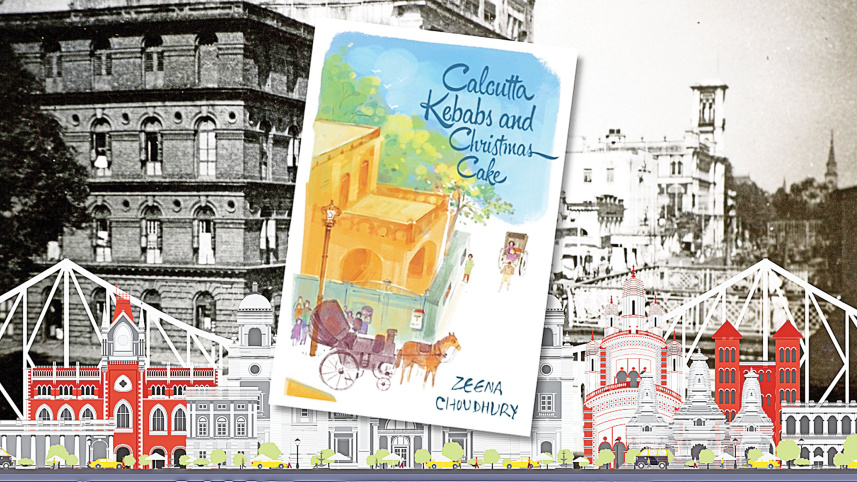
7 Park Lane is the domestic domain described as “etched in memory like a beloved sepia photograph […] It was a world apart from the disciplined confines of Loreto Convent, Darjeeling.” Zeenie spent the years 1946 to 1951 at the hill-station, returning for her winter break.
Zeenie’s innate curiosity while coming of age, and her close involvement with her extended family, both young and old, form the framework and content of Calcutta Kebabs and Christmas Cake. The book’s title reflects the city and the symbolic presence of Zeenie’s two Queens—her Nanna is the landlady and her maternal grandmother who resides upstairs and Maggie is the other loving grandmother residing downstairs. Thus we have kebabs from upstairs and Christmas cakes from downstairs.
 For all latest news, follow The Daily Star's Google News channel.
 Her first visit downstairs results in the following welcome: “So you are the pretty princess who climbed the convent walls and escaped.” Reading it, I giggled, quite pleased, then beamed. I loved her from that instant. “I am Zeena from upstairs. She introduced herself, curtsying. Nanna sent some food. She hopes you will like the kebabs”, and thus we have our first introduction to Zeenie. She describes herself in the Dramatis Personae innumerable pages later, as “Narrator and Princess of Park Lane, observant, mischievous and tender-hearted.”
The Princess of Park Lane (Berkely, 2003) is a cheeky charmer. “The most notable man at Lower 7 Park Lane was sunburnt. I soon discovered he was 7 Park Lane’s very own Rhett Butler, our Clark Gable […] Every time we met, we would re-enact the final scene of Gone with the Wind. I was, of course, Scarlett O’Hara. He was my Rhett Butler—we would both giggle, and then I would say, “Rhett, Rhett. You’re not leaving me?” He would reply, “Frankly, my dear, I don’t give a damn,” and then I would sigh and say, “After all, tomorrow is another day.”
Zeenie further writes, “Master moshai, to put it simply, was my “bestest” friend. With him, a walk was history, poetry, theatre. We critiqued films and jatras, hummed ragas and popular choruses, studied Zainul Abedin’s famine drawings and Jamini Roy’s folk saints, debated everything and dared to form opinions.” His name was Dipankar Chakrabarty. Dipankar= deepa (lamp) + pankar (bearer)–fitted him to a T. One who carries light—symbolically, it represents wisdom, enlightenment, guidance and inner brightness. Slowly, as Zeenie grows up, the author Zeena emerges.
Zeenie relates frank details of family members and other painful adult encounters. There is an invitation to Memdidi, Master moshai’s wife, and Master moshai’s 30th anniversary of their very first meeting in Brighton on January 19, 1920. Amongst much merriment, “Memdidi wore a tight smile” and “confided the sad truth about her three miscarriages, that, due to medical complications, she would never be able to bear a child.”
Seated at the piano, Memdidi sang in plaintive tones:
“Shokatore oi kandiche shokole, shono! shono! pita!
Ja kichu paay, haraye jaay, na mane shantona”
Late at night, “Nanna spoke in tight whispers, clutching the phone. “Oh no! Master moshai…it just cannot be!...Mira has killed herself.” A heart rending experience for a sensitive child to witness.
A contrasting exposure for Zeenie is the arrival of Nana Sahib, her maternal grandfather. “The whole house seemed shrouded in gloom, despite the bright winter sunshine outside. I felt so suffocated that I tiptoed down the stairs to Maggie…and cried for Nanna, who looked so sad. How dare he come back to 7 Park Lane—Nanna’s house—after pushing her aside to make way for his third wife? Please, please—can’t I stay with you until he leaves?” Maggie replied, “I think this is the time for you to be her special guardian angel, always by her side.” At a tender age, Zeenie is exposed to harsh realities of life and the deep pain endured by a loved one.
Moving on to Calcutta’s cityscapes steeped in history and rooted in heritage, Zeenat evolves into a compulsive researcher. All her childhood locations come alive with distant memories; as she provides the reader with adulthood research. We read of her favourite places, providing us with the rich background of its founders in a historical and cultural context. One is transported to an era; a Calcutta in the 1940s with its cosmopolitan composition of inhabitants and their lifestyles.
Cultural and religious rituals of Eastern and Western origin: Muslims (Sunni and Shia), Buddhists, Jews, Hindus (of every caste), Christians (Anglicans, Catholics, and Protestants) appear. Zeenie’s accounts of these exposures include descriptions of gastronomic spreads, all in good taste.
No book on Calcutta may omit Park Street, known in colonial times as Shaheb Para. Zeenie’s haunts read like a map of the city’s social life: Flury’s Tea Room with Granny Maggie, Trincas, Mocambo, the Grand Hotel, and Nahoum’s in New Market, founded by a Baghdadi Jew in 1902 and still beloved. College Street, Calcutta’s famed Boi Para, rounds off the tour—a bibliophile’s haunt then as now, best followed by a stop at The Coffee House and Presidency College.
Calcutta Kebabs and Christmas Cake comes to a close on page 568. An encyclopaedia of 25 pages of Dramatis Personae and glossaries follows. Family photographs spanning the 1930s to 2026 add faces to the narrative, ending with genealogies. Close to 600 pages, the book qualifies for the remark by British author C.S. Lewis (1898–1963): “You can never get a cup of tea large enough or a book long enough to suit me.”
Raana Haider is the author of India: Beyond the Taj and the Raj (University Press Limited, 2013).
Comments