


Bureaucratic hurdles stall DU student’s higher education dreams

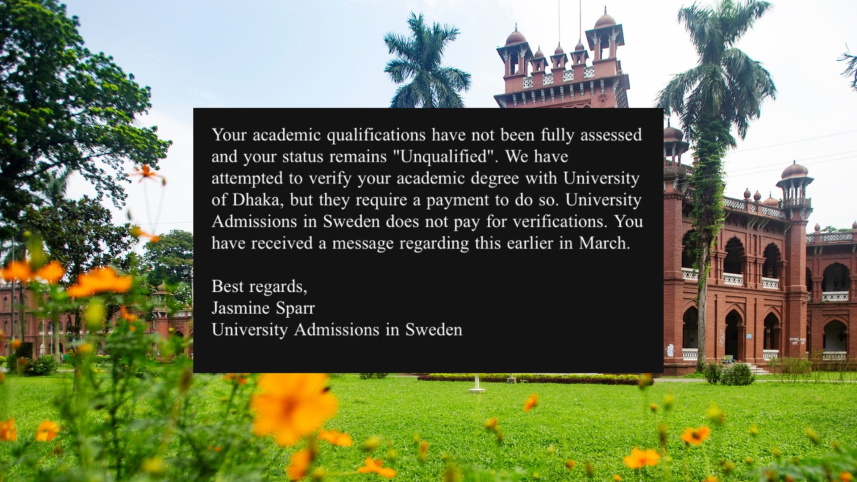
A Dhaka University (DU) graduate’s dream of pursuing higher education in Sweden has been derailed, not by academic shortcomings, but by a web of bureaucratic hurdles, administrative delays, and an unexpected verification fee demand from her own university.
Zinnia Tasnim, a graduate of the food and nutrition department (session 2017–18), alleged that her application to Swedish universities was ultimately rejected after DU required payment to verify her academic credentials, something the Swedish central admissions authority refused to comply with.

“I logged into the portal before the results and saw my status marked as ‘unqualified,’ citing that I had less than 180 ECTS credits,” Zinnia said. “But according to our syllabus, my degree amounts to around 240 ECTS.”
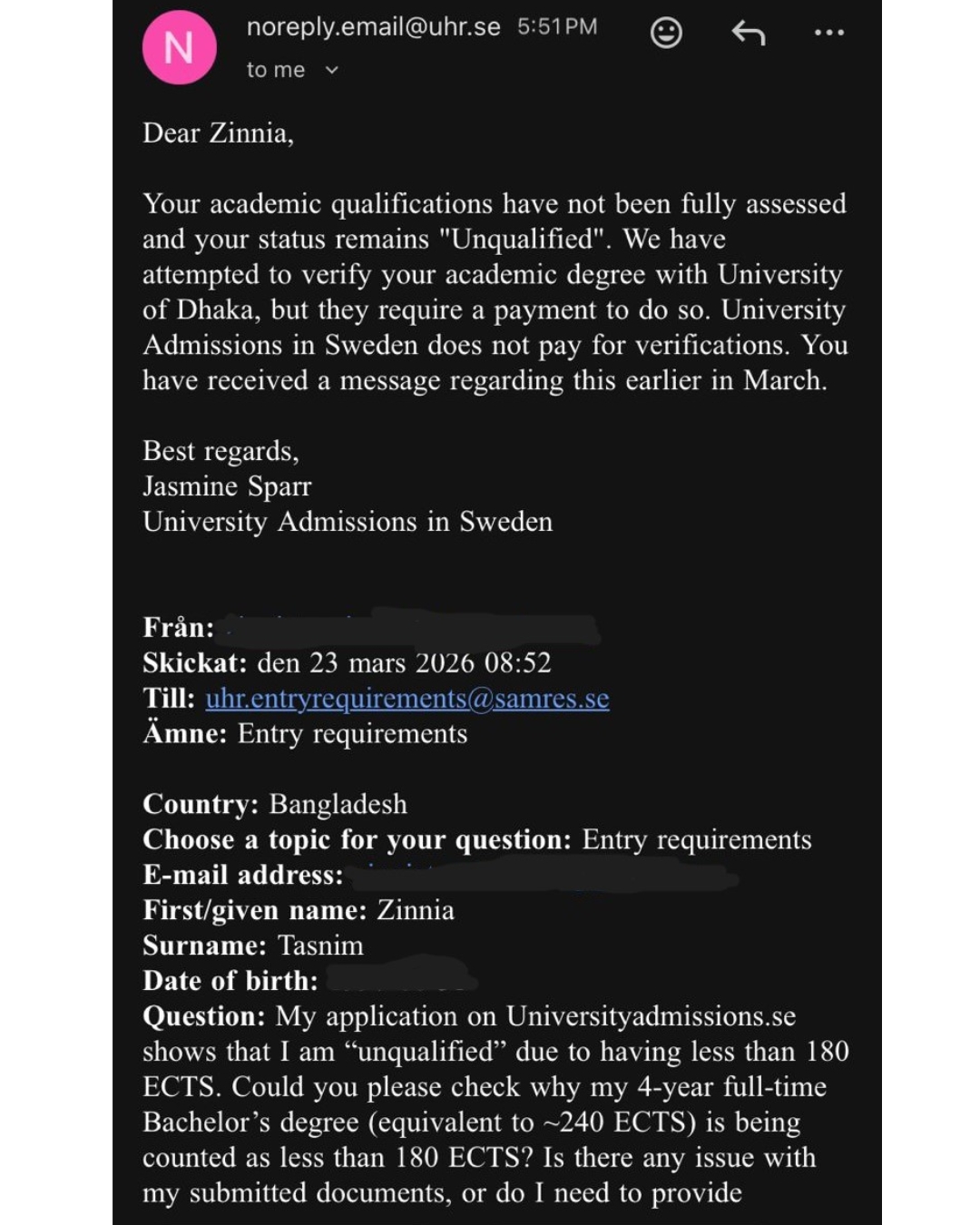
She contacted the admissions authority requesting a review. Days later, after the official results were published, she received a reply stating that her qualifications could not be verified because DU had demanded payment to verify her credentials.
“University Admissions in Sweden does not pay for verifications,” the response read, leaving her application incomplete.
DU Registrar Munshi Shams Uddin Ahmed told The Daily Star that there is an existing charge for verifying credentials.
“But I need to check how the notice was communicated to the Swedish admission authority,” he said.
However, Zinnia’s ordeal began weeks earlier while collecting and attesting her documents.
She applied for her transcript on December 22, paying an emergency fee of Tk 2,800 with a promise of delivery within seven days. But when she went to collect it, she was made to wait all day and asked to return later.
“For three to four days, I sat from morning to evening in front of Room 310. They kept sending me from one desk to another,” she said. “At one point, I had to search for my own documents from a pile.”
Despite paying additional attestation fees—Tk 200 per page and Tk 200 per envelope—she faced repeated delays, staff unavailability, and uncooperative behaviour.
Balancing a full-time job in Mohammadpur, Zinnia took multiple days off. “I even stayed two full days, from morning to evening, but still didn’t get my documents,” she said.
Even on the assigned date for attestation, her documents remained unsigned. “Only after a near argument and pressure did they finally sign them,” she added. In total, the process took nearly two weeks.
After completing all steps, including sending documents via DHL and attending an online interview, Zinnia’s application still failed due to unsuccessful verification.
Unknown to her, the Swedish admissions authority had contacted Dhaka University for verification. The university reportedly demanded payment, which the Swedish side declined.
“I was never informed about this requirement,” Zinnia said. “Even when I asked the university if there were any additional requirements for foreign applications, they only mentioned the envelope process.”
Contacted Pro-Vice Chancellor (Administration) Professor Sayema Haque Bidisha said she had recently been informed of the issue and had forwarded it to the Registrar for investigation.
 For all latest news, follow The Daily Star's Google News channel.
 “I have asked for a detailed explanation of the entire process and how this happened,” she said. “There are charges in certain cases, but we need to understand this specific incident to resolve any confusion.”
She acknowledged that service charges exist but noted that some have been reduced in recent years, including email-related fees.
“We are trying to rationalise and simplify the process for students,” she added.
Zinnia’s case highlights longstanding complaints about administrative inefficiency and lack of transparency at Dhaka University, particularly in document processing and verification.
“I did everything correctly,” Zinnia said. “But in the end, it all went to waste, not because of my qualifications, but because of the system.”
Comments