Genesis of a genocide report

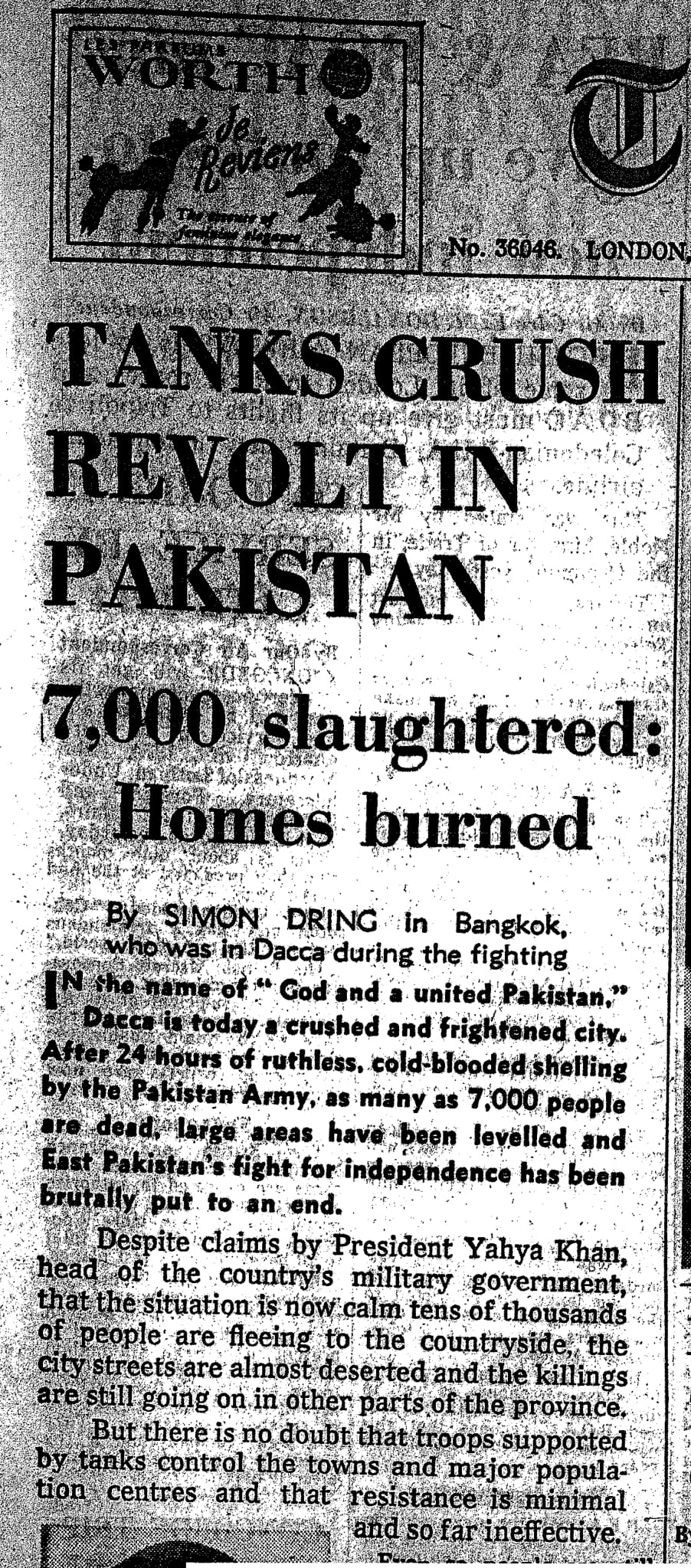
“In the name of ‘God and a united Pakistan’, Dacca [Dhaka] is today a crushed and frightened city. After 24 hours of ruthless, cold-blooded shelling by the Pakistan Army, as many as 7,000 people are dead, large areas have been levelled, and East Pakistan’s fight for independence has been brutally put to an end.
Despite claims by President Yahya Khan, head of the country’s military government, that the situation is now calm, tens of thousands of people are fleeing to the countryside, the city streets are almost deserted, and the killings are still going on in other parts of the province.”
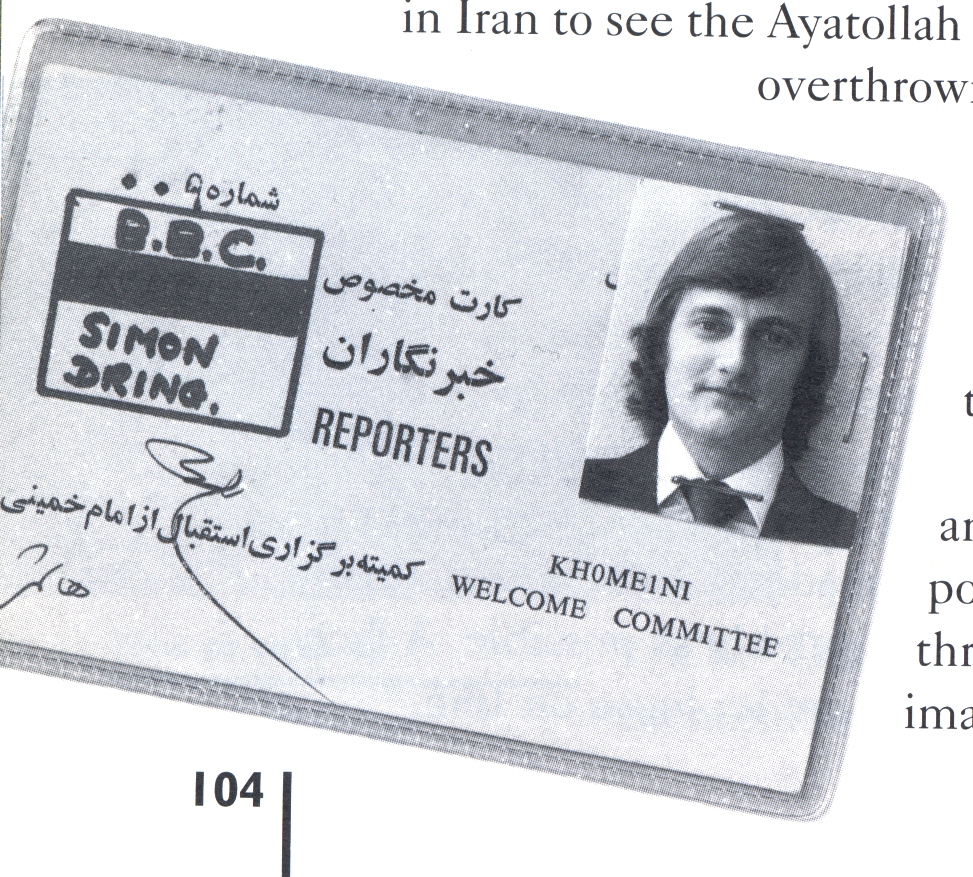
… This is the intro of a news report by an international newspaper in 1971. On March 30, 1971, London-based The Daily Telegraph published this scoop titled ‘Tanks Crush Revolt in Pakistan’. A young war correspondent of that media outlet risked his life to reveal Pakistani barbarity in East Pakistan to the world. And he was Simon John Dring (1945–2021), a war hero for Bangladesh.
Simon John Dring is also a pioneer of modern broadcast journalism in Bangladesh. He established Ekushey Television and worked as a consultant for many TV channels in the country. The 24-hour news-based station Jamuna TV was his last workplace in Bangladesh. At this station, he worked as Chief Broadcast Adviser from 2013 to 2014. At that time, I was a senior reporter there. One afternoon in the CEO’s room at Jamuna TV, Simon told me about his more than 32 hours of high-risk time in Dhaka in 1971. At the starting point of Operation Searchlight—a barbaric genocide blueprint of the Pakistan Army—he and Michel Laurent, a French AP photojournalist, made an extraordinarily dangerous excursion in the burning city of Dhaka. They collected news and photos from Dhaka University, Old Dhaka, Ramna Mandir, Bangabandhu Sheikh Mujib’s house, and other places as the first foreign journalists.
II
In 1971, Simon John Dring was covering the Cambodia conflict as a war correspondent for The Daily Telegraph. At that time, Pol Pot’s Khmer Rouge forces were fighting with the government army. In the last week of February, the Telegraph editor phoned Simon from London and described the volatile situation of East Pakistan, especially in Dhaka. Later, it was decided by the office that Simon would cover the unfolding situation in Dhaka. Eventually, Simon—only a 26-year-old young journalist—reached Dhaka on March 6, 1971.
Dhaka was a completely new city for Simon. New people, a new environment, new food, and, most significantly, an unknown language were not easy to deal with during the non-cooperation movement called by the Awami League. However, one particular thing was similar to his previous experience. From his past experience, he understood the situation before war and conflict very well. After spending just one night in Dhaka, he covered Sheikh Mujibur Rahman’s historic speech at the Race Course Maidan (now Suhrawardy Udyan) on March 7,1971. At that time, Bangla was an incomprehensible language to him. Due to the lack of an interpreter, he could not understand anything of the speech. Though, by observing the people’s expressions, enthusiasm, and eagerness, and by listening to the roar of ‘Joy Bangla’, he was able to understand very well that it was not possible to subdue this nation with military might.
After March 7, he met Sheikh Mujib several times at Dhanmondi 32. Simon noted that those meetings were very helpful for his reporting. On the afternoon of March 25, Simon and nearly 200 foreign journalists in Dhaka learned that President Yahya Khan had left the city. Rumours were in the air that Yahya may have already ordered a military operation. Simon could clearly understand then that “the chips are down” (something very bad is going to happen). That was the night of March 25, 1971—a fateful, dark chapter in the history of Bangladesh.
III
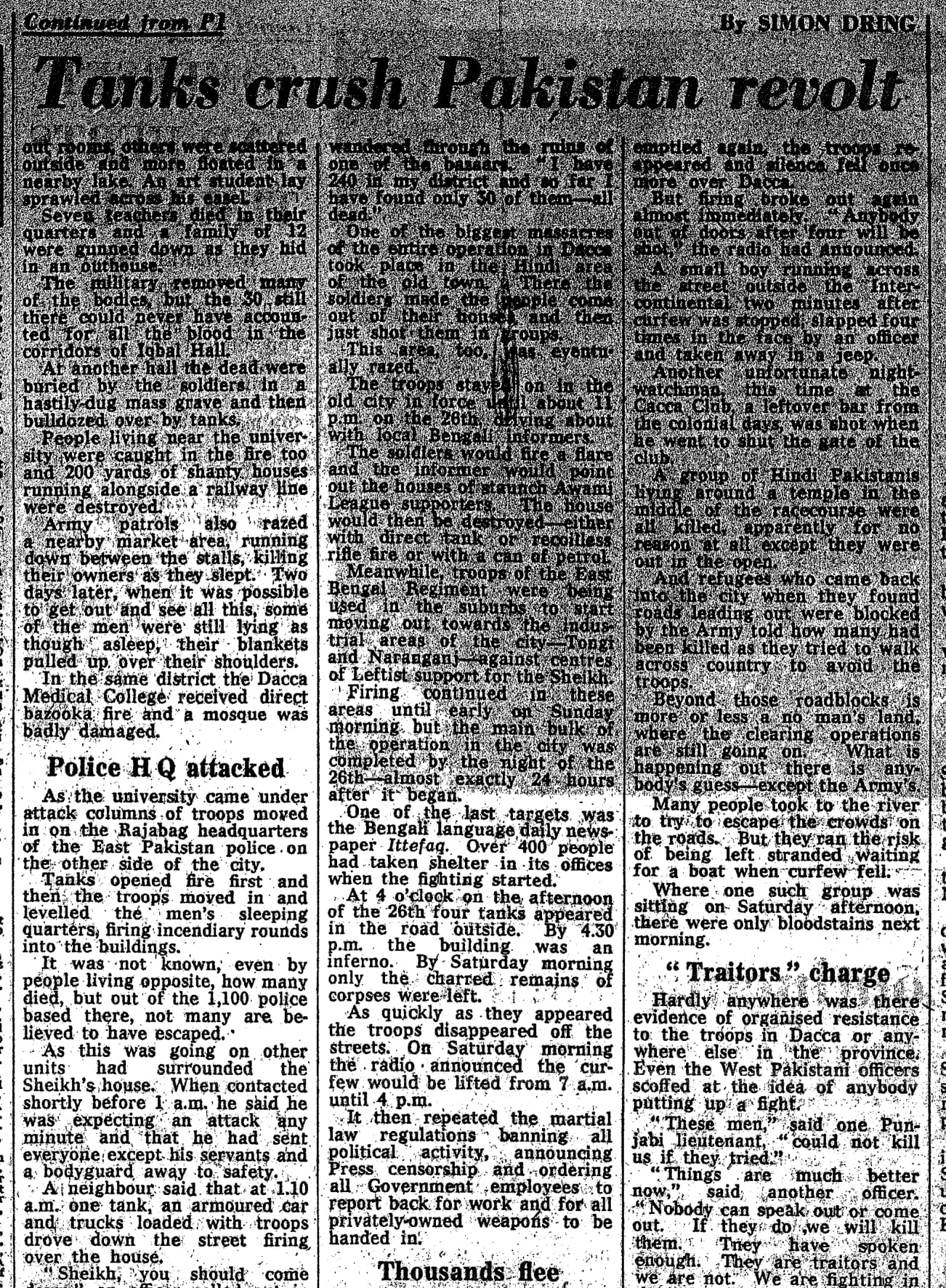
‘The students were also warned, but those who were still around later said that most thought they would only be arrested. Led by American-supplied M-24 World War II tanks, one column of troops sped to Dacca University shortly after midnight. Troops took over the British Council library and used it as a fire base to shell nearby dormitory areas. Caught completely by surprise, some 200 students were killed in Iqbal Hall [now Shahid Sergeant Zahurul Huq Hall of Dhaka University], headquarters of the militantly anti-government student group, as shells slammed into the building and their rooms were sprayed with machine-gun fire.’
This was the first account of Dhaka University by a foreign reporter reporting from the ground zero of the genocide zone. Simon told me that, after avoiding deportation from Dhaka to Karachi, he and Michel rushed to the Dhaka University area in a bakery van provided by the helpful Bengali employees of Hotel Intercontinental on March 27, after the curfew was lifted. Simon described those Bengali staff of the Intercontinental Hotel as one of the first groups of liberation fighters for Bangladesh.
IV
‘As the university came under attack, columns of troops moved in on the Rajarbagh headquarters of the East Pakistan Police on the other side of the city. Tanks opened fire first and then the troops moved in and levelled the men’s sleeping quarters, firing incendiary rounds into the buildings.
It was not known, even by people living opposite, how many died, but out of the 1100 police based there, not many are believed to have escaped.’ – in this part of ‘Tanks Crush Revolt in Pakistan’, Simon described the Bangali resistance at the East Pakistan Police headquarters. Simon also added in this remarkable news story about the burning down of two pro-liberation newspapers. The People was attacked in the first hour of Operation Searchlight, and Daily Ittefaq on the afternoon of 26 March. Simon described the attack on The People as follows: ‘There was still heavy shelling in some areas but the fighting was noticeably beginning to slacken. Opposite the Intercontinental Hotel, a platoon of troops stormed the office of Dacca’s The People newspaper, burning it down along with most houses in the area and killing a lone night-watchman.’
V
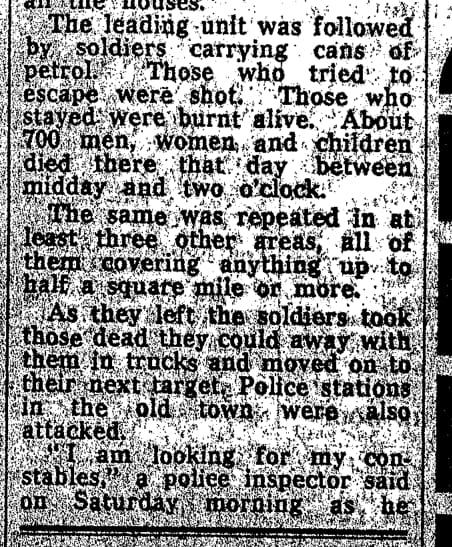
‘One of the biggest massacres of the entire operation in Dacca took place in the Hindu area of the old town. There the soldiers made the people come out of their houses and then just shot them in groups. This area, too, was eventually razed. The troops stayed on in the old city in force until about 11 p.m. on the 26th, driving about with local Bengali informers.’ – this horrific description of old Dhaka’s Hindu areas captured international attention. In those days of the 1971 war, Hindus were a prime target of Pakistani soldiers. Simon and Michel were among the first journalists to walk through the burned areas of old Dhaka. Simon told me that Pakistani soldiers carried cans of petrol in those neighbourhoods. They learned that the army had attacked the area around midday on March 26. About 700 people were killed. Many who remained inside their homes were burned alive.
VI
After collecting news and photos of a devastated city, Simon and Michel were looking for a way out of Dhaka. At that time, Pakistan International Airlines (PIA) was operating a lot of extra flights. In that emergency situation, the airline used to issue numbers against tickets for passenger transportation. Luckily, two Germans in the Intercontinental Hotel gave them two numbers. Then Simon and Michel planned how to keep the camera film and story notes intact. In that tense time, Simon went to the British High Commission office in Dhaka. But they did not cooperate. However, the East German embassy assured him cooperation. They agreed to send their films with diplomatic tags. Simon and Michel gave half the film (nine rolls) to the East German High Commission. But those valuable films were lost forever and never reached Germany.
Simon and Michel’s experience at Dhaka airport was quite terrifying. Simon was really nervous. Fortunately, Air Force officers on duty at the airport failed to recognise them. Michel and Simon went to customs separately. All the bags were being checked thoroughly. They found some maps of then East Pakistan and began to grow suspicious. The interrogation continued. However, a few books helped Simon and Michel through that journey. Simon told the officer, “I came to visit East Pakistan as a tourist.” They managed to get through Dhaka airport. They passed immigration carrying socks and toothpaste, inside which the photos and notes for the report were hidden.
Due to restrictions in Indian airspace at that time, Pakistani commercial planes were flying via Colombo. Simon reached Ceylon (now Sri Lanka) from Dhaka. There was a one-hour transit. Simon called the British High Commission in Colombo and requested political asylum. But the High Commission said, “Sorry! No help.” Simon boarded the plane to Karachi.
In Karachi, their luggage was opened and examined more closely. The officer there suspected that they were journalists. Simon was completely stripped and his body was searched. However, he had cleverly hidden the notes inside his socks, which remained undetected. Simon believed that Siddique Salik, the Pakistan Army’s public relations officer, had discovered their activities and sent a message to Karachi, which explained the unusually thorough checks. Despite this, they were eventually released, and the Pan American plane took off for Bangkok.
While on the plane, Simon retrieved the notes from inside his shoes. Based on those notes, he began writing the story—the genocide account of Dhaka titled ‘Tanks Crush Revolt in Pakistan’. That report is now part of the historical record of Bangladesh. Its author, Simon John Dring, died in July 2021 in Romania at the age of 76.
Rahat Minhaz is an Assistant Professor in Mass Communication and Journalism at Jagannath University, Dhaka. He can be reached at minhaz_uddin_du@yahoo.com
Sources
‘Tanks Crush Revolt in Pakistan’ (30 March 1971), The Daily Telegraph, London.
Interview of Simon John Dring (2013) by Rahat Minhaz.
‘Simon Dring, reporter who covered conflicts around the world and was made an honorary citizen of Bangladesh – obituary’ (2 July 2021), The Telegraph (online), retrieved on 08-12-2025, https://www.telegraph.co.uk/obituaries/2021/07/22/simon-dring-reporter-covered-conflicts-around-world-made-honorary/
Send your articles for Slow Reads to slowreads@thedailystar.net. Check out our submission guidelines for details.
Tajuddin Ahmad: A life for Bangladesh

Interactive / The haor crisis explained
Interactive: Bangladesh Labour History · 1881 - 2026 / Fight for Justice
Justice at work for all
The Price of Labour
Interactive / How many more lives before workplaces become safe?
The expansion of wage labour and the message of May Day
In conversation with Richard Wolff / Can workers seize the opportunity as Western capitalism declines?