


Global growth to slow to 3.1% this year as war and AI boom split world economy: IMF

The global economy will grow 3.1 percent in 2026, down from 3.5 percent last year, as the Middle East war and an artificial intelligence (AI) investment surge pull countries in different directions, the International Monetary Fund (IMF) said.
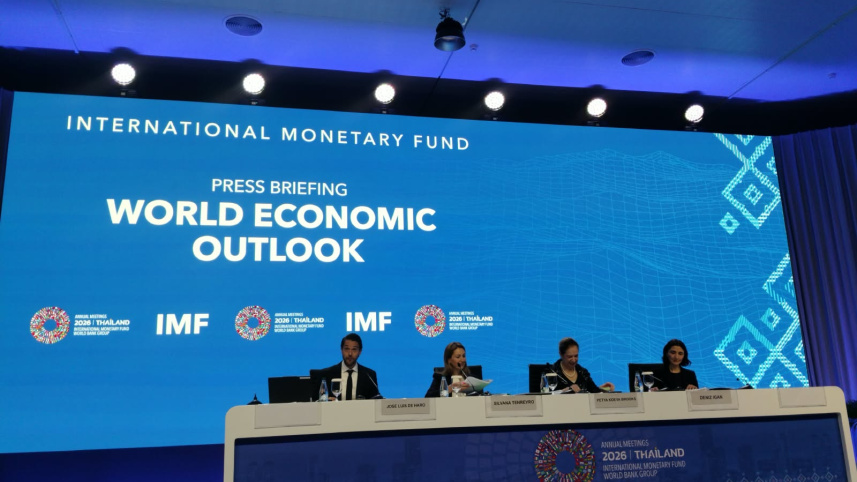
The IMF released the World Economic Outlook, which projects a recovery to 3.4 percent in 2027, at a press conference today at the IMF-World Bank Annual Meetings in Bangkok.

It left its 2026 forecast unchanged from April and raised the 2027 figure by 0.2 percentage point. But the steady headline masks sharp divergence as 32 economies account for 95 percent of global growth, down from 54 in April, and about 47 percent were downgraded.
Countries shielded from the energy shock and connected to the tech supply chain are holding up. Energy importers outside that chain, including many low-income countries, face higher import bills, currency pressure and weaker incomes.
The IMF projects advanced economies will grow 2.1 percent this year, emerging and developing economies 3.7 percent and China 4.5 percent. The Middle East and Central Asia region is hardest hit, contracting 0.3 percent, reflecting a longer closure of the Strait of Hormuz.
It expects global inflation to rise from 4.1 percent in 2025 to 4.7 percent in 2026, driven mainly by energy and food prices, before easing to 4.1 percent in 2027. It assumes oil will average about $96 a barrel this year, against $68 in 2025.
In South Asia, India remains among the fastest-growing major economies, with growth expected at 7.0 percent in 2026 and 2027 on a fiscal-year basis.
Bangladesh is projected to grow 3.6 percent in 2026 and 3.2 percent in 2027, with inflation at 8.7 percent and 10.9 percent, respectively. Pakistan is forecast to grow 3.6 percent in 2026 and 3.5 percent in 2027.
The IMF said risks remain tilted towards weaker outcomes as a prolonged conflict and El Niño-linked weather could lift energy and food prices, while a reassessment of AI profit expectations could trigger a sharp market fall.
It urged governments to rebuild room in their public finances, avoid broad fuel subsidies and price controls, and keep support temporary and targeted, preferably through cash transfers.
 For all latest news, follow The Daily Star's Google News channel.
Comments