


GDP calculation methodology has ‘significant flaws’

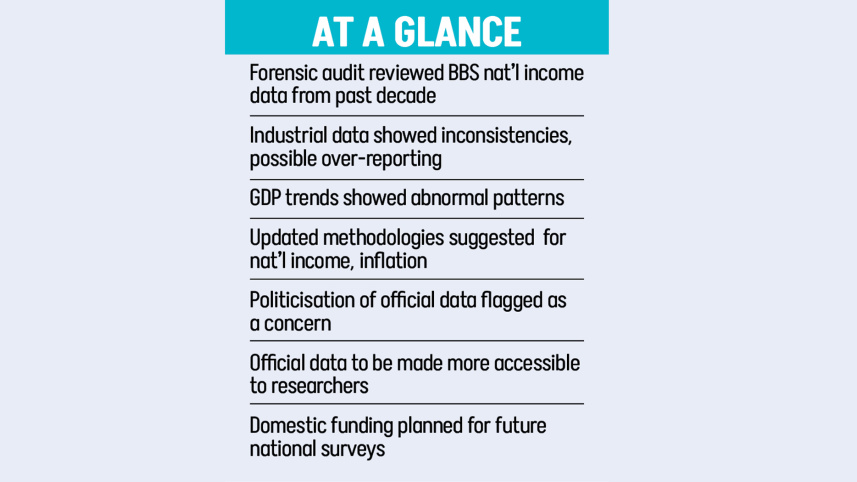
There have been “significant flaws” in the methodology used to calculate Bangladesh’s national income and gross domestic product (GDP), according to a paper presented by a government-formed forensic audit committee yesterday.
The committee reviewed national income statistics prepared by the Bangladesh Bureau of Statistics (BBS) over the past decade and found substantial scope for inconsistencies in industrial data.

It noted that some figures are collected from secondary sources, including the National Board of Revenue, the Export Promotion Bureau and state-owned enterprises, which creates a risk of over-reporting.
The government earlier formed the seven-member committee, headed by Statistics and Informatics Division (SID) Secretary Md Firoz Sarker, to audit BBS data, particularly GDP and inflation figures, amid concerns that official statistics may have been distorted during the previous Awami League government’s tenure to portray a stronger economic picture.
The country’s economy has been facing challenges for the past several years.
The paper, prepared by two committee members -- BIDS Director General AK Enamul Haque and Research Director Atonu Rabbani -- was presented at a roundtable on national income statistics at the BIDS office, organised to gather expert views on the quality, transparency and accessibility of official statistics.
The interim government had earlier formed an expert taskforce to assess these issues. After taking office, the BNP-led government said it would conduct an in-depth review to determine whether official data had been incorrectly reported or distorted.
BIDS Board Member Wahiduddin Mahmud, a former adviser to the interim government, chaired the discussion, while Prime Minister’s Adviser for Finance and Planning Rashed Al Mahmud Titumir and State Minister for Planning Md Zonayed Abdur Rahim Saki also spoke.
“Several issues have emerged regarding the GDP growth figures during the past government’s tenure, which were presented to us during the consultation. The forensic panel is now conducting further analysis,” a participant told The Daily Star, wishing anonymity.
He also said governance reforms should ensure the BBS can work independently, while technical improvements should focus on sound, updated methodologies and calculations.
Another participant, wishing anonymity, said the audit committee compared GDP trends using two base years -- 2005 and 2015 -- to identify abnormal patterns and investigate their possible methodological causes.
“By comparing the trends under the two base years, they identified some abnormal patterns, particularly in the manufacturing sector, and then examined the possible methodological reasons behind them,” he said.
The use of the Quantum Index of Industrial Production (QIIP) also involves a number of technical, procedural and methodological assumptions that require closer scrutiny, he said.
SID Secretary Md Firoz Sarker said the government is committed to establishing the accuracy of official statistics and resolving confusion over national income measurement.
The paper said flaws in the existing methodology mean the government does not have sufficiently precise economic data.
Wahiduddin Mahmud advised the BBS to introduce a designated digital framework for national income accounting, and also develop a similar template for inflation measurement soon.
Echoing him, Titumir emphasised the need to prevent politicisation of data, and said accountability cannot be ensured without science-based information.
Future national surveys would be financed domestically rather than through donor agencies, and the government would soon open official data to researchers and educational institutions, he added.
He also expressed plans to establish a data verification laboratory at the BIDS Graduate School.
Zonayed Saki said confusion over inflation measurement among the public needs to be addressed immediately.
 For all latest news, follow The Daily Star's Google News channel.
 National Professor Mahbub Ullah, BBS Director General Md Shamimul Haque, Policy Research Institute of Bangladesh Chairman Zaidi Sattar, Centre for Policy Dialogue Executive Director Fahmida Khatun, CPD Distinguished Fellows Debapriya Bhattacharya and Prof Mustafizur Rahman, Dhaka University Economics Professor Sayema Haque Bidisha, and SANEM Executive Director Selim Raihan also joined the discussion among others.
Comments