


Bangladesh-Saudi weekly flight entitlement rises to 84

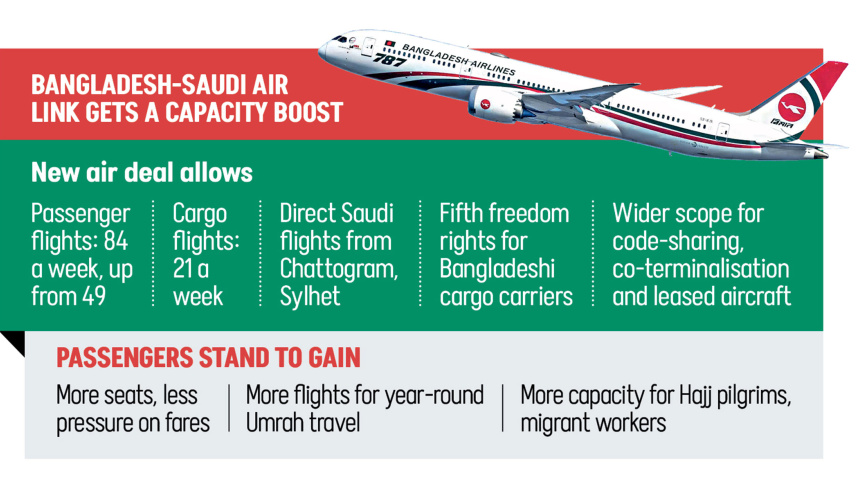
Saudi Arabia has opened the high-demand Bangladesh-Saudi air route wider under a new bilateral deal, giving Bangladeshi airlines more room to expand. But how much of that opportunity they can use will depend on whether they have enough aircraft.
The agreement raises the weekly passenger flight limit to 84 from 49, creating room for 35 more flights.

The 84-flight entitlement applies to each side, meaning Bangladeshi designated airlines can operate up to 84 passenger flights a week to Saudi Arabia, while Saudi carriers have a reciprocal entitlement to operate up to 84 flights to Bangladesh. The previous limit was 49 flights a week for each side.
It also opens the door to more direct services from Chattogram and Sylhet, while airlines say the extra capacity could ease seat shortages, support year-round Umrah travel and help keep fares in check.
The new memorandum of understanding between the Civil Aviation Authority of Bangladesh (CAAB) and Saudi Arabia also allows 21 cargo flights a week, fifth freedom traffic rights, code-sharing, co-terminalisation and aircraft leasing, according to a CAAB press release issued yesterday.
Under fifth freedom traffic rights, Bangladeshi airlines will be able to carry cargo through Saudi Arabia to destinations including Spain and Germany, according to the press release.
The Bangladesh-Saudi air route is already one of the busiest in the region.
Bangladesh-Saudi Arabia ranked as the ninth-largest country-pair passenger market serving the Middle East in the January-March quarter of this year, according to International Air Transport Association data cited by Riyadh Air.
Mohammad Shafiul Azam, director of air transportation at CAAB, described the agreement as a “win-win situation” for both countries.
“We have managed to convince the Saudi authorities to operate flights directly from Saudi Arabia to Chattogram and Sylhet,” he told The Daily Star.
Azam said 4-5 million Bangladeshis living in Saudi Arabia could benefit from the move, while more flights would also help make the two regional international airports busier.
He said the new entitlement gives designated airlines greater access, although actual operations will depend on fleet size and how many flights carriers can operate.
That capacity question is particularly relevant for Biman Bangladesh Airlines.
Captain AKM Aminul Islam, director of flight operations at Biman, said the airline had not been able to use all the flights available under the previous arrangement.
“We previously had the capacity under the bilateral arrangement to operate 49 flights a week, but we were able to operate only 28, while 13 others were operated by the US Bangla Airlines.”
“The new bilateral arrangement will give us access to operate more, but it will completely depend on the size and capacity of the fleet,” he told The Daily Star.
He said demand on the Saudi route would remain strong because Umrah travel continues throughout the year, while millions of Bangladeshis, including migrant workers, live there.
Aminul said Biman acquired the Boeing 787 partly because it is well suited to seven-to-eight-hour flights to the Middle East. “So, the new scope will definitely create opportunities for us,” he said.
Private carrier US-Bangla Airlines also sees the higher flight limit as essential for expansion.
Kamrul Islam, general manager for public relations at US-Bangla Airlines, said US-Bangla currently operates flights to Jeddah and Riyadh and has Madinah and Dammam in its future plans.
 For all latest news, follow The Daily Star's Google News channel.
 Without more flight slots, Kamrul said, airlines would struggle to expand into new destinations while serving both regular passengers and Hajj travellers at the same time.
During peak Hajj periods, he said, fewer flights could squeeze regular passenger services, push up fares and force more travellers to rely on costlier transit flights operated by third-country airlines.
Kamrul said the higher limit is a positive step, but Bangladeshi carriers will need stronger fleet capacity to take full advantage of it.
US-Bangla has already announced plans to add 21 aircraft to its fleet, with larger aircraft also under consideration, he said.
Speaking to reporters at CAAB headquarters yesterday, CAAB Chairman Air Vice Marshal Md Mostafa Mahmood Siddiq said airlines from both countries would now be able to operate up to 84 passenger flights a week, creating room for 35 additional weekly flights.
He said Hajj and Umrah passengers would be among the biggest beneficiaries, as the extra flights could ease seat shortages and reduce operational pressure during the Hajj season.
Comments