


City Group plans to raise Tk 1,500cr from stock market
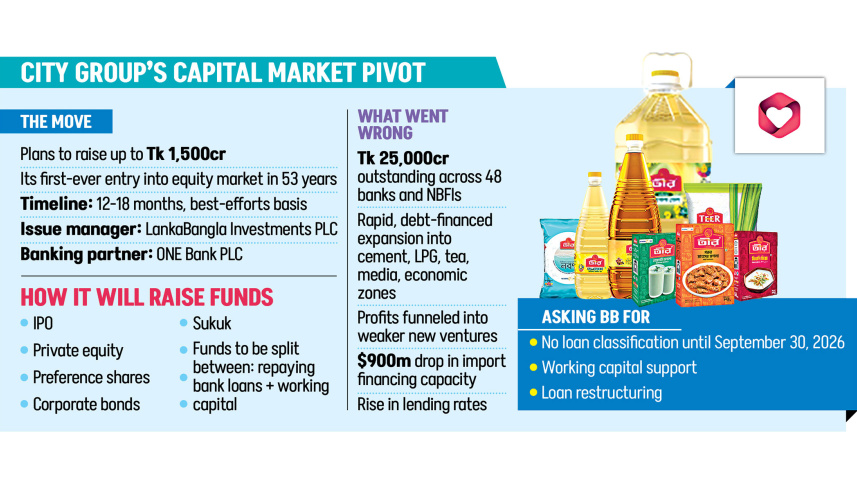
City Group, one of Bangladesh’s leading commodity importers and processors, plans to raise up to Tk 1,500 crore from the capital market to broaden its funding base and reduce its reliance on bank loans.
The move marks the 53-year-old group’s first entry into the equity market as it works through a period of financial pressure linked to rapid expansion, higher interest rates, currency depreciation and delayed returns on some investments.

In a press release issued yesterday, the consumer goods manufacturer said it has appointed LankaBangla Investments PLC as the issue manager to structure the fundraising, which may involve an initial public offering (IPO), private equity, preference shares, corporate bonds or Sukuk.
ONE Bank PLC will serve as the banking partner for the proposed transactions, which are expected to proceed on a best-efforts basis over the next 12 to 18 months, subject to regulatory approval and market conditions, according to the statement.
According to the banking regulator and lending banks, the group has outstanding debt of around Tk 25,000 crore across 48 banks and non-bank financial institutions.
The fundraising plan comes as the corporate giant, known for consumer brands such as Teer, Sun and Natural, pursues a three-year plan to strengthen its liquidity and manage its debt.
City Group has been a leading importer of edible oil, sugar and wheat flour for several decades.
“Its funding had so far been largely limited to bank loans, and the group has now recognised the need for equity and long-term financing,” said Mohammed Nasir Uddin Chowdhury, director of LankaBangla Investments.
“Part of the funds raised will be used to repay existing bank loans, and part to improve liquidity as working capital,” he said.
Nasir said not all of the funds will be raised through an IPO. Some may come through preference shares and some through bonds.
“We want to connect them to long-term financing tools,” Nasir said. “It’s true that if they could have come to the capital market earlier, it would have been better, and they might not have faced their recent issues.”
He said the company has now recognised the importance of long-term financing for future growth, describing the move as a starting point from which City Group would improve its financing mix through the capital market.
Syed Mahbubur Rahman, a former chairman of the Association of Bankers, Bangladesh (ABB), described the development as a “smart and better move” for City to find a new avenue for financing.
“It should have come to the market much earlier. It’s a good lesson for other companies too, to come to the stock market while they remain in a good position,” he said.
Mahbubur, however, expressed concern about whether the market is ready to provide large amounts of funding, noting that it has remained sluggish for many years.
“The capital market should be more private-sector friendly,” he added, “so that companies do not need to wait long to raise capital.”
HOW THE GROUP CAME UNDER PRESSURE
Bankers and industry sources, speaking on condition of anonymity because they were not authorised to discuss client matters publicly, said City Group’s expansion in recent years had extended into non-core sectors, including cement, LPG, tea, media and economic zones.
They said profits from its core food and commodity businesses had been channelled into the newer ventures, which failed to generate expected returns.
Sources said the biggest drag on the group’s finances had been the Hoshendi Economic Zone in Munshiganj, where it invested nearly Tk 12,000 crore to establish six industrial units.
 For all latest news, follow The Daily Star's Google News channel.
 Despite completing construction, the factories remain idle because they lack gas connections, City Group told the Bangladesh Bank earlier.
City is exploring the sale or divestment of some non-core assets, including the Hoshendi Economic Zone, its tea garden, LPG business and television channel Ekhon TV.
In a letter to the Bangladesh Bank governor a few months ago, City Group Managing Director Md Hasan outlined a set of macroeconomic factors affecting the group’s operations and sought regulatory support.
The letter estimated that its import financing capacity had declined by around $900 million, citing a 42 percent fall in the taka against the US dollar over the past four years.
Domestic lending rates have risen by four to five percentage points, while US dollar borrowing costs have nearly tripled since 2022, according to the letter. Tighter credit conditions and difficulties in obtaining international letter of credit (LC) confirmations have further reduced effective credit limits by $400 million.
City has requested that the central bank instruct lenders not to classify its existing loans until September 30, 2026, while providing working capital support and loan restructuring.
An agreement formalising the group’s entry into the capital market was signed at City Group’s corporate head office in Dhaka on August 12.
The signing was attended by Md Hasan, managing director of City Group, and Farzana Rahman and Shampa Rahman, both sponsor shareholders and directors of the group.
Mohammed Nasir Uddin Chowdhury, director of LankaBangla Investments and managing director of LankaBangla Securities, and Muhit Rahman, managing director of ONE Bank, along with senior executives from both organisations, were also present.
The Daily Star approached the City Group for further details of its market entry plan, but the group did not respond.
Comments