


Bangladesh seeks Australia’s support for joining RCEP
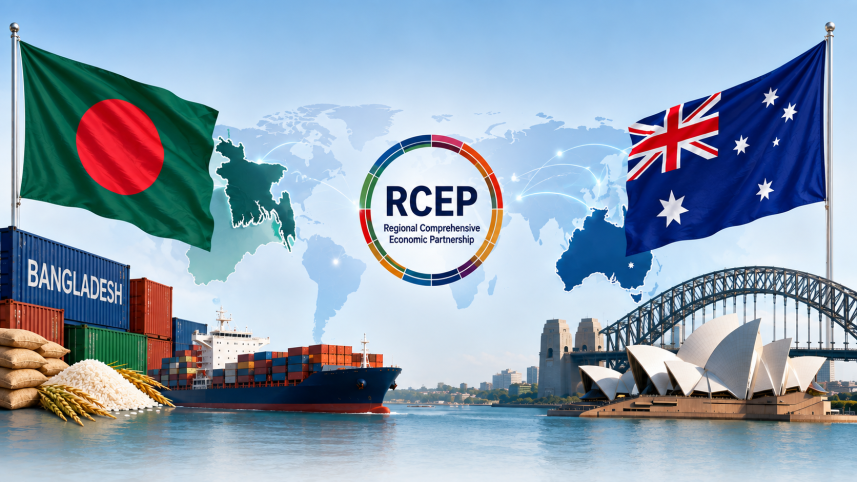
Bangladesh has sought Australia’s support for joining the Regional Comprehensive Economic Partnership (RCEP) agreement to enjoy preferential market access after its graduation from the least developed country (LDC) category.
Commerce Secretary Md Ataur Rahman Khan made the call at a meeting in Australia’s Canberra today with Ravi Kewalram, first assistant secretary of the Australian Department of Foreign Affairs and Trade, and Sarah Storey, first assistant secretary of the South and Central Asia Division.

The secretary is now leading a delegation on a tour to Australia and New Zealand to find out opportunities to increase bilateral trade.
With a huge market of 170 million people, Bangladesh’s accession to the RCEP would create a bridge connecting South Asia with East Asia and the Association of Southeast Asian Nations.
Bangladesh has already formally submitted the RCEP accession questionnaire and has begun the process of aligning its laws on intellectual property, competition, and personal data protection with RCEP standards.
In view of global energy-price inflation, trade disruptions, and recent domestic economic challenges, Bangladesh has applied to the United Nations for an extension of its preparation period for LDC graduation until November 2029.
The UN Committee for Development Policy has already recommended the extension, and a final decision is expected to be taken by the United Nations General Assembly in September.
During the meeting, Bangladesh sought Australia’s friendly support on this matter and expressed gratitude to Australia for continuing duty-free and quota-free market access for Bangladeshi products even after graduation.
Bangladesh proposed that Australia consider concluding a bilateral free trade agreement and, in response, Australia said it would consult with stakeholders and determine the appropriate course of action.
It was mentioned that Bangladesh could use Australia’s high-quality wool and cotton to produce higher-value products for its global apparel industry.
Bangladesh’s ready-made garment sector was identified as an important destination for Australia’s premium natural fibres.
The meetings also discussed partnerships in clean-energy technologies and grid modernisation, as well as cooperation in workforce development with Australian technical and vocational education and training institutions.
 For all latest news, follow The Daily Star's Google News channel.
Comments