


Asian governments spend billions of dollars to offset oil price shock
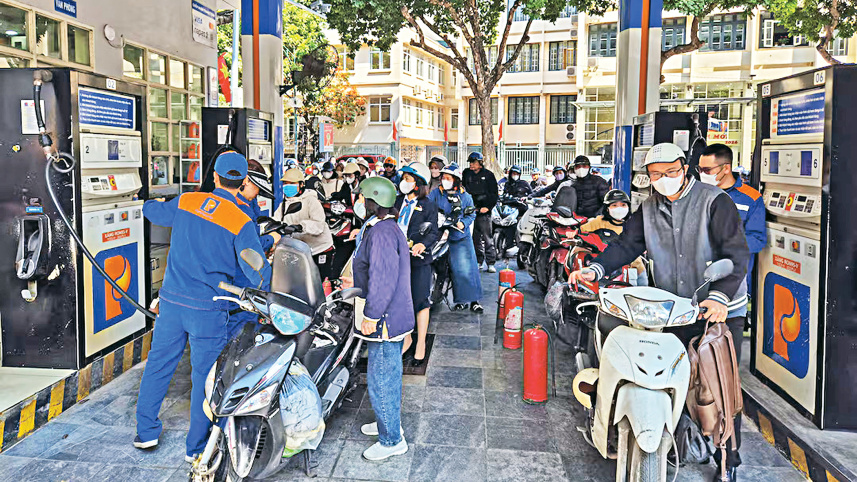
Asian governments are spending billions of dollars in subsidies to shield consumers from the oil price shock triggered by the US-Israeli war with Iran.
Below are the steps taken by governments in Asia, where most oil from the Middle East is bound.
 For all latest news, follow The Daily Star's Google News channel.
 INDONESIA
Indonesia plans to remove from May import duties on some plastic products and liquefied petroleum gas (LPG) for six months to help plastic producers cope with a naphtha shortage, its chief economic minister said on April 28.
Jakarta budgeted 381.3 trillion rupiah ($22.4 billion) for energy subsidies and to compensate state energy firm Pertamina and utility company PLN for their efforts to keep fuel prices and electricity tariffs at affordable levels.
The Indonesian government maintained the price of subsidised fuel as it assesses price adjustments of non-subsidised fuels. It also implemented a limit on fuel sales at 50 litres per day per car.
Jakarta also plans to implement a work-from-home policy for civil servants on Fridays and to reduce its free meal distribution to five days to save trillions of rupiah in fuel subsidies.
JAPAN
The Japanese government is tapping 800 billion yen ($5.02 billion) in reserve funds to finance subsidies aimed at keeping gasoline prices at about 170 yen per litre on average. That would cost as much as 300 billion yen per month.
SOUTH KOREA
South Korea's budget ministry proposed in late March a supplementary government budget of 26.2 trillion won ($17.3 billion) to support low-income earners, young people and companies in response to high oil prices.
It is the second extra budget in less than a year under the administration of President Lee Jae Myung. Parliament is expected to approve the budget by April 10.
PHILIPPINES
The Philippine energy ministry said it is activating a 20 billion pesos ($329.75 million) emergency fund to strengthen fuel security.
Under the programme, the government plans to buy up to 2 million barrels of fuel to support domestic supply and purchase refined products and liquefied petroleum gas.
THAILAND
Finance Minister Ekniti Nitithanprapas said measures to ease the economic impact of rising oil prices, will be proposed at the new government's first cabinet meeting on April 6.
The government plans an oil tax cut, a borrowing guarantee for an oil subsidy fund, along with other support measures.
Last month, Prime Minister Anutin Charnvirakul ordered civil servants to conserve energy and reduce electricity use at office buildings, and asked the public to cooperate by carpooling.
VIETNAM
Vietnam has suspended environmental protection and special consumption taxes on gasoline, diesel and jet fuel until April 15 to stabilize the domestic market, with a possibility of being extended until the end of June.
The suspension of the taxes will reduce revenue for state coffers by 7.2 trillion dong ($273.34 million) a month, its finance ministry said.
MALAYSIA
Malaysia is spending 4 billion ringgit ($992.56 million) monthly, up from 700 million ringgit previously, to maintain the fixed price of a widely used transport fuel and provide cash assistance to some diesel vehicle operators.
Employees at government ministries, agencies and state-linked companies will also begin working from home this month as part of measures to save energy costs.
INDIA
India has slashed excise duties on petrol and diesel, which will result in a loss of 70 billion rupees ($749.10 million) a fortnight, while imposing windfall taxes on aviation fuel and diesel exports to recover some of its revenue.
AUSTRALIA
Prime Minister Anthony Albanese said the government would halve the excise on fuel and diesel and remove the heavy road user charge for three months, which will cost the government A$2.55 billion ($1.76 billion).
Australia will also provide up to A$1 billion in interest-free loans to critical businesses, including transport operators and fertiliser producers.
NEW ZEALAND
New Zealand said it would provide temporary financial support of NZ$50 ($28.57) every week from April for low income families as conflict in the Middle East drives up fuel prices and adds pressure to household budgets.
The policy is estimated to cost a one-off NZ$373 million if it runs for the full year, Finance Minister Nicola Willis said.
Comments