


Spend more, spend better on social sectors
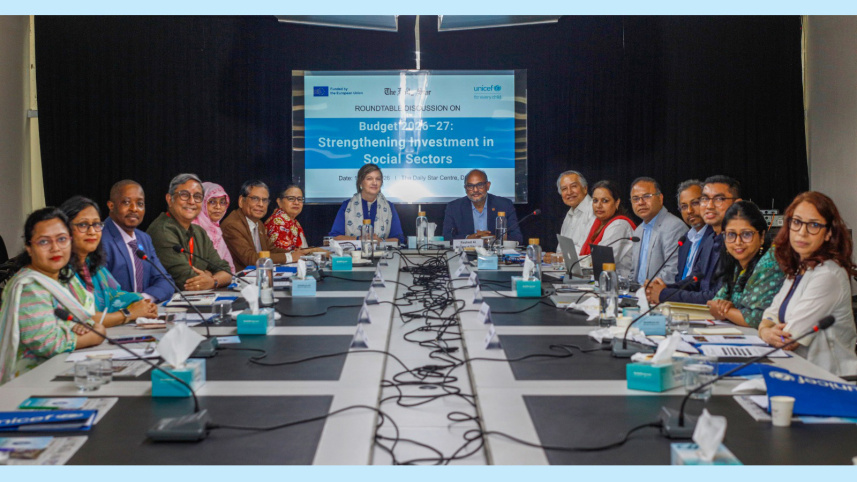
The government needs to allocate more to education, health, and social protection in the upcoming budget, and ensure that the funds are properly utilised to create a better future for every child in the country, development specialists and donor agencies said yesterday.
Speaking at a roundtable, they pointed out that utilisation of development budgets in both sectors has hovered around 50 percent for at least two fiscal years. The discussion, regarding strengthening investment in social sectors in the upcoming budget, was jointly arranged by The Daily Star and Unicef with support from the European Union.

Md Ashiq Iqbal, social policy and economic specialist at Unicef, said in fiscal year 2024-25 (FY25), utilisation of the development budget of education was 47.4 percent while it was 9.8 percent in the health sector.
According to him, the underutilisation of funds pointed to significant room for efficiency gains. “Over 50 percent gain is possible for education and health within the existing envelope.”
But he stressed that efficiency alone would not close the gap, as overall investment remains critically low to begin with.
The social policy expert noted that Bangladesh’s spending on education is one of the lowest shares in the world -- just 1.5 percent of its GDP on education against a government target of 5 percent.
The gap between current and target investment is 70 percent, which has widened over the past decade, he added. “Significant budgetary steps are required to progressively reach the target.”
Health spending stands at 0.7 percent of GDP, also among the world’s lowest. “The same thing is happening in the social protection budget too.”
Iqbal depicted the consequences of the spending failure, citing child welfare data.
Some 6.5 percent of primary school-age children are out of school, he said, adding that attendance falls sharply after primary school while foundational skills improve but remain far too low. “Bangladesh’s primary education progress is in stagnation.”
The Unicef official also said, “serious” risks persist in public health.
Two in five children and one in 13 pregnant women show elevated blood lead levels. The neonatal mortality rate stands at 22 per 1,000. Nearly two-thirds of children aged 6 to 23 months live in food poverty, as social protection coverage shrank in recent times.
In fiscal year 2024-25 (FY25), utilisation of the development budget of education was 47.4 percent while it was 9.8 percent in the health sector
Iqbal welcomed the commitments made by the ruling BNP in its manifesto on education access and quality, child survival, and malnutrition.
He called for allocating at least 2 percent of GDP to quality and inclusive education of children, with increased funding for foundational learning and teacher development, and at least 1.5 percent of GDP for health, with ringfenced vaccine budgets and free medicine for the poor.
Prof Rashed Al Mahmud Titumir, finance adviser to the prime minister, said the government inherited an economy burdened with multiple problems, further aggravated by current global pressures.
He explained that with inflation persisting, the government could not adjust fuel prices and was instead focusing on proper utilisation of spending.
The official also said the government was moving toward a universal social protection system to eliminate inclusion errors, exclusion errors, and fragmentation with one card per family for service delivery.
In addition, he said, for the first time, farmers would also receive cards through scheduled banks, entitling them to multiple subsidies. The government hopes to reduce errors and create fiscal space through these initiatives.
The government was also focusing on transparency and accountability in spending, with budget implementation effectiveness and digitalisation of revenue collection among its priorities, Titumir added.
 For all latest news, follow The Daily Star's Google News channel.
 The PM’s adviser also flagged that conditions attached to loans taken by the previous government from the International Monetary Fund (IMF) were creating pressure that “may not be child-friendly or women-friendly”.
Criticising the United Nations for reportedly not speaking out on these issues, he called for better coordination and harmonisation in the intergovernmental organisation.
Rana Flowers, country representative of Unicef Bangladesh, said she recognised that the government inherited an economy where debt obligations are rising, and economic uncertainties came from the global arena.
She pointed out that the situation demands figuring out how to use limited resources efficiently.
The Unicef official urged the government to focus on improving capital development, child education and social protection.
Rasheda K Choudhury, executive director of the Campaign for Popular Education, said education spending should be treated as an investment in human capital.
“If we curb corruption, if we curb violence against women and if we curb drug addiction, it will free up substantial funds for social sectors,” she said, urging the government to actively court non-resident Bangladeshis for support.
Prof Mustafizur Rahman, a distinguished fellow at the Centre for Policy Dialogue, said the government needs to prioritise its spending and draw up plans to adjust investment in the social sectors.
Gitanjali Singh, country representative of UN Women, called for higher social sector allocations alongside a tracking system to ensure expenditure efficiency.
She also urged the government to raise tax revenue and shift toward progressive taxation, given the constraints on fiscal space.
Prof Abu Eusuf, executive director of Research and Policy Integration for Development (RAPID), called on authorities to publish the actual education budget by subtracting the technology budget from it, and urged the reinstatement of the child budget.
He also asked for the social protection budget to be broken down clearly, separating pension obligations from other programmes.
Furthermore, the policy expert proposed establishing eight top-class hospitals -- one per division -- so that people do not need to travel to Dhaka for specialised care.
On revenue, he noted that tax exemptions amount to 6 percent of GDP and urged the government to widen the tax base without pressuring existing taxpayers.
Mahfuz Anam, editor and publisher of The Daily Star, said he has been covering child issues for many years as a journalist, and the same stories keep recurring.
While the country has made some advances, it remains far from where it needs to be, he added, urging all to use the newspaper to improve child rights issues.
Kishower Amin, programme manager of Public Financial Management, said revenue reform was essential, including reform of the revenue board and full digitalisation of tax systems.
Without higher revenue collection, she said, increases in health and education spending would not be possible.
Mosammat Ayesha Akther, deputy director of the National Academy for Educational Management of the Ministry of Education, Shumon Sengupta, Country Director of Save the Children in Bangladesh, Lole Valentina Lucchese, programme manager of Social Protection of EUD, and Stanley Gwavuya, Chief-SPEAR of Unicef, also talked at the event.
This roundtable was moderated by Tanjim Ferdous, Head of Strategic Partnerships, The Daily Star.
Comments