


Inflation outpaces wages for 50 months


By fishing, Rafique Majhi earns about Tk 500 on a good day, if luck favours him. The income has barely changed over the years. After the pandemic, when the cost of daily essentials began to surge, food was the first item he cut back on.
At Mahipur in Patuakhali district, his family began seeing fish or eggs on their plates less frequently.
 For all latest news, follow The Daily Star's Google News channel.
 Over time, that has worsened rather than improved. When catches fail or fishing bans are imposed, borrowing has become more frequent. Each day, Rafique’s struggle is to secure three meals, often only rice and vegetables.
After weeks of disrupted fishing due to fuel shortages, he is now anxious about surviving the next fishing ban from mid-April. “Prices of everything have gone up, but income has remained the same,” said the 52-year-old fisherman.
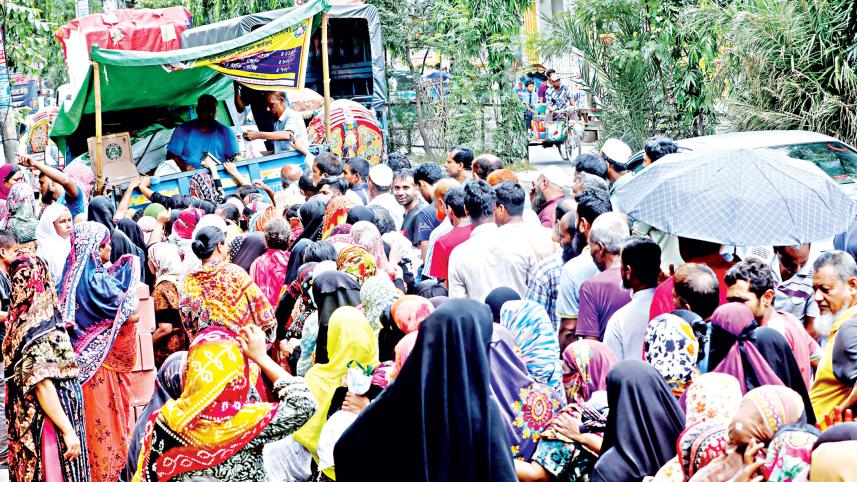
Like him, many low-income households across the country are under pressure as earnings fail to keep pace with rising prices. The difference between income growth and inflation have driven real incomes down.
Official data show real incomes have remained negative for four consecutive years.
“It’s impossible to cover all basic needs,” said Kabir Hossain, an employee at a fish depot at Mohipur Fish Landing Centre in the same southern district.
He said his children often ask for better meals, but he cannot afford them. To manage daily expenses, he relies on borrowing almost every month. The upcoming fishing ban is also a major concern.
According to the Bangladesh Bureau of Statistics (BBS), inflation has outpaced wage growth for 50 consecutive months up to March, despite a gradual rise in pay since February 2022.
The wage growth rate stood at 8.09 percent in March, 0.62 percentage points below inflation of 8.71 percent, according to the Wage Rate Index. In the previous month, the gap between inflation and wage growth was 1.05 percentage points.
Unlike Rafique or Hossain, Prashanna Kumar Roy, a farm labourer at Rajpur union in Lalmonirhat, is not concerned about fishing bans. But his pressure comes from rising farming costs, which he said have reduced his income.
Roy, who used to earn Tk 15,000 to Tk 20,000 a month during the farming season, said it is now difficult to earn even Tk 14,000.
After cutting all possible expenses, including exhausting the very small family savings and skimping on nutritious food, the 45-year-old labourer said any emergency, such as medical needs, now forces him to take loans, adding to existing debt.
These people belong to the country’s informal sector, which makes up about 84 percent of the total employed population of 6.9 crore. A large share of them are now at risk of falling into poverty or is already below the poverty line.
COMPROMISING NUTRITION INVITES LASTING CONSEQUENCES
Mohammad Lutfor Rahman, professor of economics at Jahangirnagar University, said low-income households are cutting back on protein-rich foods such as fish, meat, eggs, milk and fruit, relying instead on basic calorie intake just enough to work the next day.
He said such compromises could have long-term consequences.
“A malnourished workforce cannot remain productive, and their physical capacity declines over time,” Prof Rahman said, adding that children in low-income families risk falling behind in cognitive development.
He said weak labour demand is adding further pressure.
Several sectors, including construction, have recorded weak or negative growth in recent months, reducing demand for labour.
“At the same time, more people are entering the labour force, creating excess supply and pushing wages down.”
The prof also pointed to sluggish public spending. “ADP implementation has been among the lowest in decades, cutting off an important source of income for workers,” he added.
In its latest monthly update, the General Economics Division (GED) warned that rising energy and utility costs could further increase real income pressures as households face higher spending on electricity, gas and transport, disproportionately affecting lower-income groups.
“This divergence underscores intensifying real income pressures, as households face rising costs without corresponding wage adjustments,” said the report.
It added that stagnant wages in this context highlight the erosion of purchasing power, particularly among lower-income groups whose spending is dominated by essentials.
The February assessment suggested inflationary pressures are rising faster than wage adjustments, widening the mismatch between incomes and expenditure.
“This identifies a need for coordinated wage and price management, as inflationary pressures continue to undermine real income stability,” the report said.
In March, wage growth in agriculture stood at 8.10 percent, up 0.01 percentage points from February. Industrial wages rose to 8.02 percent, while services recorded 8.23 percent.
The Wage Rate Index tracks wages of informal daily workers across 63 occupations in agriculture, industry and services.
To ease pressure, Prof Rahman called for targeted intervention. “The government should expand subsidised food distribution and consider compensation measures so low-income households can at least maintain minimum nutrition and purchasing power.”
Bangladesh Bank reported a slight rise in nominal wage growth in the second quarter of fiscal year 2025-26, with the wage index increasing to 8.07 percent in December 2025 from 8.02 percent in September, although still below the previous fiscal year.
All major sectors saw marginal gains, with agriculture at 8.16 percent, industry at 7.91 percent and services at 8.24 percent, supported partly by Aman harvest demand. However, wage growth continued to lag inflation, keeping real wages negative and steadily eroding household purchasing power.
WAR SHOCKS COMPLICATE INCOME OUTLOOK FURTHER
Last week, the World Bank projected weaker economic growth for Bangladesh in the current fiscal year, saying an additional 12 lakh people will remain below the poverty line mainly due to the impact of the US-Israel war on Iran.
Before the conflict in the Middle East, about 17 lakh people were expected to move out of poverty this year. That figure has now dropped to 5 lakh.
At the $3 international poverty line, an additional 14 lakh people are projected to fall into poverty over the same period, it added.
The Washington-based multilateral lender said the conflict is likely to affect Bangladesh’s economy materially, compounding existing vulnerabilities, including high inflation, financial sector stress, limited policy space and weakened confidence.
Comments