The Nakshi Kantha: Tradition and transformation
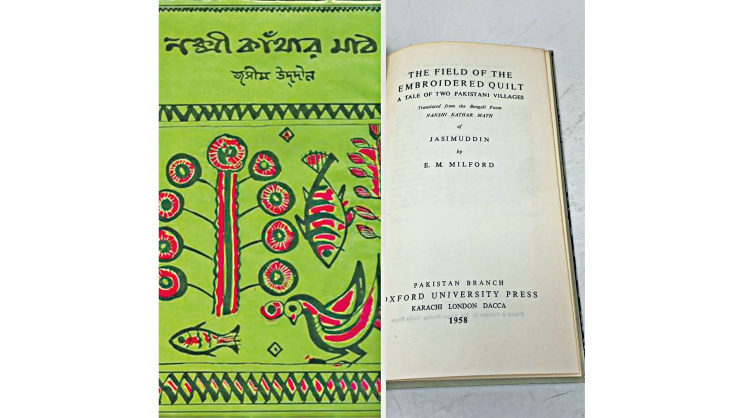
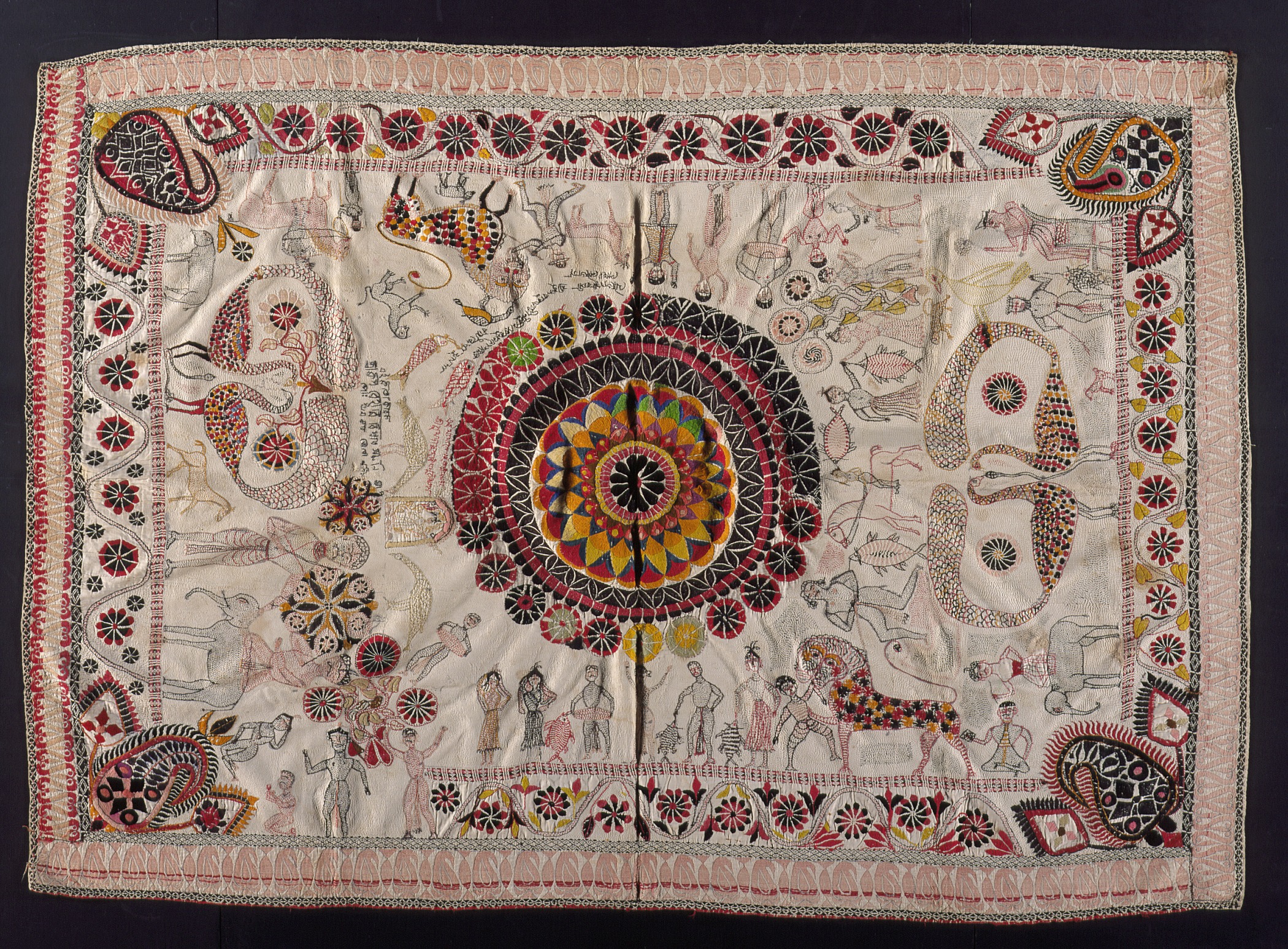
Originally made of worn-out saris, lungis or dhotis, the kanthas of Bengal had a functional, domestic use as coverlets, wrappings, pillow covers, ashons. However, they were occasionally embellished by floral motifs or even entire scenes drawn from rural life, myths, and folklore to give as gifts to loved ones – a daughter leaving home, a son getting married, a revered father. By writing Nakshi Kanthar Maath (1929), Jasim Uddin immortalised this women’s domestic art in poetry and gave the embroidered quilt the name that has become popular over the years.
In 1964, Tofail Ahmed, a collector of folk art, lamented that the kantha was “a lost art.” He noted that Jasim Uddin’s poem had become better known than the article itself and that, when the average Bengali spoke of the nakshi kantha or heard the term, it was the poem that was referred to or understood. With changing tastes and lifestyles, the popular craft of kantha was becoming a lost art. He believed that it would be in Jasim Uddin’s poem alone that the kantha would be preserved. “Drishtibhangi o paribartaner sange purba Pakistaner e gana shilpa lupta hoye jacche. Pallikabi Jasimuddiner ‘Naskshi Kanthar Maather’ bhitar diye amar thakbe e lupta shilper smriti.”
The kantha tradition, perhaps linked back to the embroidered quilts commissioned by the Portuguese from Satgaon, helped create some very fine kanthas in the regions of Jessore, Faridpur, and Khulna in the 19th century. Rajshahi and Kushtia also made kanthas, thicker and with fewer motifs. Notably, a kantha from Kushtia was given as a gift to Rabindranath Tagore, who lived in Shelaidaha between 1891 and 1901, and is preserved in Santiniketan.
The kantha tradition, perhaps linked back to the embroidered quilts commissioned by the Portuguese from Satgaon, helped create some very fine kanthas in the regions of Jessore, Faridpur, and Khulna in the 19th century. Rajshahi and Kushtia also made kanthas, thicker and with fewer motifs. Notably, a kantha from Kushtia was given as a gift to Rabindranath Tagore, who lived in Shelaidaha between 1891 and 1901, and is preserved in Santiniketan.
Though functional kanthas never stopped being made, a recognition of its significance in the cultural life of the people of this region took place twice: once, in Bengal, during the early years of the twentieth century which saw the rise of the swadeshi movement for independence from Britain and, second, in Bangladesh, after liberation. The swadeshi movement was a political movement but also a cultural one, attempting to recover the past traditions of Bengal. Dinesh Chandra Sen collected ballads and kanthas from the region – work in which he was aided by a young Jasim Uddin who would later write Nakshi Kanthar Maath, translated as The Field of the Embroidered Quilt by E. M. Milford. Gurusaday Dutt, apart from starting the bratachari movement, also collected different forms of folk art, including the kantha. It was also at this time that Stella Kramrisch started collecting kanthas and writing about them.
The creation of Pakistan in 1947 encouraged an “Islamic” culture, which rejected many indigenous arts and crafts. Nevertheless, with the language movement, especially after February 21, 1952, a Bangladeshi nationalism arose which would ultimately lead to Bangladesh. The alpana, designs made traditionally with rice paste for Hindu religious ceremonies, was used to decorate the area around the Shaheed Minar. However, the “revival” of the kantha took place after independence.
Following the War of Independence, when many women had been left destitute, widowed or separated from their families, kantha-making was developed as an economic activity, particularly in Jessore, Kushtia, Faridpur, and Rajshahi, regions of Bangladesh with strong kantha traditions. In 1974, a National Handicrafts Exhibition, inspired by the artist Zainul Abedin, initiated a resurgence of interest in traditional arts. Karika, a handicrafts cooperative, was set up and helped promote the kantha by using its motifs and embroidery on household ware and garments. Karika was followed by Aarong – the outlet for the Mennonite Church Council and then for Bangladesh Rural Advancement Committee (BRAC) – and Kumudini. In 1979, BRAC introduced kantha-making at its centre in Jamalpur. However, the catalyst for the kantha revival was the setting up of the Pan Pacific Sonargaon Hotel in 1981.
What is perhaps very interesting is that men are taking an interest in embroidering kanthas. A World Crafts Council Award of Excellence was given to Md. Aminul Islam in 2024 for his nakshi kantha. Ibraheem Rengelink, from Holland but with roots in Bangladesh, discovered the kantha on his visit to his Bangladeshi grandmother and made kanthas himself.
Martha Alter Chen, an American working with BRAC, had been working with kanthas at the BRAC centre in Jamalpur. When a Japanese firm involved in the development of the hotel approached BRAC for a traditional design, Chen called upon Surayia Rahman, an artist who had earlier worked with WVA, to design a triptych kantha wall hanging. Drawing upon photos from the Stella Kramrisch Collection of the Philadelphia Museum of Art, Surayia Rahman designed a composite nakshi kantha. A sample kantha was made. BRAC, however, was unable to take up the work for the larger piece. As a result, Kumudini, which also had been working with kanthas, finally did the work on the larger piece. Apart from Surayia Rahman, Razia Quader also designed two pieces for the hotel: one replicated different forms of the lotus motif down its length, the other was a marriage scene which used the basic running stitch, but a stylised parallel form. Both this second kantha and Suraiya Rahman’s have influenced later kantha-making in Bangladesh. These pieces were very different from the functional kanthas as well as from the traditional kanthas in that they were made from new cloth and were designed to be viewed frontally rather than from the top as in traditional pieces. And in making these pieces – and training women to do the embroidery – the kantha was revived and made new again. However, even as the revival of the kantha was made possible by these pieces, the kantha was also changed by them. Sister Michael Francis, or Sister Mike as she was generally called, an American nun of the order of the Holy Cross, had left the college to work in craft organisations. She was working with Kumudini at the time and offered to teach the Kumudini workers the needlework skills that they would need in order to complete the work. She helped needlewomen hone their traditional needlework skills, but also taught them a stitch to fill in large expanses of colour. Locally called the Kashmiri stitch or bhorat – which simply means filling – it is what is known in the western repertoire of embroidery stitches as the Romanian stitch. In traditional kanthas, large expanses of colour are filled by a variety of kantha stitches: the simple running stitch, darning stitches, pindot stitches, kaitya, or chatai. The use of traditional kantha stitches produces a muted effect. The Romanian stitch creates large expanses of colour. Surayia Rahman’s piece was embroidered using the bhorat. Instead of using the kantha stitch for the background, the empty spaces between the motifs were filled in with the darning stitch which eliminates the ripple effect of the traditional kantha running stitch.
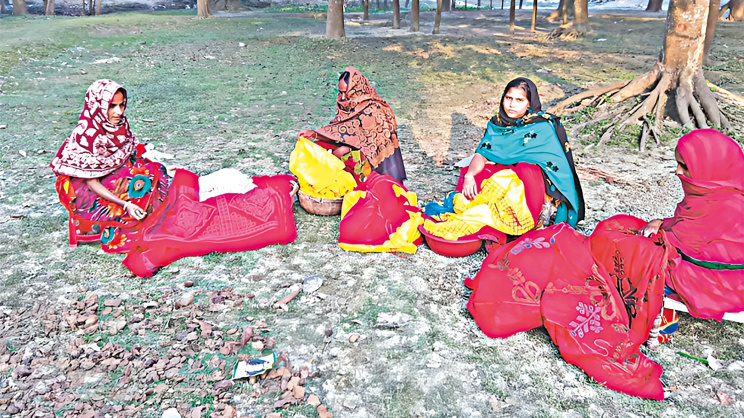
Sister Mike also made significant changes in Razia’s piece. Razia had planned that it would be worked in traditional kantha stitches, and designed feathery and light stitches to suggest the type of stitches to be used. However, Sister Mike substituted Razia’s suggested stitches with the chatai. Kanthas made at Banchte Shekha and Banchte Shekha Hasta Shilpa in Jessore use this stitch exclusively for their work.
Today, because kanthas are meant to be hung and viewed frontally, the traditional design has undergone a change. Instead of a centre and four corners, many kanthas have a top and a bottom. Furthermore, as the kantha is designed by an artist or designer and the designs then traced onto the kantha to be given to craftswomen to embroider, the needle is not used to mark out the motifs to be filled. With all the designs being traced onto the cloth, the needlewoman no longer needs to swirl around motifs but fills in the gaps between them. The moulding effect is, therefore, often missing from these kanthas. So too is the playfulness and experimentation with motifs and stitches found in old pieces where the needlewoman relied on her imagination. The ripple effect of traditional kanthas is also missing in many wallhangings. The characteristic kantha stitch is a ripple stitch created partly because of the pattern of running stitches and partly because the needlewoman did not use an embroidery frame. These “kanthas,” however, use the darning stitch and an embroidery frame, thus creating a smooth surface instead of the rippled one created by the kantha stitch.
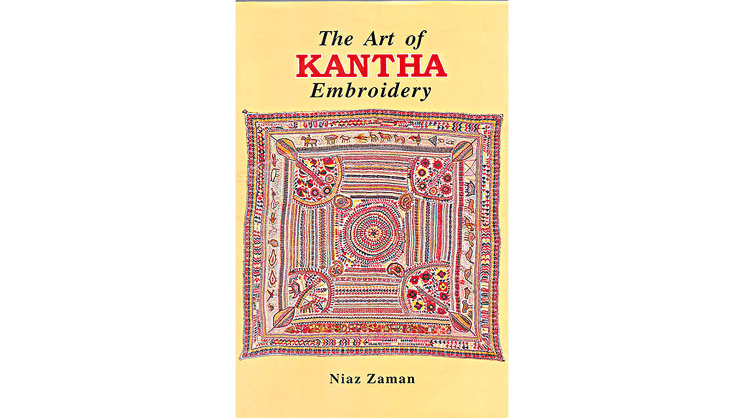
Older kanthas juxtaposed traditional motifs with contemporary ones. The kantha revival is, however, a conscious revival of a traditional art. Many kanthas therefore portray rural scenes – as Razia Quader’s kantha does. However, in old kanthas there is often a juxtaposition of the traditional and the contemporary. Thus, Manadasundari’s kantha from Jangalbadhal depicts rows of British soldiers and rows of English gentlemen alongside Indians of different classes, “good” women, their heads covered, along with entertainers and Indian gentlemen watching the dancers, an old beggar woman, a fisherman, two gachhis in loin cloth, among others.
Many of Surayia Rahman’s pieces are based on rural Bengal. In addition, she drew upon Mughal subjects and scenes of Bengal under the Raj. She was also inspired by Jasim Uddin to design kanthas based on Nakshi Kanthar Maath and Sojan Badiyar Ghat. When the US Embassy planned to shift to a new building, Surayia was commissioned to design a wall-hanging. The wall-hanging portrays President Ershad of Bangladesh and Ambassador De Pree of the United States opening the embassy on July 4, 1989. Behind them, is a picture of the embassy while the lower right and left features scences of life in Bangladesh. In the lower left and right hand corners are kadamba flowers – common to traditional kanthas and associated with Krishna, the god of love.
The kantha expresses a woman’s love, but it can also express her sorrow and anger. In a kantha at the Bangladesh National Museum, the woman making the kantha expresses her anger at her husband who is too attached to his father. She embroiders a sentence about her husband’s attitude and writes at the end, “Ja, shala, ja.” The kantha may also be used to protest against patriarchy. Banchte Shekha Hasta Shilpa has embroidered a kantha based on a poster by Banchte Shekha which shows the many tasks performed by a woman whose husband claims that his wife does not work.
The figures of the number of women employed in commercial kantha-making will give some idea of how many lives have been affected by the revival. In July 2008, at an exhibition of kanthas organised by Aarong to celebrate its third decade, the figures of women employed for kantha work at their different centres were as follows: Jamalpur 4512, Jessore 4026, Kushtia 3324, and Sherpur 3935. If we add other organisations as well as Bangladeshi women who turn old saris into kanthas for domestic use – for their families or for customers who want functional kanthas – the numbers could easily be quadrupled. The town of Jamalpur has become a kantha town, with many women entrepreneurs setting up kantha shops which employ large numbers of women.
Apart from nakshi kanthas which are used for decorative purposes, their stitches, borders and motifs are explored by designers and boutiques to design high-end saris, shawls, and western-style outfits. At the same time, some NGOs and craft shops are using printed saris to make colourful, functional kanthas embroidered with large running stitches. Basha Boutique, for example, advertises “kantha blankets” made with colourful, printed saris.
What is perhaps very interesting is that men are taking an interest in embroidering kanthas. A World Crafts Council Award of Excellence was given to Md. Aminul Islam in 2024 for his nakshi kantha. Ibraheem Rengelink, from Holland but with roots in Bangladesh, discovered the kantha on his visit to his Bangladeshi grandmother and made kanthas himself. He was also part of a team which worked on a kantha book for children based on Chander Buri.
The journey of the kantha from a simple layered coverlet to a work of art has not been smooth. On the way it absorbed external influences, looked at a changing world, and, in the process, changed the way we use or look at it.
Niaz Zaman, who has written The Art of Kantha Embroidery, is a retired academic.
Send your articles for Slow Reads to slowreads@thedailystar.net. Check out our submission guidelines for details.
Reading Sarat Chandra at 150, with empathy
Who really owned Britain’s royal jewels?
The 25,000-year history of betel nut chewing
The world map we know is distorted. Why does it matter?

Bengal and the coming of Islam: A story of soil and spirit
Xuanzang’s travels to Bengal and beyond : The man, the pilgrim and the Monkey King
Professor Anisur Rahman: The economist who put people at the centre
APO 433: Dhaka’s forgotten post office of World War II
Dadabhai Naoroji: The man who exposed the economics of British colonialism